This article contains advertising. Our booking links are routed through a partner that adds commission tracking automatically, so if you book through one we earn a commission from the provider, at no extra cost to you. It never affects what we recommend. Affiliate disclosure
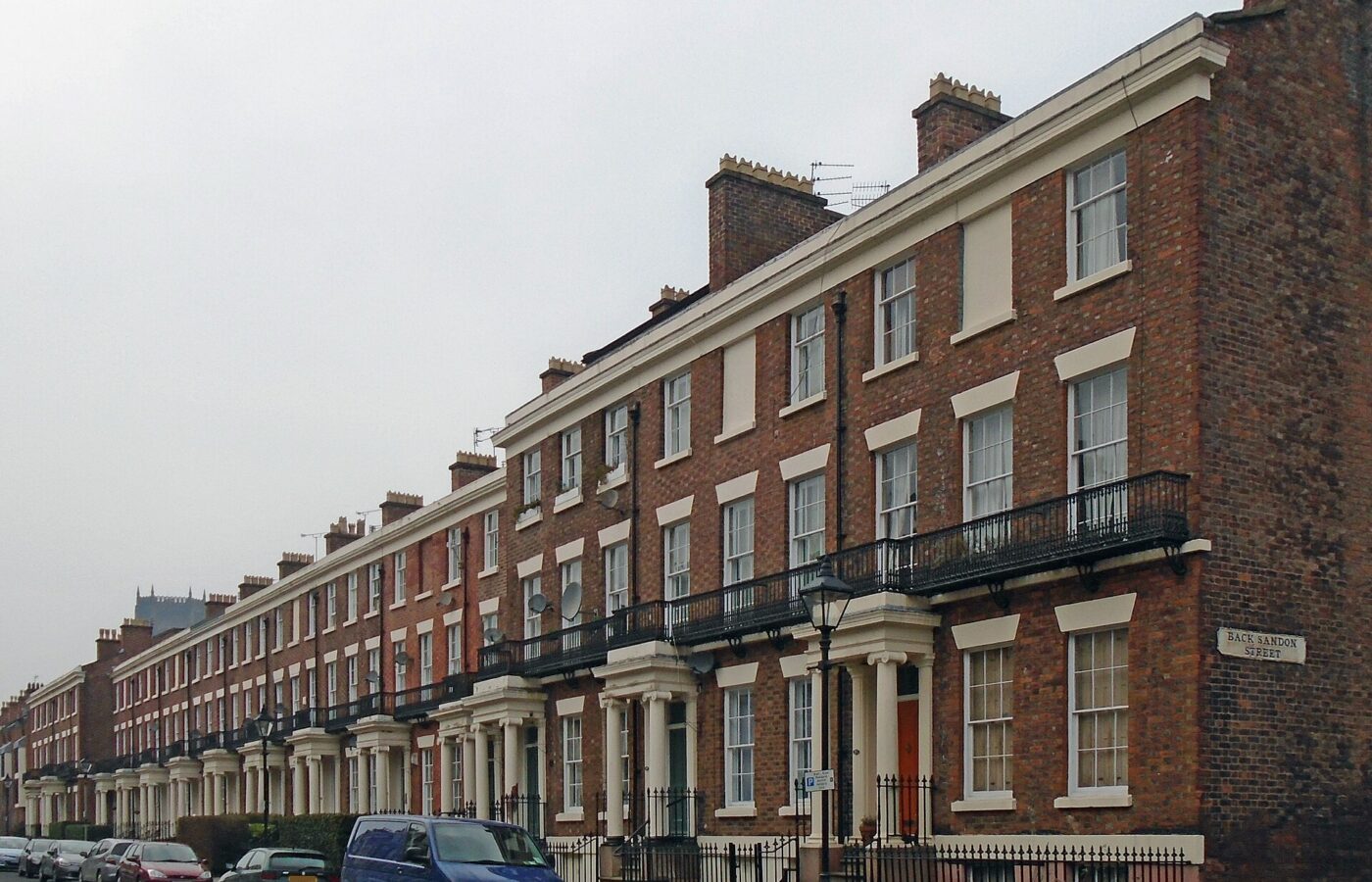
Stand at the bottom of Huskisson Street and look up it. The terrace runs away from you for a quarter of a mile — red brick, cream stucco doorcases, iron balconies at first-floor level, chimney stacks stepping up the hill in perfect sequence — and at the far end, half-lost in the weather, the tower of the Anglican Cathedral. It is the best single view in the city and almost nobody photographs it, because the georgian quarter liverpool occupies is a residential neighbourhood rather than an attraction, and residential neighbourhoods do not get put on postcards.
This guide covers what the area actually is, what is worth walking to, where to eat and drink, and how to spend an afternoon here without a plan. It also covers the things visitors get wrong: the name locals actually use, how steep the walk up really is, and which of the famous buildings you can go inside. Prices and opening arrangements were checked in September 2026 — treat them as the right order of magnitude and confirm anything time-sensitive with the venue.
What and Where It Is
The Georgian Quarter is the grid of streets on the ridge between Liverpool’s two cathedrals, roughly bounded by Hope Street to the west, Upper Parliament Street to the south, and the university buildings to the east. It went up between about 1780 and 1840, built as houses for the merchants, shipowners and professionals who were making very large amounts of money from a port at its peak.
Two things about that matter. First, it was built quickly and to a consistent pattern, which is why the streets have such unbroken rhythm. Second, it was built uphill from the docks, deliberately — far enough from the smell and the noise, close enough to walk to the counting house. That gradient is still the defining physical fact of the area, and the reason so many visitors underestimate the walk.
| Detail | |
|---|---|
| From Lime Street | 10–12 minutes’ walk, uphill |
| From the Albert Dock | 20 minutes, steeply uphill |
| Nearest station | Lime Street or Liverpool Central |
| Buses | 14, 82E, 86C along Hope Street and Hanover Street |
| Time needed | An afternoon; a full day with both cathedrals |
| Cost | Free, apart from the Lutyens Crypt and food |
| Best for | Architecture, theatre, dinner, aimless walking |
What locals call it
Mostly Canning, after the conservation area, or simply “the cathedrals end” or “up by Hope Street”. “Georgian Quarter” is used and understood, but it is a relatively recent branding. If you are asking a taxi driver, name Hope Street, Rodney Street or Falkner Square and you will get a clearer answer faster.
Hope Street: The Spine
Half a mile long, with a cathedral at each end. That is not a marketing line — it is the literal layout, and walking it end to end is the single best thing to do in the area.
What is on it
- Philharmonic Hall, the 1939 Art Deco concert hall seating 1,700, home of the Royal Liverpool Philharmonic Orchestra. It programmes far more than classical — touring bands, film with live orchestra, folk and jazz all appear. See our entertainment venues guide.
- The Philharmonic Dining Rooms, directly opposite. Grade I listed, which for a public house is almost unheard of. More on this below.
- The Everyman Theatre, rebuilt in 2014 and awarded the Stirling Prize. It seats 400 on a thrust stage and programmes new writing and work with a strong Liverpool identity. Its famous basement Bistro, a Hope Street institution for four decades, is now hired out for private events, with food served in the ground-floor Street Café.
- LIPA — the Liverpool Institute for Performing Arts, founded by Paul McCartney in the building that was his own school. It is a working institution, not a visitor attraction, but the frontage is worth a look.
- A Case History, the sculpture of stacked suitcases outside LIPA, each one carrying the name of somebody connected with the street. It is the closest thing Hope Street has to a landmark and it is easy to walk past.
- Restaurants — Hope Street and the roads off it hold a disproportionate share of the city’s better kitchens.
The Two Cathedrals
Liverpool is the only British city with two twentieth-century cathedrals, they are a mile apart on the same street, and they could not be less alike. Seeing both in an afternoon is the classic way to do this neighbourhood.
Liverpool Cathedral (Anglican)
At the southern end of Hope Street, on St James’s Mount. It is the largest cathedral in Britain and by some measures the largest Anglican cathedral in the world — begun in 1904, finished in 1978, built in red sandstone at a scale that photographs simply do not convey. The interior is one enormous volume; the acoustic has a reverberation of several seconds.
Entry to the cathedral floor is free with a suggested donation. The tower climb is ticketed and takes you to the highest viewpoint in the city, though it involves lifts plus a final flight of steps, so it is not step-free. Allow an hour for the building and ninety minutes if you go up. Our Liverpool Cathedral guide has the detail.
Immediately below is St James’s Cemetery, a former quarry converted into a sunken burial ground in 1829 and now a green, overgrown ravine directly beneath the cathedral wall. It is one of the strangest and quietest spaces in the city and most visitors never go down into it.
Metropolitan Cathedral of Christ the King (Catholic)
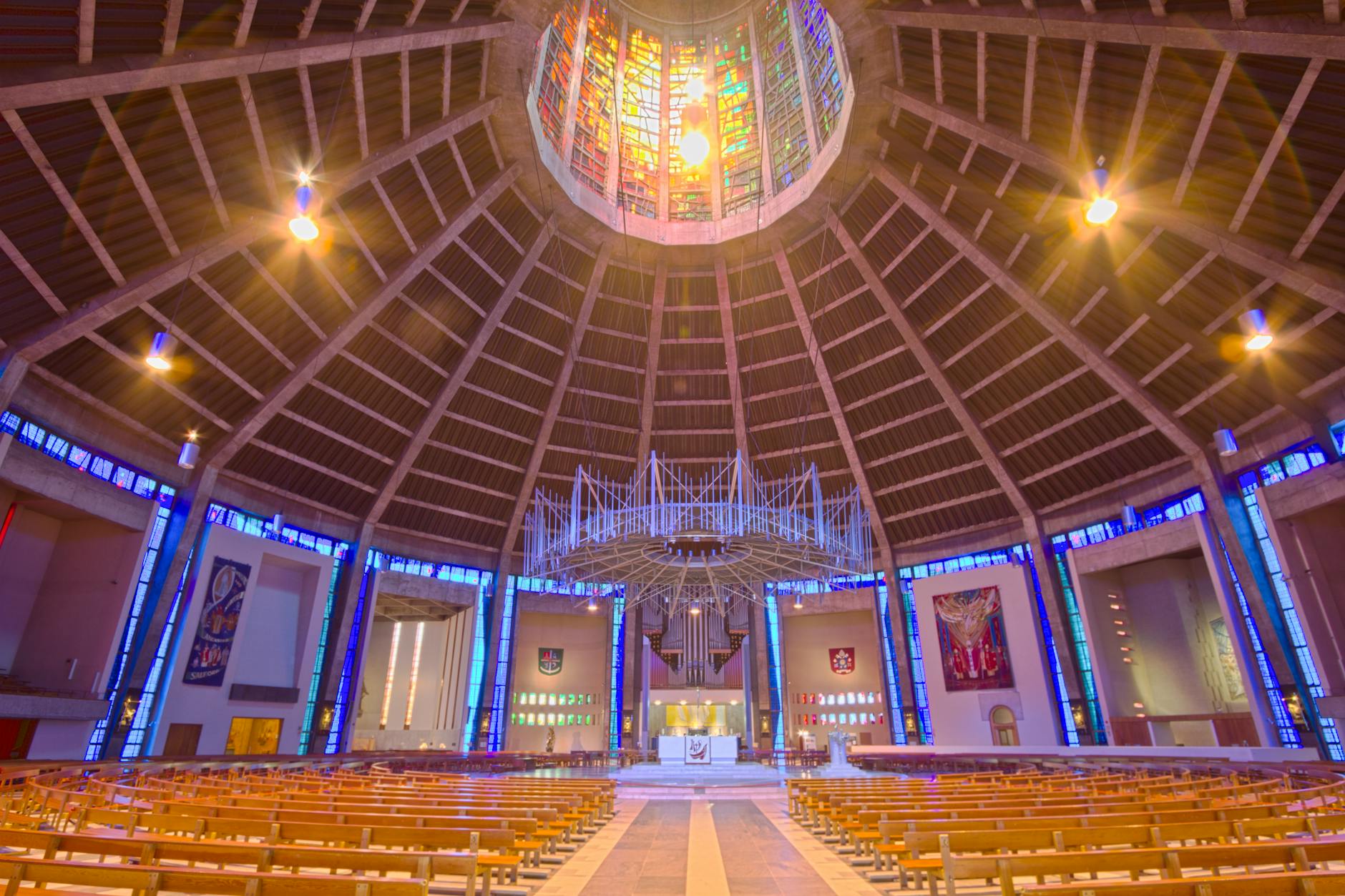
At the northern end, and universally known in the city as Paddy’s Wigwam — affectionately, and by Catholics as much as anyone. Completed in 1967, it is Britain’s largest Catholic cathedral: circular in plan, with thirteen chapels arranged around the rim and a lantern of stained glass overhead that throws coloured light across the whole floor. There is nothing else like it in the country.
Entry is free with donations welcomed. The Lutyens Crypt underneath carries a small charge and is, for many people, the more interesting half — it is all that was built of Edwin Lutyens’s original design for a cathedral that would have been the second largest in the world, a vast brick undercroft to a building that never happened.
It is about ten minutes’ walk from Lime Street. Buses 14, 82E and 86C run from Hanover Street, and there is an underground car park.
The Terraces
This is what people actually come for, even when they think they are coming for the cathedrals.
Huskisson Street
The most photographed terrace in Liverpool and deservedly so. A long, uninterrupted run of Georgian houses with columned doorcases and first-floor iron balconies, stepping up the hill towards the cathedral. Upper Huskisson Street, where it meets Falkner Square, is the corner that appears in production after production.
Falkner Square
A proper Georgian square with a railed garden in the middle, cream stucco on three sides and mature trees. It is a genuine residential square where people live, walk dogs and park badly. Sit on a bench for ten minutes and you get more sense of the neighbourhood than any tour delivers.
Rodney Street
Liverpool’s Harley Street — a long, handsome run of red brick town houses, historically full of consultants and still holding a good number of private medical practices. William Gladstone was born at number 62. Number 59 is the Hardmans’ House, a National Trust property preserved exactly as the photographer Edward Chambré Hardman and his wife Margaret left it — a 1950s home and working studio with the chemicals still in the darkroom. It is small, atmospheric and utterly unlike any other National Trust property.
At the top of Rodney Street is St Andrew’s Church, ruined and roofless, with the pyramid tomb of William Mackenzie in its graveyard — a railway contractor said, in a story nobody can substantiate, to have been buried sitting upright at a card table. The pyramid is real; the story is the sort of thing Liverpool enjoys.
Gambier Terrace and Percy Street
Gambier Terrace faces the Anglican Cathedral across St James’s Mount and is one of the grandest runs in the city. John Lennon lived in a flat here in 1960, which is the sort of detail this neighbourhood scatters around without commemorating. Percy Street, just off, is a near-perfect stone-fronted terrace.
The Philharmonic Dining Rooms
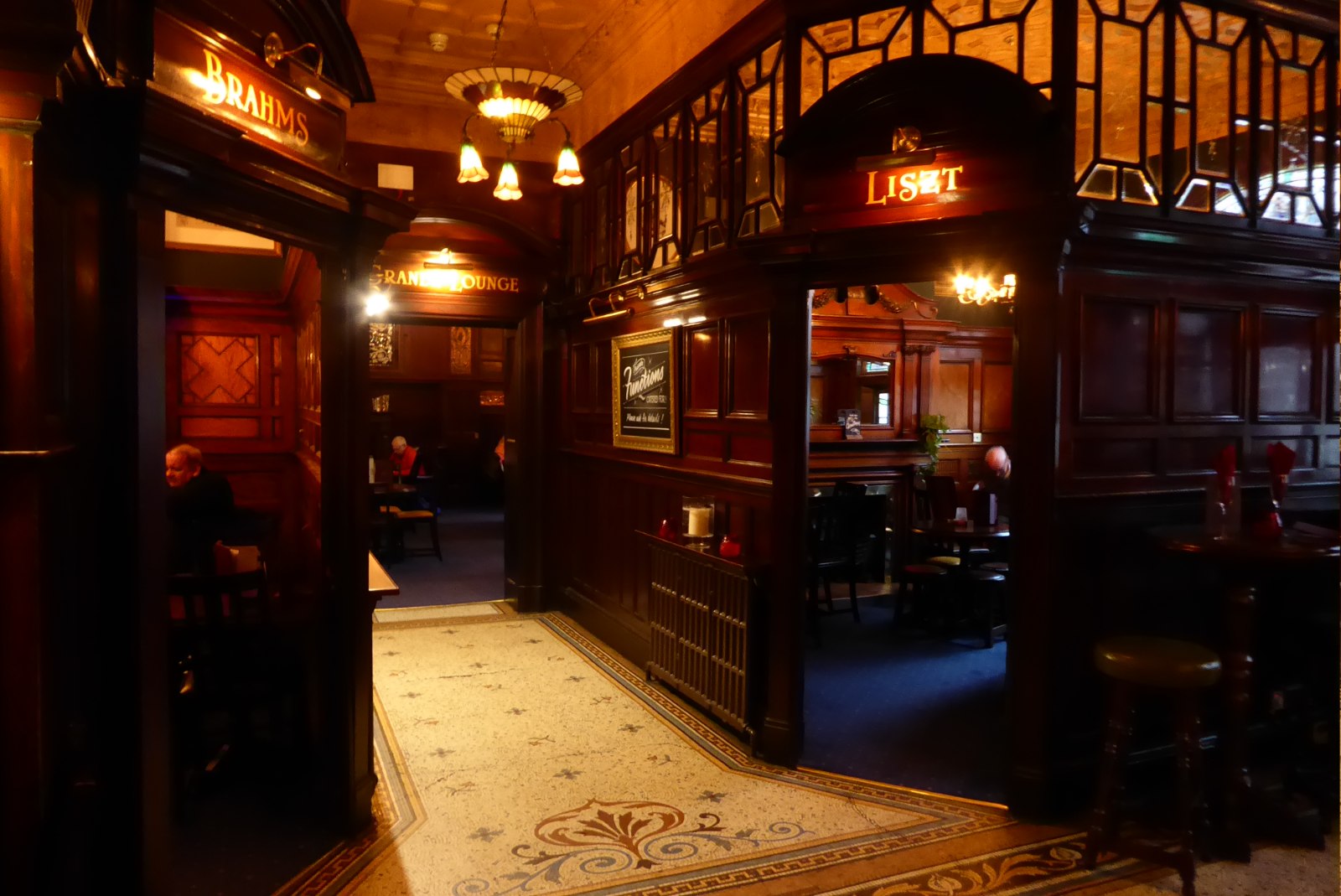
A separate section because it deserves one. Built in the 1890s for the shipping trade, decorated by the craftsmen who were working on the Cunard liners, and Grade I listed — a designation almost never given to a pub. The interior is mahogany, stained glass, mosaic floors and beaten copper, with two snugs named Brahms and Liszt, which is a joke that lands better once you know the rhyming slang.
The gents’ toilets are marble and mosaic and are genuinely famous. People do go in to look at them. If you do, buy a drink — it is a working pub, not a museum, and the staff have seen several thousand people wander in with a camera and wander out again.
Eating and Drinking
The Georgian Quarter is where Liverpool goes for a proper dinner rather than a fast one, and Hope Street is the concentration point.
- Pre-theatre menus around the Everyman and Philharmonic end are among the best value in the city if you eat before 18:30. This is the single best-kept piece of practical advice about the area.
- Hope Street’s restaurants cover the upper mid-range and the genuinely serious end. See our fine dining guide and best restaurants.
- Pubs: the Philharmonic Dining Rooms for the building, Ye Cracke on Rice Street for the history — Lennon drank there as an art student and it has changed very little. Our best pubs guide covers more.
- Coffee is well served around the university end and along Hardman Street.
- Cheaper options sit just downhill on Bold Street, five minutes away — see the Bold Street food guide.
The access caveat
Many of the small bars and restaurants in the Georgian streets are in basements or up a flight of stone steps to a raised front door, and very few publish access information. If step-free access matters, ring ahead rather than turning up. Our accessible Liverpool guide is honest about where this area falls short.
A Walking Route
About two miles, mostly downhill if you do it in this order, and it takes two to three hours with stops.
- Start at the Metropolitan Cathedral. Ten minutes from Lime Street, and doing the climb first gets it out of the way. Twenty minutes inside, plus the crypt.
- Down Hope Street, past the Everyman, the suitcases and the Philharmonic Hall.
- Detour into Falkner Square and along Huskisson Street — the best five minutes of the walk.
- Back to Hope Street and on to the Anglican Cathedral. An hour, or ninety minutes with the tower.
- Down into St James’s Cemetery, the sunken quarry graveyard beneath the cathedral.
- Return north via Rodney Street, past the Hardmans’ House and St Andrew’s ruined church.
- Finish on Bold Street at St Luke’s, the roofless bombed-out church, which puts you at the top of the city’s best eating street.
Our self-guided walking tour extends this down to the waterfront, and the architecture guide explains what you are looking at.
The Hill: An Honest Warning
Liverpool’s centre is flat. The Georgian Quarter is not, and the map does not show it. Duke Street from the Albert Dock to Upper Duke Street is a sustained climb of about seventy metres over three-quarters of a mile, and it is genuinely hard work with luggage, a pushchair, or on a hot day.
The fixes are straightforward: come up from Lime Street rather than the waterfront, which is a shorter and gentler ascent; take the 14, 82E or 86C bus up Hanover Street; or do the walking route above in the downhill direction. Do not plan to do the Albert Dock in the morning and walk up to the cathedrals in the afternoon without factoring in twenty hard minutes.
Beyond the Obvious
- The Bluecoat, downhill on School Lane, is the oldest surviving city-centre building in Liverpool, dating from 1717, and now an arts centre with a free gallery and a courtyard garden.
- The Victoria Gallery & Museum in the university’s redbrick Victoria Building — free, small, and holding a genuinely good collection including works by Audubon and Turner.
- The Oratory, a small Greek Revival chapel beside the Anglican Cathedral, opens irregularly and is startling inside.
- Blackburne House and the streets around it, a quieter corner most visitors miss entirely.
- Toxteth and Granby, further south and downhill, where the Granby Four Streets market runs on the first Saturday of every month except January, 10:00 to 15:00, with seventy to eighty traders. See our neighbourhoods guide.
On Screen
The Georgian Quarter’s terraces are among the most-filmed streets in Britain. Peaky Blinders used them repeatedly, as have a long list of period dramas — the combination of unbroken Georgian frontage, no modern intrusion and a cooperative film office makes the area unusually easy to dress for any decade between 1800 and 1950. Nothing is signposted and there is nothing to visit; you are simply walking down streets you may recognise. Our film locations guide covers the full picture.
When to Come
- Late afternoon in autumn is the best light on the terraces — the sun comes down Huskisson Street directly.
- Weekday mornings are quietest, and both cathedrals are close to empty.
- Term time brings a large student population onto Hardman Street and the eastern edge, which changes the atmosphere considerably.
- Sunday is fine here, unlike the business district — the cathedrals are working churches, so check service times if you want to look round rather than attend.
- Evening is when Hope Street is at its best, with the theatres turning out and the restaurants full.
Frequently Asked Questions
Where exactly is Liverpool’s Georgian Quarter?
It is the grid of streets on the ridge between the two cathedrals, with Hope Street running along its spine, bounded roughly by Upper Parliament Street to the south and the university to the east. It is a ten to twelve minute walk uphill from Lime Street station.
Is the Georgian Quarter worth visiting?
Yes, and it is the part of Liverpool that most surprises people who arrived expecting only docks and football. It is not an attraction with an entrance — it is a residential neighbourhood you walk around — so come for the architecture, the two cathedrals and a good dinner rather than for something to tick off.
How long does it take to walk between Liverpool’s two cathedrals?
About fifteen minutes along Hope Street, half a mile, on a gentle gradient. Doing both properly, with time inside each, takes three to four hours.
Can you go inside Liverpool’s cathedrals for free?
Yes, both. The Anglican Cathedral’s floor and the Metropolitan Cathedral’s main space are free to enter with donations welcomed. The Anglican tower climb and the Metropolitan’s Lutyens Crypt both carry charges.
What is Paddy’s Wigwam?
The city’s nickname for the Metropolitan Cathedral of Christ the King, from its conical shape and Liverpool’s large Irish Catholic population. It is used affectionately and universally, including by the people who worship there.
Why is the Philharmonic Dining Rooms famous?
It is one of very few Grade I listed pubs in England — built in the 1890s and decorated by craftsmen from the Cunard liner trade, with mahogany, stained glass, mosaic floors and two snugs named Brahms and Liszt. The marble and mosaic gents’ toilets are genuinely a destination. Buy a drink if you go in to look.
Is the walk up to the Georgian Quarter steep?
From the Albert Dock, yes — a sustained climb of around seventy metres. From Lime Street it is shorter and considerably gentler. Buses 14, 82E and 86C run up from Hanover Street if you would rather not walk it.
Where should I eat in the Georgian Quarter?
Hope Street and the roads immediately off it hold most of the area’s better restaurants. The pre-theatre menus near the Everyman and the Philharmonic, served before about 18:30, are among the best value meals in the city. For cheaper eating, Bold Street is five minutes downhill.
If you only book one evening in the quarter, make it the Everyman. Our guide to the Everyman and Playhouse covers what is on into 2027, where to sit round the thrust stage, the Rock ‘n’ Roll Panto and the £5 tickets for 14–25s. It also explains what became of the famous basement bistro, which is now hired out for private events, with food served in the ground-floor Street Café instead.
Hope Street’s centrepiece is the Philharmonic Hall, Herbert Rowse’s 1939 Streamline Moderne concert hall, home to the Royal Liverpool Philharmonic Orchestra. Our Liverpool Philharmonic Hall guide has the season highlights, including a complete Beethoven symphony cycle in January 2027, plus seating advice and the £10 ticket scheme.
Huskisson Street has a small place in television history too: Carla Lane’s The Liver Birds, which ran on BBC1 through the 1970s, set its two flatmates’ home here. Our guide to TV shows filmed in Liverpool covers the other Liverpool series and their locations.
Huskisson Street and Hope Street are two of the stops in our Liverpool photo spot guide, which covers where to stand, when the light suits each place and how to photograph residential streets without getting in anyone’s way.
Related Liverpool Guides
- Liverpool Neighbourhoods — how this area fits with the rest of the city.
- Liverpool Cathedral Guide — the tower, the timings and when to go.
- Liverpool Architecture Guide — why the terraces look the way they do.
- Liverpool Entertainment Venues — the Philharmonic and the Everyman in detail.
- Best Pubs in Liverpool — including the Philharmonic and Ye Cracke.
- Self-Guided Walking Tour — a longer route through the whole city.
- Liverpool Film Locations — these streets on screen.
- Fine Dining in Liverpool — most of it is on Hope Street.
Photo Credits
The Georgian terrace on Huskisson Street, Liverpool: 25 – 51 Huskisson Street 1 by Rodhullandemu, CC BY-SA 4.0, via Wikimedia Commons.
The interior of the Philharmonic Dining Rooms on Hope Street: Interior of Philharmonic Dining Rooms – geograph.org.uk – 8200742 by Philip Halling, CC BY-SA 2.0, via Wikimedia Commons.