This article contains advertising. Our booking links are routed through a partner that adds commission tracking automatically, so if you book through one we earn a commission from the provider, at no extra cost to you. It never affects what we recommend. Affiliate disclosure
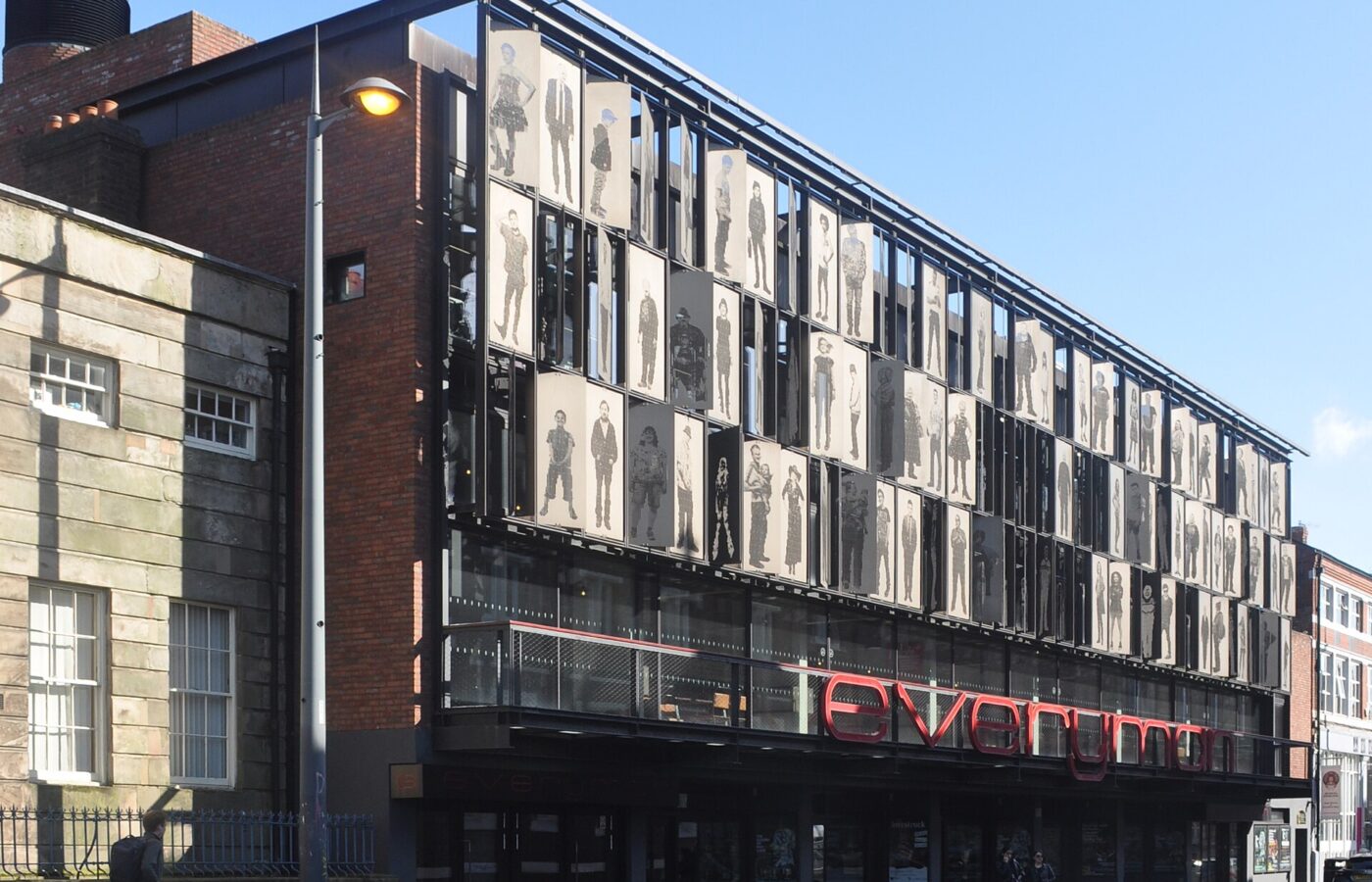
Walk up Hope Street towards the Metropolitan Cathedral and a crowd of Liverpudlians stares back at you from the front of a building: 105 life-size portraits, cut into the metal sunshades that screen its upper floors. They are ordinary people from all over the city, photographed for the rebuild, and between them they sum up what the Everyman Theatre Liverpool has always been about: the city putting itself on stage and arguing with itself in public. Fifteen minutes’ walk away, down in Williamson Square, its older sister the Playhouse does the same job from behind a Victorian front with two domed turrets.
The two theatres are run by one organisation. They share a box office, a website and a youth programme, and they make their own productions as well as hosting touring ones, which is why people here tend to say “the Everyman and Playhouse” in one breath. This guide covers both: what each one stages, the programme into 2027, where to sit, the Rock ‘n’ Roll Panto, what became of the famous Everyman Bistro, how to pay less for tickets, getting there and where to eat first. Details were checked in September 2026 against the theatres’ own listings. Programmes and prices change, so confirm with the box office before you travel.
The Everyman and Playhouse at a Glance
| Everyman | Playhouse | |
|---|---|---|
| Where | 5–11 Hope Street, at the cathedral end of the Georgian Quarter | Williamson Square, in the shopping streets between Lime Street and Liverpool ONE |
| Building | New theatre opened 2014 on the site of the 1964 original; RIBA Stirling Prize 2014 | Victorian music hall of 1866, a repertory theatre since 1911, with a 1960s glass foyer alongside |
| Seats | About 400, wrapped round a thrust stage | Up to about 650, on three levels facing a traditional proscenium stage |
| Mainly stages | Its own “Made in Liverpool” productions: new plays, reworked classics, the Rock ‘n’ Roll Panto | Touring drama and musicals, stand-up comedy, dance and children’s shows, plus the Christmas musical |
| Nearest station | Lime Street or Liverpool Central, 12–15 minutes on foot (uphill) | Lime Street or Liverpool Central, about 5 minutes on foot |
| Box office | 0151 709 4776, or book online through the Everyman & Playhouse website | |
| Cheapest way in | YEP membership for 14–25s: £5 tickets (checked September 2026) | |
| Coming up | Rock ‘n’ Roll Panto: Beauty and the Beast, 14 November 2026 – 16 January 2027 | Little Shop of Horrors, 3 December 2026 – 9 January 2027 |
One Company, Two Very Different Theatres
A “producing theatre” makes its own shows: it hires the director, casts the actors, builds the set and rehearses in the building. A “receiving house” books productions that are already on the road. Most British cities have one or the other. Liverpool’s Everyman and Playhouse do both, and they split the work between the two buildings in a way that is worth understanding before you buy a ticket.
The Everyman is the engine room. Most of what it stages is made here and billed as “Made in Liverpool”: new writing, classic plays with a local cast and a local accent, and the annual Rock ‘n’ Roll Panto. If you want to see something that exists nowhere else, this is where to look.
The Playhouse is the more varied house. Most weeks it hosts a touring play or musical, a big-name comedian or a dance company, with family shows in the school holidays and a home-grown musical at Christmas. The quality depends on the week. A strong touring drama in a 650-seat Victorian theatre can be a better night than the same show in a barn of a venue elsewhere, but if you have already seen the tour at home, there is less reason to book it here.
If you are weighing these against the rest of the city’s venues, our Liverpool entertainment venues guide puts every theatre, arena and comedy club side by side.
The Everyman: Hope Street’s Theatre
Where it came from
The Everyman opened in 1964 in Hope Hall, a former chapel that had also spent time as a cinema. It was cheap, scruffy and run on enthusiasm, and one of the people behind it was Alan Durband, the Liverpool Institute English teacher who had taught a teenage Paul McCartney. A blue plaque in the foyer still remembers him as co-founder, teacher, author and “tireless promoter of new writing”. Fans on a Beatles pilgrimage rarely know it is there.
The theatre’s reputation was made in the 1970s, when a young company that included Julie Walters, Pete Postlethwaite, Bill Nighy, Jonathan Pryce and Antony Sher came through Hope Street. That era’s defining show was Willy Russell’s John, Paul, George, Ringo… and Bert, which opened at the Everyman in 1974 and went on to the West End. The theatre was never polished, and that was part of its appeal. Its audience came for plays about their own city, written in their own voice, at prices students could afford.
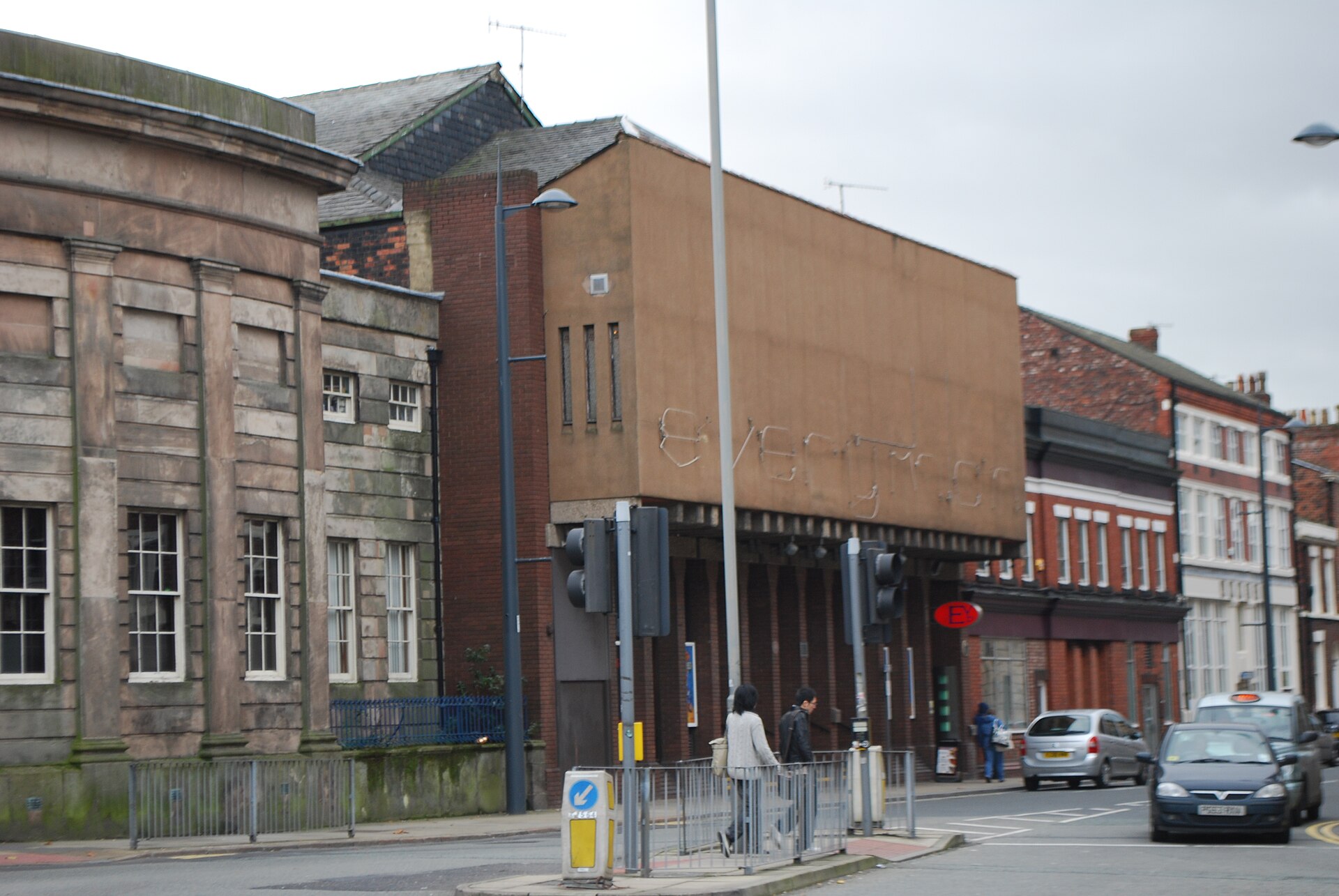
By the 2000s the old building was falling apart. It closed in 2011, was taken down and replaced on the same site by a new theatre designed by Haworth Tompkins, which opened in 2014. That was a risk. People were attached to the old place, low ceilings and all. It paid off. The new Everyman won the RIBA Stirling Prize, Britain’s biggest architecture award, in the year it opened, and most regulars admit it kept the feel of the old theatre while fixing everything that did not work.
The building
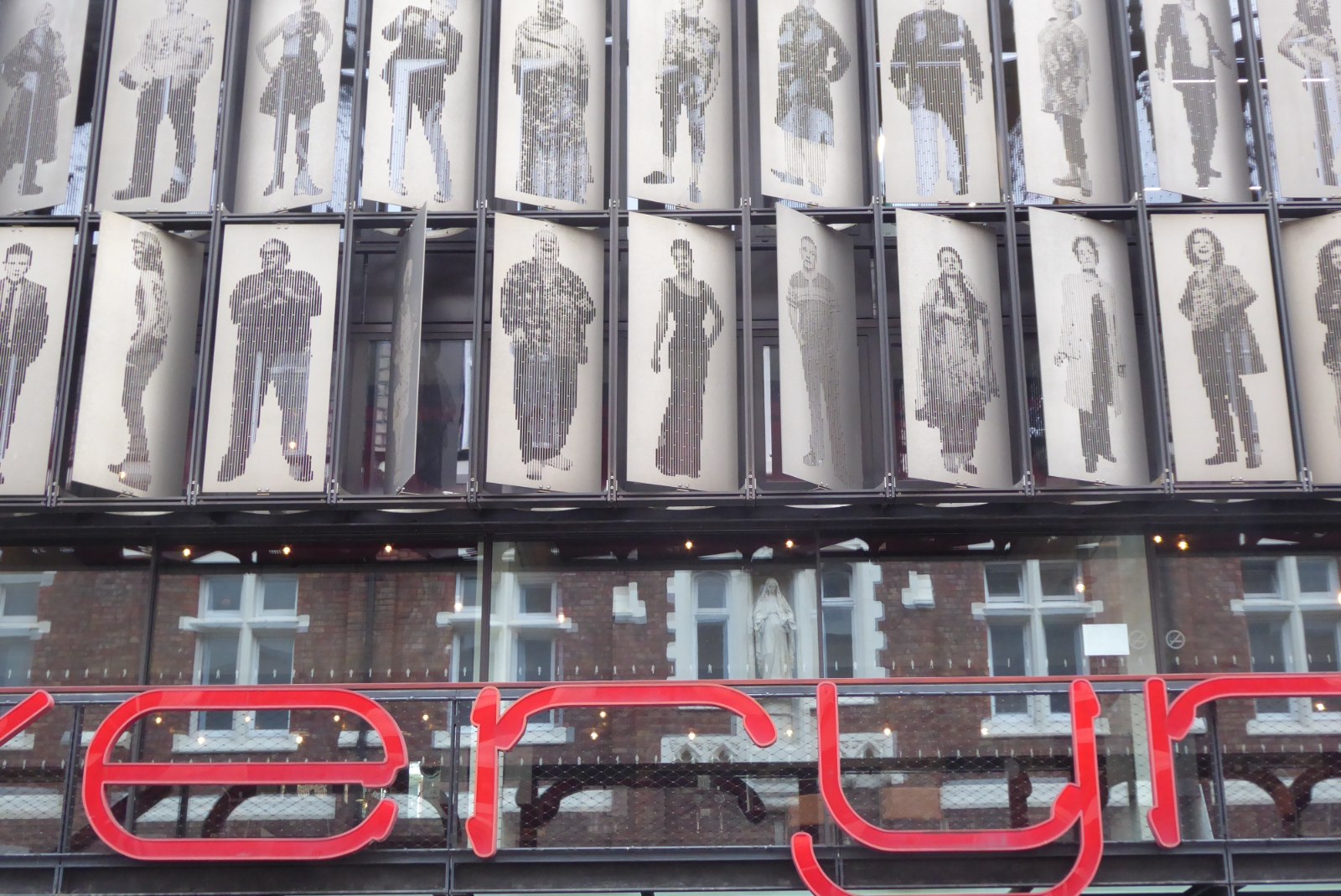
It is worth arriving ten minutes early just to look at the building. The portraits on the front are the obvious feature. Stand under them for a minute and you will pick out young and old, a woman in a long evening dress, a man with his arms folded as if waiting for curtain-up. Less obviously, the new theatre reuses thousands of bricks salvaged from the old one. The tall brick stacks rising from the roof are not decoration: they draw air through the auditorium naturally, so the building needs far less mechanical ventilation than a theatre of its size normally would.
Inside, the ground floor is an open foyer with the Street Café and bar, and you do not need a ticket to use it. It is a good place for a coffee on a wet afternoon in the Georgian Quarter even if you are not seeing a show. The building was designed for step-free access, and there is a Changing Places toilet.
The auditorium and where to sit
The Everyman seats about 400 round a thrust stage, meaning the stage pushes out into the audience, who sit on three sides of it. That was the defining feature of the old theatre too, and the rebuild kept it. Nobody is far from the actors, and there is none of the watching-through-a-window feeling you get in a big Victorian house.
- Centre block: faces the stage head-on and gives you the full stage picture, including any set at the back. This is the best choice for a first visit and for text-heavy plays.
- Side blocks: often closer to the action than the centre, but in a thrust theatre you will sometimes see a scene over an actor’s shoulder, and entrances from one side are easier to see than the other. Most people find this part of the fun. If you want the director’s intended view, stay central.
- Front rows: very close, occasionally close enough to be spoken to, particularly at the panto. Brilliant if you like that, awkward if you don’t.
- Check the plan for each show. Layouts can differ between productions, and the seating plan on the booking page shows what you will get.
A thrust stage is forgiving, so the cheaper seats here are much better value than the cheap seats in a large proscenium theatre. If money is tight, book the cheapest seats and don’t worry about the view.
The Playhouse: Williamson Square’s Victorian Survivor
From music hall to “the Rep”
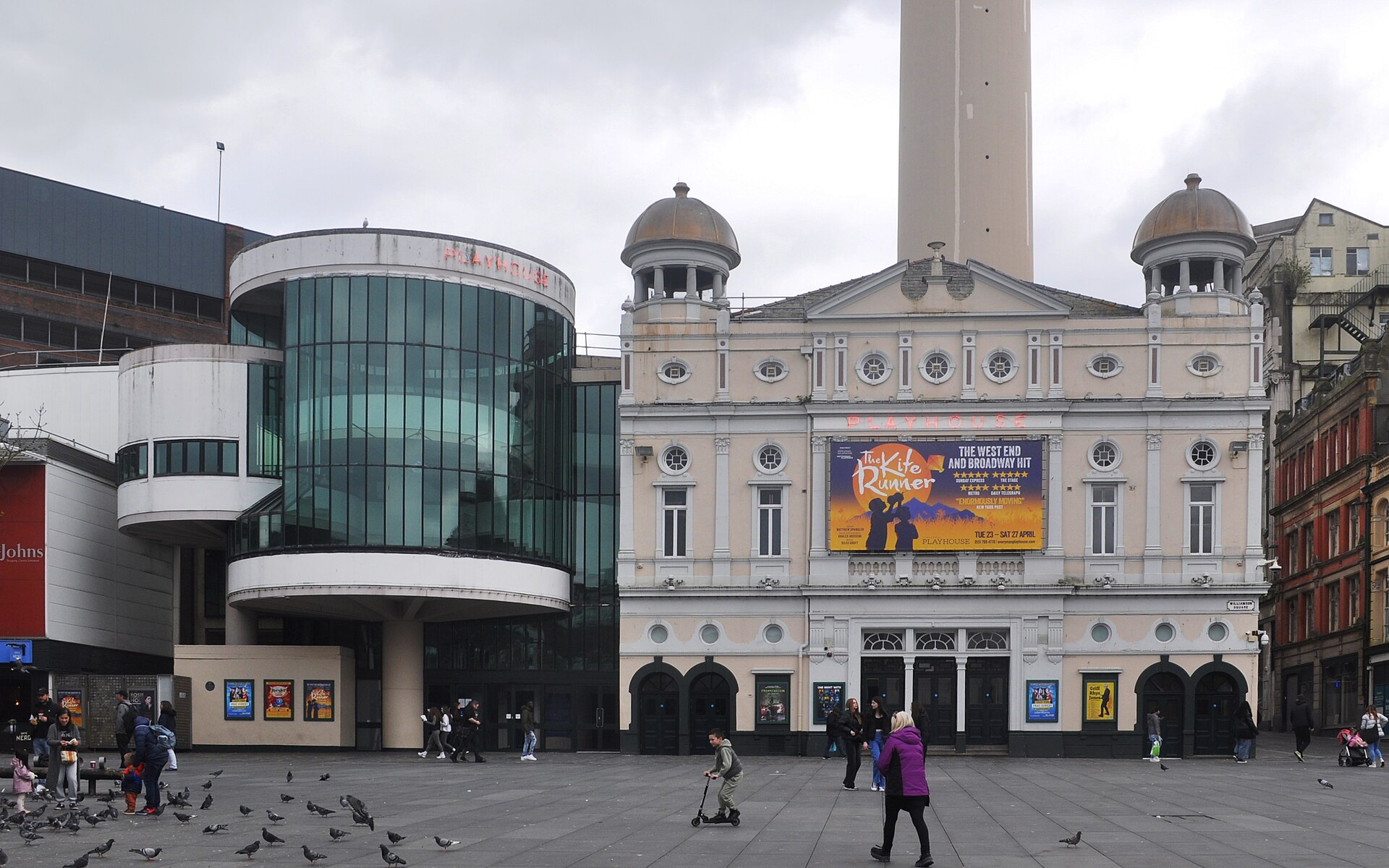
The Playhouse opened in 1866 as the Star Music Hall and became the Liverpool Repertory Theatre in 1911, which is why older Liverpudlians still call it “the Rep”. It is often described as the oldest surviving repertory theatre in Britain. For decades it ran a resident company that trained a remarkable list of actors. Rex Harrison made his first stage appearance here in the 1920s, and Michael Redgrave was in the company in the 1930s. Beryl Bainbridge worked backstage as a young assistant stage manager and turned the experience into her novel An Awfully Big Adventure, later filmed with Hugh Grant and Alan Rickman.
The building is a good example of Liverpool’s habit of sticking the new directly onto the old. The Victorian front, cream stucco with round windows and two domed turrets, faces the square. Next to it are the curved glass drums of a 1960s extension, which holds the foyer. Some people find the pairing jarring. Most end up quite liking it.
The theatre has been running Behind the Curtain heritage tours, which take you backstage and through the building’s history. The current run of dates ends on 10 October 2026. If you like knowing how a theatre works, it’s worth checking for new dates, and our Liverpool walking tours guide covers the city’s other guided options.
Where to sit
The Playhouse is a traditional Victorian theatre on three levels: the stalls, the circle and the upper circle above it. The same rules apply as in most theatres of its age.
- Stalls, centre, from about a third of the way back: the best all-round seats for plays and comedy. You’re close enough to see faces and far enough back to see the whole stage.
- Front of the circle: the best seats for musicals and dance, where it helps to see patterns on the stage floor.
- Upper circle: the cheapest seats, and steep. Fine for stand-up, where you’re mainly listening, but less good for a visual show. If you don’t like heights, avoid the front row.
- Extreme side seats on the upper levels can lose a corner of the stage. The booking page usually flags restricted views, and it’s worth reading before you pay.
What it stages
A typical season mixes touring drama, comedy, dance and children’s shows. In autumn 2026 that meant Paul Merton and Suki Webster’s improv show, Lenny Henry, Maisie Adam and Nish Kumar on the comedy side, Jasmin Vardimon’s dance piece Lullaby, Noël Coward’s Present Laughter, and a stage version of The Haunting of Hill House for the week after Halloween. The small Playhouse Studio hosts cabaret, youth work and showcases, including a QueerCore evening and Young Homotopia’s queer cabaret Out Loud in November 2026.
What’s On: Autumn 2026 to Summer 2027
These dates come from the theatres’ own listings in September 2026. More titles are added through the year, and comedy dates in particular sell out and new ones get added, so treat this as a snapshot.
| Dates | Show | Theatre |
|---|---|---|
| 19 Sep – 10 Oct 2026 | Death of a Salesman (Made in Liverpool) | Everyman |
| 9–10 Oct 2026 | YEP Writers Showcase 2026 | Everyman |
| 13–17 Oct 2026 | Pride & Prejudice* (*sort of) | Playhouse |
| 20–24 Oct 2026 | Noël Coward’s Present Laughter | Playhouse |
| 27–31 Oct 2026 | Sir Charlie Stinky Socks and the Really Big Adventure (children’s show, half-term) | Playhouse |
| 3–7 Nov 2026 | The Haunting of Hill House | Playhouse |
| 14 Nov 2026 – 16 Jan 2027 | The Rock ‘n’ Roll Panto: Beauty and the Beast | Everyman |
| 3 Dec 2026 – 9 Jan 2027 | Little Shop of Horrors | Playhouse |
| 19–23 Jan 2027 | The Signalman, from Dickens’s ghost story | Playhouse |
| 9–13 Feb 2027 | Million Dollar Quartet | Playhouse |
| 16–20 Feb 2027 | The Very Hungry Caterpillar Show (half-term) | Playhouse |
| 20 Feb – 13 Mar 2027 | Martin McDonagh’s A Skull in Connemara (Made in Liverpool) | Everyman |
| 23–27 Feb 2027 | A Thousand Splendid Suns | Playhouse |
| 16–20 Mar 2027 | Savage, a comedy about Lily Savage | Playhouse |
| 31 Mar – 10 Apr 2027 | Pip and Posy, then Zog and the Flying Doctors (Easter holidays) | Playhouse |
| 22–26 Jun 2027 | The King’s Speech | Playhouse |
| 6–10 Jul 2027 | Midsomer Murders: The Killings at Badger’s Drift | Playhouse |
Stand-up in the first half of 2027 includes Daniel Kitson (6 February), Sue Perkins (3 March), Ed Byrne (29 April), Jack Dee (1 May), Myra Dubois (29 May) and Matt Forde (30 June), all at the Playhouse.
The Rock ‘n’ Roll Panto
If you are in Liverpool between mid-November and mid-January, this is the show to book. The Everyman’s Rock ‘n’ Roll Panto takes a traditional pantomime story and has the cast play the music live, with actors switching between guitars, drums and keyboards while also playing the dame, the villain and the romantic lead. The songs are rock and pop hits the whole audience knows, the script is full of local jokes, and the Everyman’s thrust stage means the cast are almost in the front row’s laps.
The 2026 show is Beauty and the Beast, from 14 November 2026 to 16 January 2027. What to know before you book:
- It is a family show that adults happily attend on their own. Evening performances tend to draw plenty of adult groups and office outings, and the humour works on two levels.
- It is loud. Very small children and anyone sensitive to noise may prefer the relaxed performance, where the sound and lighting are usually softened and people can come and go.
- Book early. Weekend and school-holiday performances go first, and the dates just before Christmas are the hardest to get. Late November and January weekday evenings are the easiest.
- Accessible performances are listed with audio description, British Sign Language interpretation, captioning, a relaxed performance and an “Enhance” option. Ask the box office which dates suit you.
Our verdict: if you are choosing one Christmas show in Liverpool, the Rock ‘n’ Roll Panto is more distinctive than a standard touring pantomime. You’re getting the Everyman’s own company with a live band, and you can’t see it anywhere else. Pair it with the markets and the ice rink in our Christmas in Liverpool guide.
The Everyman Bistro: What Happened to It
Ask anyone who lived in Liverpool before 2011 about the Everyman and they will probably mention the Bistro before they mention a play. It was in the basement of the old theatre, a low, busy room of scrubbed tables and cheap wine, and for decades it was where actors went after the show, students nursed a glass for an hour, and much of the city’s creative scene seemed to hold court at one time or another. You didn’t need a ticket, and plenty of regulars never went upstairs.
The new building kept a basement bistro and reopened it in 2014, and for years it carried on the tradition. It has since changed. The theatre now calls the basement Downstairs at the Everyman and hires it out as a private event space, and day-to-day food and drink are served in the Street Café on the ground floor. Several online guides and older reviews still describe the Bistro as a restaurant you can walk into, so don’t plan a night around it. Check the Everyman’s Eat & Drink page for the Street Café’s current hours, or eat on Hope Street instead (see below).
Tickets: How to Book and Pay Less
- Book direct. Use the Everyman & Playhouse website or the box office on 0151 709 4776. Resale and “theatre ticket” sites mark up seats that are usually still available from the theatre at face value.
- Aged 14–25? Join YEP. Young Everyman Playhouse is the theatres’ youth programme, and its members pay £5 for theatre tickets (checked September 2026). For a student on a city break, that is the best deal in Liverpool theatre.
- Look for previews. The first few performances of a Made in Liverpool production are often priced lower while the show beds in. The show is almost always ready by then.
- Go midweek. Tuesday to Thursday evenings have the best choice of seats. Friday and Saturday nights, especially during the panto, go first.
- Compare the total. Online bookings can carry a transaction fee. Look at the final price, not the headline one.
- Groups: for ten or more, ask the box office about group rates before booking seats one by one.
- Skip the packages. “Theatre break” bundles sold by third parties that combine a hotel room with tickets rarely beat booking both yourself, and they limit your choice of seats.
Eating and Drinking Before the Show
Around the Everyman
Hope Street is one of the best pre-theatre streets in the north of England, and the Everyman is at the top of it.
- The Street Café in the theatre’s own foyer is the easiest option, with no dash up the road when the bell goes.
- Hope Street’s restaurants run from smart mid-range to serious fine dining, and several offer pre-theatre set menus if you order before about 18:30. Tell them your curtain time when you book. Our fine dining guide covers the top end.
- The Philharmonic Dining Rooms, at the corner of Hope Street and Hardman Street, is one of the most spectacular Victorian pubs in Britain, all mosaics, carved wood and stained glass. A pint here before a show is a Liverpool ritual.
- Ye Cracke on Rice Street, a couple of minutes away, is a small, scruffy and much-loved pub where John Lennon drank as an art student. It has barely changed.
- Bold Street is ten minutes downhill and much cheaper, with Indian, Lebanese, Middle Eastern and Italian food. See our Bold Street food guide.
Our Georgian Quarter guide covers the whole neighbourhood, and the best pubs guide has more of the city’s historic pubs.
Around the Playhouse
Williamson Square sits among the shops, so the choice nearby is mostly chains. Walk five to ten minutes in any direction and it gets much better.
- Bold Street is about seven minutes away and is the best bet for an independent meal at a sensible price.
- The Vines and The Crown on Lime Street are two of the city’s grandest old pubs, about five minutes away, and both are good for a quick drink before a 19:30 start.
- Liverpool ONE has big chain restaurants that can take a group at short notice.
- Chinatown is about fifteen minutes’ walk and good value for groups.
Getting There
The Everyman
- On foot from Lime Street: about 12–15 minutes, uphill along Mount Pleasant. Allow longer in bad weather or if walking is hard for you, because the hill is steady.
- From Liverpool Central (Merseyrail): about 12 minutes, up Bold Street and Leece Street, then left onto Hope Street.
- By bus: the 14, 82E and 86C from Hanover Street stop close to the Metropolitan Cathedral, a minute or two from the theatre.
- By car: the Metropolitan Cathedral’s underground car park is the closest, and there is pay-and-display parking on the Georgian Quarter streets. Check evening hours and charges before you rely on either.
- Taxi: after the show, black cabs pass along Hope Street. On busy nights, book a private-hire car for a set time or walk down to the Philharmonic corner.
The Playhouse
- On foot: about five minutes from Lime Street and about the same from Liverpool Central, with Queen Square bus station a few minutes away.
- By car: the St Johns Shopping Centre car park is right next to the theatre. Check the closing time, because shopping-centre car parks can close earlier than a late comedy show finishes.
For the wider network, including the Merseyrail Day Saver at £4.80–6.40 after the weekday morning peak (checked September 2026), see our getting around Liverpool guide.
Accessibility
The two buildings are very different here, so plan them separately.
- The Everyman is a 2014 building designed for step-free access, with lifts and a Changing Places toilet, which makes it one of the easier theatres in the region for wheelchair users.
- The Playhouse is an 1860s theatre with a 1960s extension, so some levels involve stairs. Book access seats through the box office and ask about the route to your seat, wheelchair spaces and transfer seats.
- Assisted performances are scheduled across the season. Death of a Salesman and Little Shop of Horrors have audio-described and captioned dates. The panto and A Skull in Connemara add BSL-interpreted performances, and the panto has a relaxed one too. Dates are on each show’s page.
- Getting there: Lime Street station is step-free and has a Changing Places toilet. Bear in mind the Everyman is uphill from it, so a taxi or bus may be easier than walking.
Our wheelchair-accessible Liverpool guide covers the rest of the city in the same detail.
Taking Children
The Playhouse is the better bet for younger children outside Christmas. Its half-term and Easter programmes are built around picture-book adaptations, such as Sir Charlie Stinky Socks in October 2026, The Very Hungry Caterpillar Show in February 2027, and Pip and Posy and Zog and the Flying Doctors at Easter. These shows are short, bright and pitched at under-sevens.
At Christmas it’s the panto, as long as your children are happy with a loud room. Teenagers are well served too: YEP’s £5 tickets and its writing, acting and production programmes make the Everyman one of the more welcoming theatres in the country for young people. For the rest of a family day, our Liverpool with kids guide has plenty more.
Everyman, Playhouse, Empire or Royal Court?
Liverpool’s theatres don’t really compete with each other, because each does a different job. A quick way to choose:
| If you want… | Book… |
|---|---|
| Something made in Liverpool that you can’t see anywhere else | The Everyman’s own productions |
| A big West End musical on tour | The Liverpool Empire on Lime Street |
| A touring play, a comedian, or a musical in an intimate Victorian house | The Playhouse |
| Scouse comedy with food at your table | Liverpool’s Royal Court on Roe Street |
| An arena gig | The M&S Bank Arena |
| One Christmas show for the whole family | The Everyman’s Rock ‘n’ Roll Panto |
Our honest view: on a short visit, the Everyman is the one to prioritise. The Empire is grand, but its touring musicals will reach your nearest big city eventually. The Everyman’s work mostly won’t.
Making a Night of It
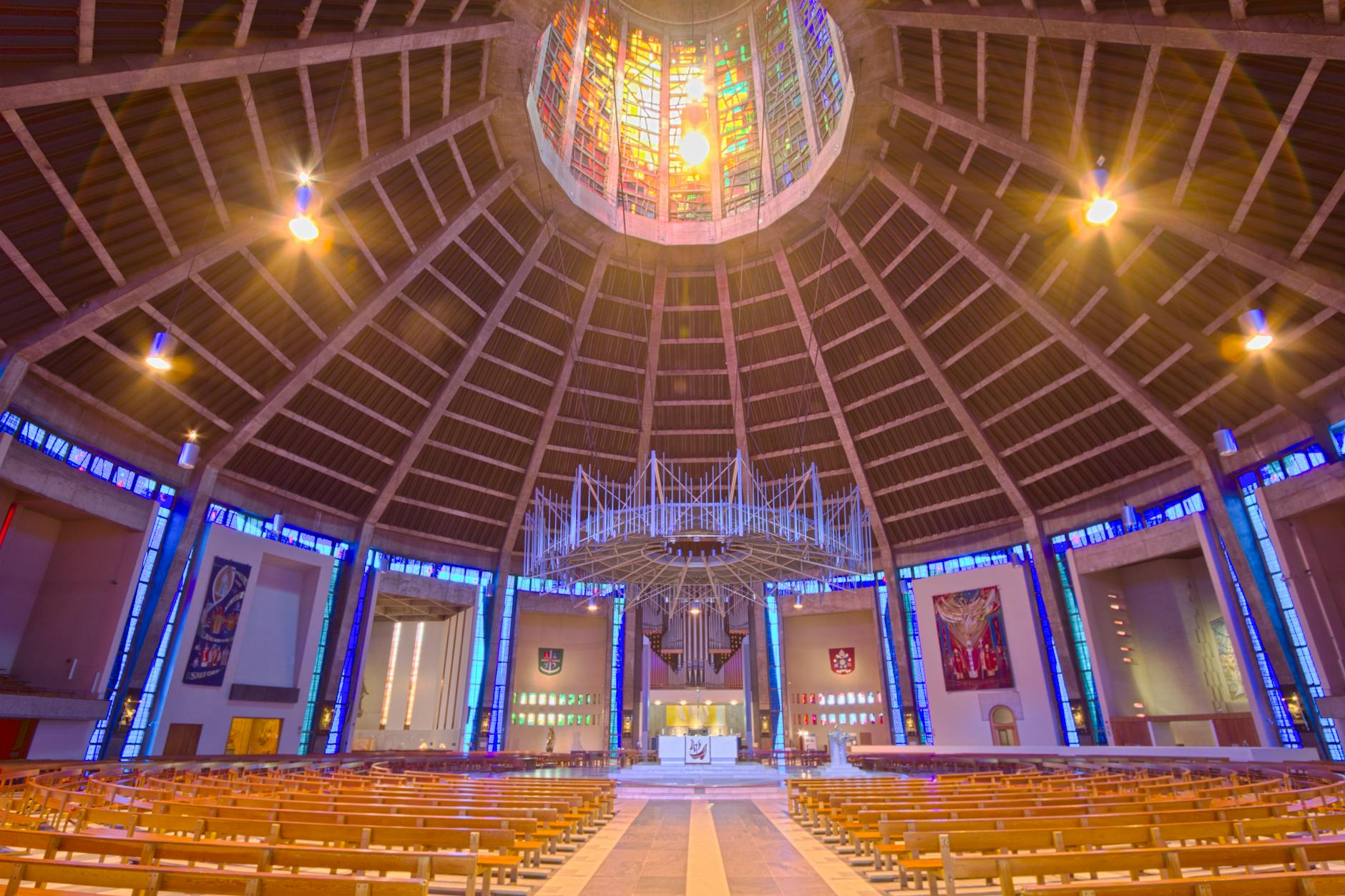
An Everyman evening fits easily into a day in the Georgian Quarter. The Metropolitan Cathedral is a minute from the theatre door and free to visit. Go in before the show, while there’s still daylight coming through the stained-glass lantern. At the other end of Hope Street, the Anglican cathedral is the largest in Britain and one of the largest in the world. Our Liverpool Cathedral guide covers the tower climb.
For a couple, dinner on Hope Street, a play at the Everyman and a nightcap at the Phil add up to one of the best evenings in the city. Our romantic things to do in Liverpool guide has more ideas like that. If you’d rather not walk far afterwards, the city-centre hotels in our best hotels guide are 10–15 minutes downhill from the Everyman, and closer still to the Playhouse.
Frequently Asked Questions
Are the Everyman and the Playhouse the same theatre?
No. They’re two buildings run by the same organisation, with one box office and one website. The Everyman is on Hope Street and mainly stages its own productions. The Playhouse is on Williamson Square in the city centre and mostly hosts touring shows, comedy and family theatre.
How many seats does the Everyman Theatre have?
About 400, arranged round a thrust stage so the audience sits on three sides. The Playhouse holds up to about 650 on three levels.
Is the Everyman Bistro still open?
Not as a walk-in restaurant. The basement, now called Downstairs at the Everyman, is hired out for private events, and food is served in the Street Café on the ground floor. Check the theatre’s website for current hours.
When is the Everyman Rock ‘n’ Roll Panto?
The 2026 show, Beauty and the Beast, runs from 14 November 2026 to 16 January 2027. The best weekend and pre-Christmas dates sell out first, so book early.
How far is the Everyman from Lime Street station?
About 12–15 minutes on foot, mostly uphill along Mount Pleasant. The Playhouse is about five minutes from Lime Street.
Are there cheap tickets?
Young people aged 14–25 who join YEP pay £5 (checked September 2026). Everyone else will usually find the lowest prices at previews and midweek performances, booked directly with the theatre.
Can I visit the Everyman without a ticket?
Yes. The ground-floor foyer and Street Café are open to everyone, and the portrait façade is on the street. The Playhouse has run backstage heritage tours. The current dates end on 10 October 2026, so check for new ones.
Is the Everyman wheelchair accessible?
Yes. It’s a modern building with step-free access, lifts and a Changing Places toilet. The Playhouse is older and some areas involve stairs, so book access seats through the box office.
Hope Street’s other great venue is a few minutes away: the Philharmonic Hall, a 1939 Art Deco concert hall with a cinema screen that rises from the stage floor. Our Liverpool Philharmonic Hall guide covers the orchestra’s season, films with live orchestra and the £10 tickets for under-25s and students.
Related Liverpool Guides
- Liverpool Entertainment Venues
- Liverpool Empire Theatre Guide
- The Georgian Quarter
- M&S Bank Arena Guide
- Best Pubs in Liverpool
- Fine Dining in Liverpool
- Christmas in Liverpool
- Romantic Things to Do in Liverpool
Photo Credits
The Everyman’s portrait façade on Hope Street: Everyman Theatre, Hope Street, Liverpool (April 2024) by User:Hassocks5489, CC0, via Wikimedia Commons.
The old Everyman before the rebuild: Everyman Theatre Liverpool by Sweetie candykim, CC0, via Wikimedia Commons.
The portrait sunshades up close: Façade of Everyman Theatre – geograph.org.uk – 8190581 by Philip Halling, CC BY-SA 2.0, via Wikimedia Commons.
The Playhouse on Williamson Square: Playhouse Theatre, Williamson Square, Liverpool (NHLE Code 1218642) (April 2024) (2) by User:Hassocks5489, CC0, via Wikimedia Commons.