This article contains advertising. Our booking links are routed through a partner that adds commission tracking automatically, so if you book through one we earn a commission from the provider, at no extra cost to you. It never affects what we recommend. Affiliate disclosure
Before a film night at the Phil, the lights dim and a cinema screen rises slowly out of the stage floor, while the organist plays it up from a console that has itself risen into view on its own lift. The audience applauds it like a returning star. Few concert halls in the world could pull off that bit of theatre, and it tells you a lot about the Liverpool Philharmonic Hall: a Grade II* listed Art Deco concert hall of 1939, home to one of the oldest orchestras in the country, and still happy to show off.
This guide is for anyone going to a concert there, whether it’s a Mahler symphony, a film with live orchestra, a tribute band or a gig in the intimate Music Room. It covers the building and its history, the Royal Liverpool Philharmonic Orchestra’s 2026/27 season, where to sit, how to get £10 tickets, where to eat and drink before the show, getting there and access. Details were checked in September 2026 against the Phil’s own site. Programmes change, so confirm with the box office before you travel.
Liverpool Philharmonic Hall at a Glance
| What | Detail (checked September 2026) |
|---|---|
| Where | Hope Street, at the corner of Hardman Street, in the Georgian Quarter |
| Built | Opened 19 June 1939, designed by Herbert J. Rowse. Grade II* listed. It replaced an 1849 hall destroyed by fire in 1933 |
| Capacity | About 1,700 in the main hall. The Music Room holds 180–250 |
| Home of | The Royal Liverpool Philharmonic Orchestra. Chief Conductor Domingo Hindoyan |
| What’s on | Orchestral concerts, films with live orchestra, bands and singers, comedy, and smaller gigs in the Music Room. More than 250 events a year |
| Cheap tickets | £10 for under-25s, students, and people on Jobseeker’s Allowance or Universal Credit, at most orchestra concerts |
| Box office | 0151 709 3789 |
| Access | Attitude is Everything Gold award, one of only nine music venues in the country to hold it |
| Nearest stations | Liverpool Central, about 10 minutes’ walk. Lime Street, about 15 minutes uphill |
Two Halls, One Fire
Liverpool has been going to concerts on this corner for more than 175 years. The Liverpool Philharmonic Society was founded in 1840, and on 27 August 1849 it opened its first hall here, designed by John Cunningham. It was widely praised for its acoustics. On 5 July 1933, it burned down.
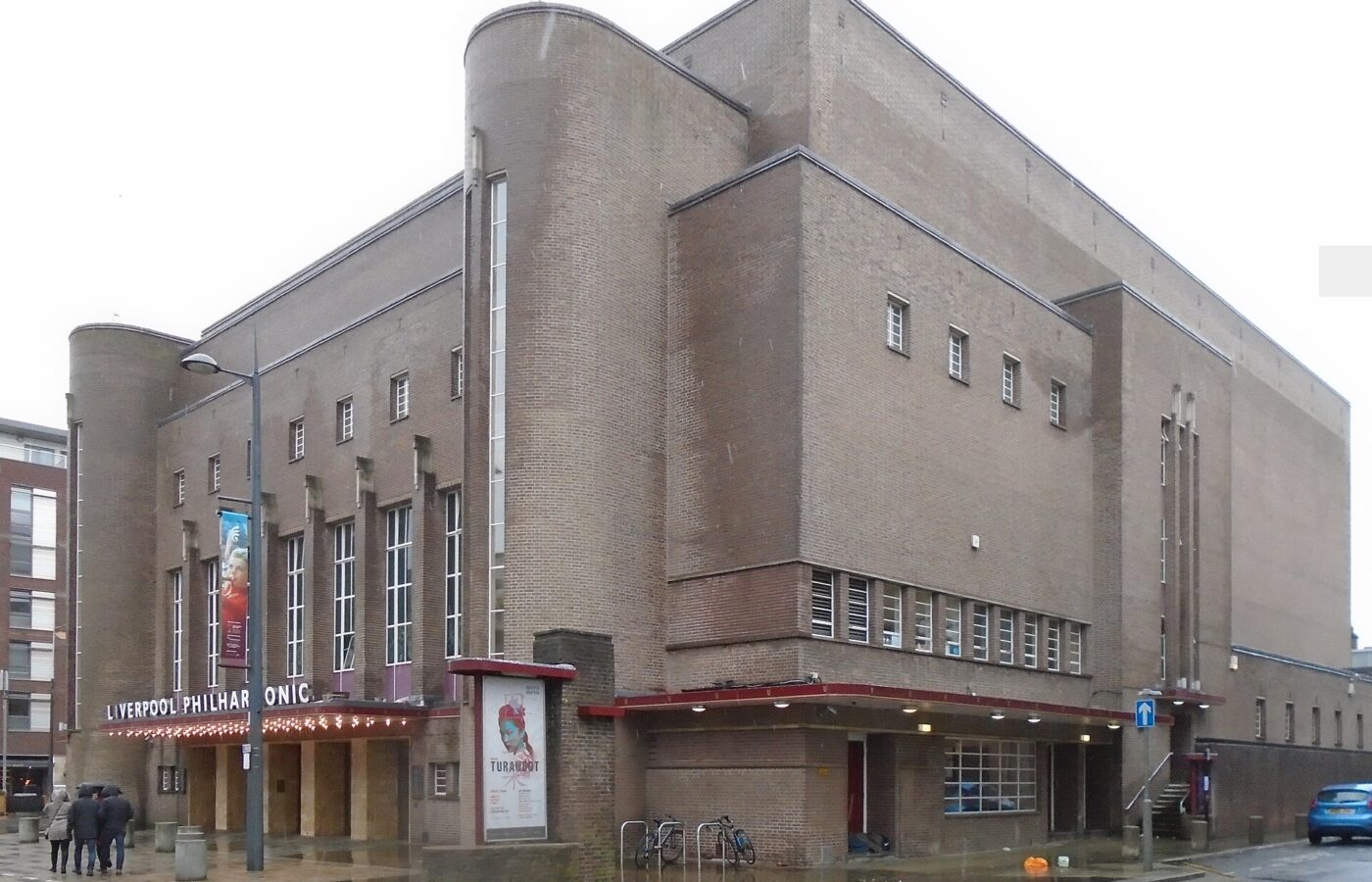
The Society turned to Herbert J. Rowse, the Liverpool architect behind India Buildings, Martins Bank and the ventilation towers of the Queensway Tunnel, and he gave the city something completely modern. The new hall opened on 19 June 1939, less than three months before the outbreak of the Second World War, at a cost of just over £120,000. The style is Streamline Moderne, the sleek late form of Art Deco: tall brick walls, rounded corner towers, long vertical windows, and inside, sweeping curves designed as much for the sound as for the look. It is now Grade II* listed.
In 2015, the hall reopened after a refurbishment of around £14 million, completed that October. The work modernised the building and replaced the old Rodewald Suite with a new small venue, the Music Room, which opened with a free open-house day on 9 October 2015. The hall now puts on more than 250 events a year, more than 60 of them classical concerts.
For the rest of the city’s twentieth-century buildings, including more by Rowse, see our Liverpool architecture guide.
What to Look For in the Building
- The rising screen. The Phil has a Walturdaw cinema screen that rises from the stage floor. It’s a rare survival from the heyday of cinema, and it’s brought up for the hall’s classic film screenings, usually to a musical interlude from the resident organist. If you get the chance to see a film here, take it.
- The organ. A three-manual pipe organ by the Liverpool firm Rushworth and Dreaper. Its console sits on a lift that sinks beneath the stage when it isn’t needed and rises into view when it is.
- The Titanic memorial. Look for the plaque remembering the musicians of the Titanic’s band, who famously kept playing as the ship went down in 1912. Liverpool’s links to the ship run deep. Our Liverpool and the Titanic guide tells that story.
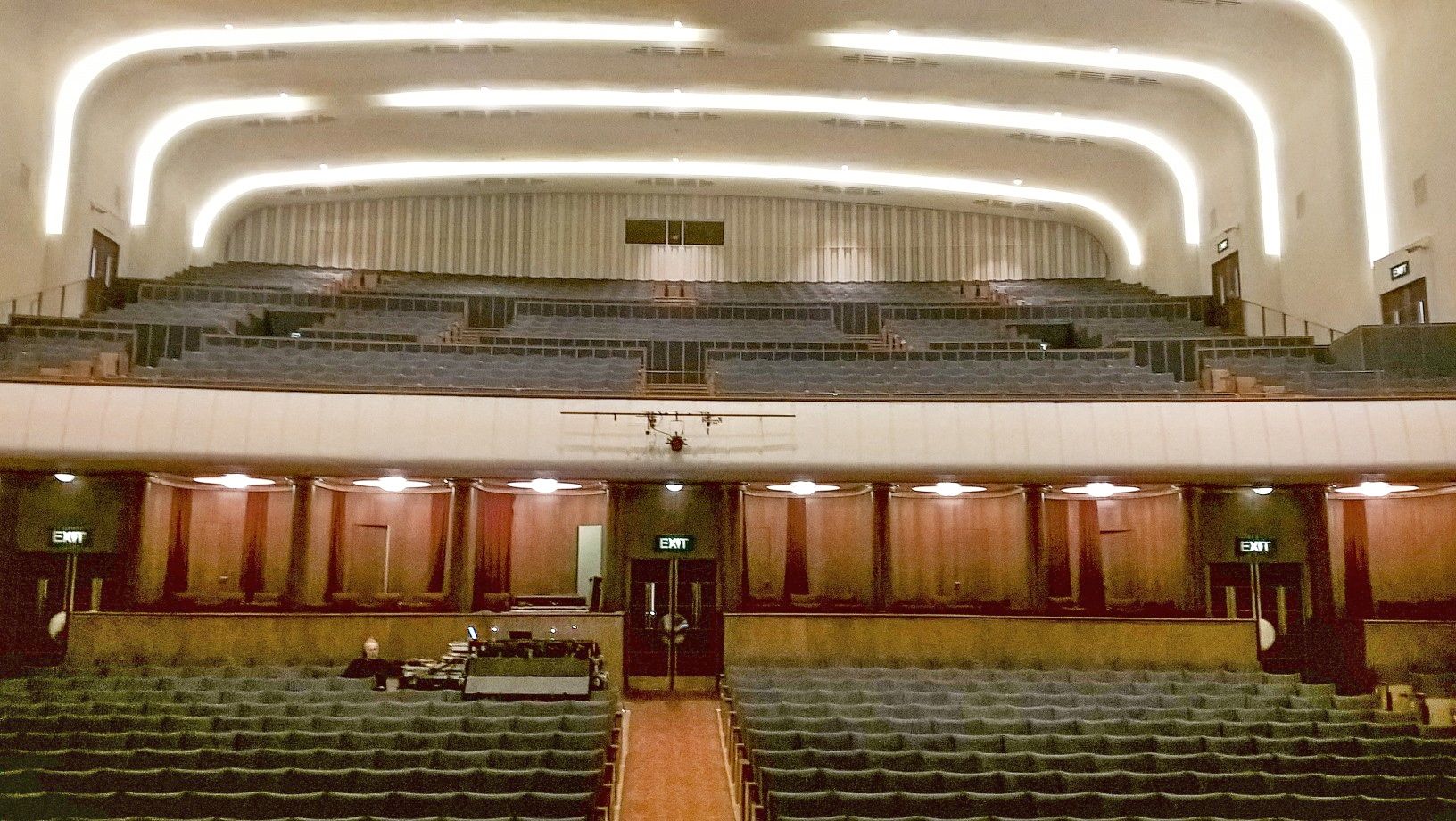
- The auditorium. Sit down early and look up. The ceiling’s curved bands of light, the wood panelling and the long, clean lines are Rowse at his best, and on a full night the room glows.
- The exterior. Walk round the building on Hope Street and Hardman Street to see its rounded brick towers and tall windows. It’s a surprisingly muscular building for a concert hall.
The Royal Liverpool Philharmonic Orchestra
The Royal Liverpool Philharmonic Orchestra grew out of the society founded in 1840, and it’s generally described as the oldest surviving professional symphony orchestra in the UK. Its Chief Conductor is Domingo Hindoyan, and 2026/27 is his sixth season in the post.
The 2026/27 season
- Opening night, 1 October 2026: Mahler’s Symphony No. 2, the “Resurrection”. It’s a huge work for orchestra, chorus and soloists, and one of the most overwhelming things you can hear in a concert hall.
- The Beethoven Festival, January 2027: marking 200 years since Beethoven’s death, Hindoyan conducts all nine symphonies across five concerts, ending with the “Choral” Symphony No. 9. If you’re only coming once this season, this is the week to aim for.
- Guest artists: the season includes appearances by the bass-baritone Bryn Terfel, the soprano Lucy Crowe, the mezzo-soprano Natalie Lewis and the cellist Guy Johnston.
- Season finale, July 2027: Orff’s Carmina Burana, a crowd-pleaser and a good first classical concert for anyone who knows “O Fortuna” from the adverts.
The full programme, with new commissions and international collaborations, is on the Phil’s website, and it’s worth checking the individual concert pages for soloists and dates.
Beyond the Orchestra: Films, Bands and the Music Room
The Phil is far from a classical-only venue, and many people’s first visit is for something else entirely.
- Films with live orchestra. The orchestra plays the complete score live while the film is screened, as with How to Train Your Dragon in Concert in September 2026. They’re huge fun and a great way to introduce children to an orchestra.
- Bands and singers. The main hall hosts touring artists and tribute shows through the year. The 80s Show (4 June 2027) and Mike and the Mechanics (16 June 2027) are two examples from the listings. With an acoustic built for orchestras, a gig here can sound much better than in an arena.
- The Music Room. The hall’s small venue, holding 180–250 people, runs contemporary music, comedy and more. In 2027 it has singer-songwriter Dan Croll (11 March) and First Time Flyers (16 April). It’s an intimate room, and you’re never far from the performers.
- Classic film screenings make the most of the rising screen and the organ.
For the rest of the city’s gig venues, see our live music venues guide, and for the festival calendar, our Liverpool music festivals guide.
Planning Around the Season
The orchestra’s season runs from autumn to summer, and the hall’s calendar has a rhythm worth knowing if you’re planning a trip around a concert.
- October: the season opens with big statements, Mahler’s “Resurrection” on 1 October 2026. Autumn is a good time for a city break anyway, with lower hotel prices than summer.
- December: festive concerts and family programmes fill the hall, and they sell fast. Pair one with the Christmas markets and the ice rink at the Pier Head. See our Christmas in Liverpool guide.
- January: the 2027 Beethoven Festival makes this the standout month of the season. January is also one of the cheapest months to visit Liverpool, so a concert weekend then is very good value. See our cheapest time to visit guide.
- Spring: a steady run of orchestral concerts, with the Music Room programme at its busiest.
- Summer: the season closes with Carmina Burana in July 2027, and touring bands and shows take up more of the calendar.
Which Venue for Which Gig?
The same artist can play several venues in Liverpool, and the room makes a big difference to the night.
| Venue | Capacity | Best for |
|---|---|---|
| Philharmonic Hall | About 1,700 | Orchestral music, seated gigs where sound quality matters, films with orchestra |
| The Music Room at the Phil | 180–250 | Singer-songwriters, small bands, comedy, up close |
| M&S Bank Arena | 11,000 | Arena tours and big pop shows |
| The Auditorium, next to the arena | 1,350 seated | Mid-sized seated concerts and comedy |
| Liverpool Empire | About 2,350 | Musicals, ballet and big comedians |
Our verdict: if an artist you like is playing the Phil, see them there rather than wait for an arena date. The acoustic and the sightlines are in a different league.
Where to Sit
The hall has a large area of stalls and a raked balcony level above them. Its acoustic is generally well regarded, but where you sit changes what you hear.
- Centre stalls, from about a third of the way back: the best all-round balance for orchestral music. The sound has had room to blend, and you can still see the players clearly.
- Front stalls: dramatic and close, but you’ll hear the strings nearest you more than the orchestra as a whole, and you’ll be looking up at the platform. These are better for a soloist or a band than for a symphony.
- Front of the balcony: many regulars’ favourite for orchestral concerts. You get a clear view of the whole orchestra, including the percussion and brass at the back, and a well-blended sound.
- Rear balcony: the cheapest seats, a long way from the platform but still good for sound. They’re ideal on a £10 ticket.
- Behind the platform: if seats behind the orchestra are on sale for a concert, you’ll see the conductor’s face and every entry, but the balance will favour the brass and percussion. It’s a great experience once.
- For films with orchestra, sit further back and centrally so you can take in the screen and the players together.
Always check the seating plan on the booking page, because layouts differ for some events.
Tickets and How to Pay Less
- £10 tickets: under-25s, students, and people on Jobseeker’s Allowance or Universal Credit can buy £10 tickets for most Royal Liverpool Philharmonic Orchestra concerts, subject to availability (checked September 2026). You can book online, by phone or in person, but you collect the tickets from the box office, where staff check proof of eligibility. For a student on a city break, it’s one of the best deals in British classical music.
- Book direct. Use the Phil’s website or the box office on 0151 709 3789. Resale sites sometimes list concerts that are still on sale at face value from the hall.
- Go early in the season, or midweek. Weekend concerts and big-name soloists sell first.
- Groups can ask the box office about group rates.
Eating and Drinking Before the Concert
The Phil sits on one of the best streets in the city for a meal or a drink, and a few minutes before the concert is all you need.
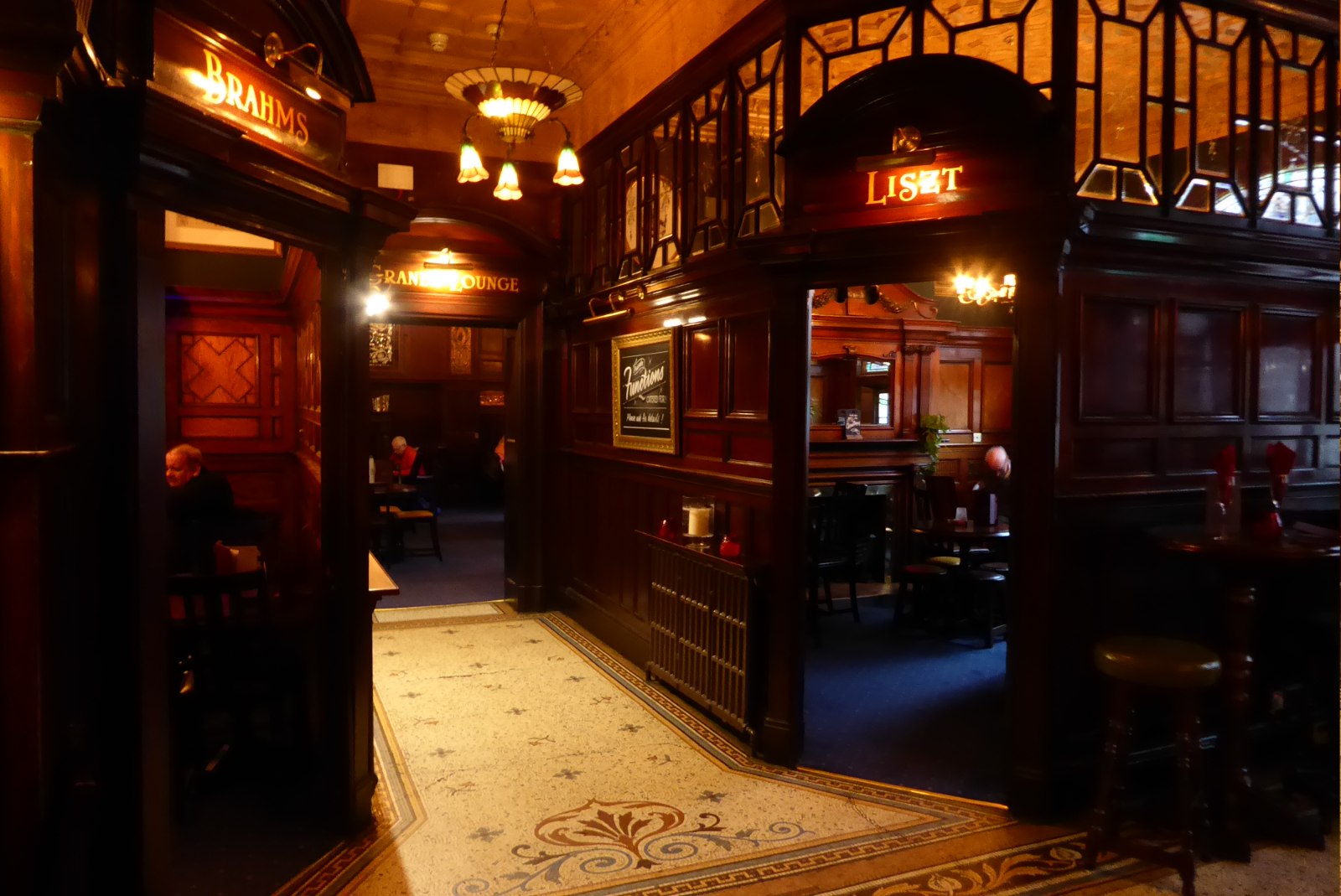
- The Philharmonic Dining Rooms, directly across the road on the corner of Hope Street and Hardman Street, is one of the most spectacular pubs in Britain. It was built at the turn of the twentieth century for the brewer Robert Cain, with mosaic floors, carved mahogany, stained glass, rooms named after composers and famous marble gents’ toilets. Everyone calls it “the Phil” too, which causes endless confusion when arranging to meet. Say “the pub”.
- Hope Street’s restaurants range from smart mid-range to serious fine dining, and several do pre-theatre menus, which are good value if you order before about 18:30. Tell them what time the concert starts. Our fine dining guide covers the best.
- Ye Cracke on Rice Street, a two-minute walk away, is a small, unchanged back-street pub where John Lennon drank as an art student.
- Bold Street, ten minutes downhill, has the widest choice of cheaper food, from Indian street food to Middle Eastern. See the Bold Street food guide.
- At the hall: there are bars inside. Order your interval drinks before the concert starts to avoid the queue.
Our best pubs guide has more of the city’s historic pubs, and the Georgian Quarter guide covers the whole neighbourhood.
Getting There
- From Liverpool Central (Merseyrail): about 10 minutes on foot, up Bold Street, across into Leece Street and up Hardman Street to the corner of Hope Street. It’s uphill most of the way.
- From Lime Street: about 15 minutes on foot, up Mount Pleasant and right into Hope Street. A taxi takes five minutes.
- By bus: several routes run up Leece Street and Hardman Street from the city centre. Use Merseytravel’s journey planner for the stop closest to Hope Street.
- By car: there’s no car park for the hall itself. The Metropolitan Cathedral’s underground car park is a few minutes’ walk up Hope Street, and there’s pay-and-display parking on the surrounding Georgian streets. Check the evening charges.
- After the concert: black cabs pass along Hope Street and Hardman Street, but the rush of 1,700 people leaving at once means a short wait. Walking downhill to the city centre takes 10–15 minutes.
For the whole network, including the Merseyrail Day Saver at £4.80–6.40 after the weekday morning peak (checked September 2026), see our getting around Liverpool guide.
Accessibility
The Phil takes access seriously, and it shows.
- Attitude is Everything Gold: the hall holds the charity’s highest award for access at live music venues, one of only nine music venues in the country to do so.
- Wheelchairs to borrow: the hall has two wheelchairs for visitors’ use, subject to availability. Ask any member of staff when you arrive.
- Assistance dogs are welcome throughout the building, and water is available for them. Tell the box office when you book if you’re bringing one.
- Book access seats through the box office so you can talk through step-free routes, wheelchair spaces and companion tickets. The Phil also publishes a detailed access guide and access plan on its website.
Our wheelchair-accessible Liverpool guide covers the rest of the city.
First Classical Concert? What to Know
If you’ve never been to an orchestral concert, the Phil is a friendly place to start.
- There’s no dress code. You’ll see everything from jeans to evening dress. Wear what’s comfortable.
- Arrive 20–30 minutes early to find your seat, get a drink and read the programme notes. Latecomers are usually held outside until a suitable break, which in a symphony can be a long wait.
- When to clap: the safe rule is to clap when the conductor turns round to face the audience. Many pieces have several movements with short pauses between them, and it’s customary to wait until the end of the whole piece. If you get it wrong, nobody will mind much.
- Phones off, and no photos during the performance.
- Look for a pre-concert talk. Some concerts have one. They’re short, informal and make the music far easier to follow.
- Start with something big. Carmina Burana, a film with orchestra, or one of the Beethoven Festival concerts in January 2027 make a great first visit.
Making an Evening of It

The Phil sits halfway along Hope Street, the street that famously links Liverpool’s two cathedrals: the Anglican cathedral at the southern end and the Catholic Metropolitan Cathedral at the northern end. Visit one in the afternoon, then dinner, then the concert. Our Liverpool Cathedral guide covers the tower climb.
The Everyman Theatre is a few minutes further up Hope Street, so theatre and music lovers can easily do a concert one night and a play the next without leaving the street. For couples, a Hope Street dinner, a concert at the Phil and a nightcap in the pub opposite is one of the classic Liverpool evenings. Our romantic things to do guide has more ideas.
Frequently Asked Questions
How many seats does Liverpool Philharmonic Hall have?
About 1,700 in the main hall. The smaller Music Room holds between 180 and 250.
When was Liverpool Philharmonic Hall built?
The current hall, designed by Herbert J. Rowse in the Streamline Moderne style, opened on 19 June 1939. It replaced the original hall of 1849, which burned down in 1933.
Who is the chief conductor of the Royal Liverpool Philharmonic?
Domingo Hindoyan. The 2026/27 season is his sixth, and includes a Beethoven Festival in January 2027 with all nine symphonies.
Are there cheap tickets for the Liverpool Philharmonic?
Yes. Under-25s, students, and people on Jobseeker’s Allowance or Universal Credit can buy £10 tickets for most Royal Liverpool Philharmonic Orchestra concerts, subject to availability. Tickets are collected from the box office with proof of eligibility.
What is the Music Room?
The Phil’s small venue, opened in 2015, holding 180–250 people. It hosts contemporary music, comedy and more.
Does Liverpool Philharmonic Hall have a rising cinema screen?
Yes. A Walturdaw cinema screen rises from the stage floor for film screenings, often to an interlude from the organist, whose console also rises on its own lift.
Is there a dress code?
No. Wear whatever you’re comfortable in.
What’s the pub opposite Liverpool Philharmonic Hall?
The Philharmonic Dining Rooms, a lavish Victorian pub built for the brewer Robert Cain and known locally as “the Phil”. It’s one of the most famous pubs in Britain.
Related Liverpool Guides
- Liverpool Entertainment Venues
- Everyman & Playhouse Theatres
- Liverpool Empire Theatre Guide
- The Georgian Quarter
- Live Music Venues
- Liverpool Architecture Guide
- Best Pubs in Liverpool
- Fine Dining in Liverpool
Photo Credits
Liverpool Philharmonic Hall from Hope Street: Liverpool Philharmonic 2017-1 by Rodhullandemu, CC BY-SA 4.0, via Wikimedia Commons.
The auditorium from the platform: Liverpool Philharmonic by Johnnyguitar01, CC BY-SA 4.0, via Wikimedia Commons.
The Brahms and Liszt rooms at the Philharmonic Dining Rooms: Interior of Philharmonic Dining Rooms – geograph.org.uk – 8200742 by Philip Halling, CC BY-SA 2.0, via Wikimedia Commons.