This article contains advertising. Our booking links are routed through a partner that adds commission tracking automatically, so if you book through one we earn a commission from the provider, at no extra cost to you. It never affects what we recommend. Affiliate disclosure
On a Friday in October you can be in a 2,381-seat Edwardian theatre on Lime Street watching a touring musical, or four hundred metres away in a 400-seat basement room watching new writing, or twenty minutes’ walk down the hill in an 11,000-capacity arena on the river. All three will finish within half an hour of each other and all three are walkable from the same hotel. The liverpool entertainment venues circuit is unusually dense for a city of this size, and the reason is straightforward: Liverpool has never stopped being a place that puts things on.
This guide covers every venue a visitor is likely to book: what it holds, what it programmes, where to sit, how to get there and what the practicalities are on the night. Capacities and details were checked in September 2026; ticket prices move constantly and vary wildly by show, so treat any figure here as an indication rather than a quote. Always check the specific event’s own seating plan — several of these rooms reconfigure completely depending on what is in them.
Liverpool’s Venues at a Glance
| Venue | Capacity | Mostly programmes | Nearest station |
|---|---|---|---|
| M&S Bank Arena | 11,000 | Arena tours, comedy, sport, awards | James Street / Liverpool Central |
| Liverpool Empire | 2,381 | Touring musicals, opera, big comedy | Lime Street (60 seconds) |
| Philharmonic Hall | 1,700 | Classical, film-with-orchestra, touring bands | Lime Street (12 min walk) |
| Liverpool’s Royal Court | 1,186 | Local comedy drama, cabaret, Christmas comedy | Lime Street (4 min walk) |
| The Auditorium | 1,350 seated | Mid-size seated shows, conferences | James Street |
| Playhouse Theatre | 650 | Drama, co-productions, touring plays | Lime Street (5 min walk) |
| Hot Water Comedy Club | 589 / 227 / 147 | Stand-up, Thursday to Sunday | Lime Street (10 min walk) |
| Everyman Theatre | 400 | New writing, repertory, Liverpool voices | Lime Street (12 min walk) |
| Epstein Theatre | ~380 | Tribute shows, small touring, local | Liverpool Central (5 min) |
Almost every venue on that list is inside a fifteen-minute walk of Lime Street. The only one that genuinely needs planning is the arena, and even that is twenty minutes on foot from the station. Our getting around guide covers the transport, and the neighbourhoods guide explains which district each venue sits in.
M&S Bank Arena
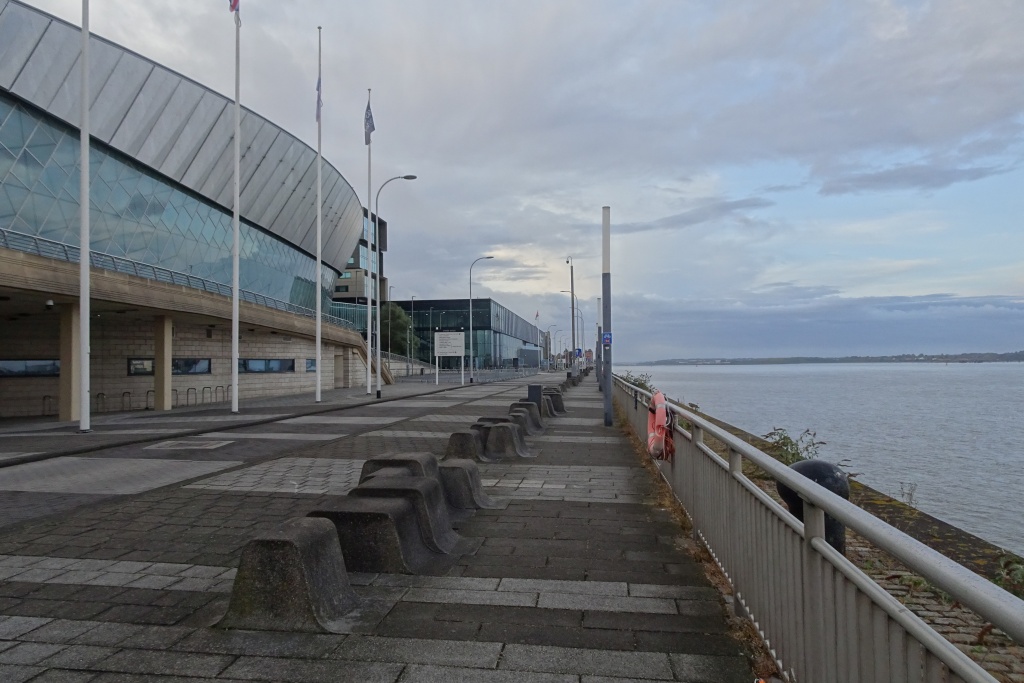
Liverpool’s big room, on the waterfront at Kings Dock. It opened in 2008 as the Echo Arena, holds around 11,000, has 22 hospitality boxes, and hosted Eurovision in 2023 — which is the shorthand most people know it by now. It is where any arena-scale tour plays when it comes to Merseyside.
Where to sit
The single most important thing to understand about this arena is that the layout is bespoke to each show. It is not a fixed bowl with a fixed stage position. Some configurations use the full room end-on; some use a half-house with the upper tiers curtained off; some are floor-standing with seated tiers around. Any generic “M&S Bank Arena seating plan” you find online is a starting point, not an answer. Check the plan on the specific event listing before you buy.
With that caveat, the general principles hold:
- Lower tier, side-on, around the halfway point of the floor is the reliable sweet spot — elevated enough to see over standing crowds, close enough to see faces.
- Floor standing is the best experience for a rock or pop show if you arrive early and the worst if you arrive late. There is no raked floor.
- Upper tier is fine acoustically and genuinely cheap. The room is small enough by arena standards that the back row is not a write-off.
- Behind or beside the stage is sold at a discount for a reason. For comedy or a seated show, avoid entirely.
Getting there and away
The arena is a twenty-minute walk from Lime Street along the waterfront, or ten minutes from James Street station, which is the closest. It sits directly beside the river, so the walk in is genuinely pleasant and the walk out in a January wind is not. There is a large car park attached but it empties slowly after a full house — if you are driving, park further back towards the city and walk.
Eating before a show
The immediate area around the arena is thin: a handful of chain restaurants in the adjacent complex and the hotel bars. Walk ten minutes north to the Albert Dock or fifteen east into the Ropewalks and the choice improves enormously. Our best restaurants guide and the street food markets round-up both cover options within walking distance.
The Auditorium
The arena’s sister venue in the same complex, seating 1,350 — or 850 when the two revolving 250-seat drums are rolled away. It takes the shows that are too big for a theatre and too small for the arena: mid-tier comedy tours, seated music, awards nights. It is a comfortable, unfussy room with good sightlines throughout, and the tickets are usually easier to get than the show would suggest.
Liverpool Empire
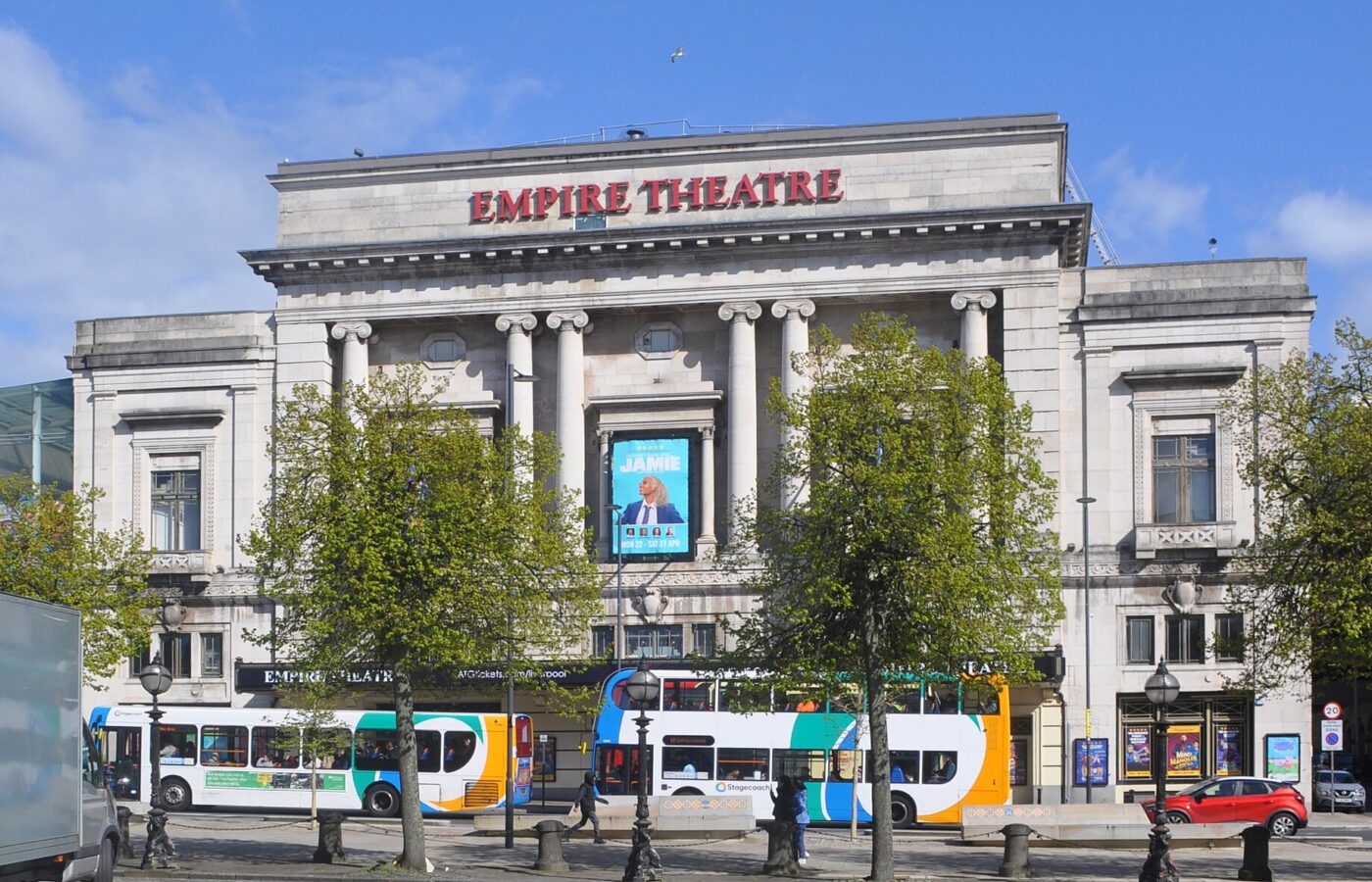
The grand one. The Empire on Lime Street holds 2,381 and has the largest two-tier auditorium in Britain — the current building dates from 1925, behind a heavy neoclassical stone frontage that faces St George’s Hall across the road. It is run by ATG and programmes the big touring product: West End musicals on tour, opera, ballet, arena-scale comedy, the occasional concert.
Where to sit
- Stalls, rows E to L, centre. The reliable choice for a musical. Far enough back that you are not craning, close enough for detail.
- Front of the Circle is arguably better than mid-stalls for a big set-piece show — you see the whole stage picture and the choreography reads properly.
- Rear stalls under the circle overhang lose some of the sound’s top end. Not ruinous, but noticeable, and worth a few pounds’ difference.
- Upper circle is steep. Very steep. Excellent value and a full view, but genuinely uncomfortable if you dislike heights.
- Side seats in either tier lose part of the stage on wide productions. Check the specific plan.
Practicalities
The Empire is sixty seconds from Lime Street’s front entrance, which makes it the easiest venue in the city to reach from anywhere on the rail network. It is a listed 1920s building, so legroom in the upper tiers reflects 1920s expectations. There are bars on each level and they get very busy at the interval — order at the start if the venue allows it. Doors are typically 45 minutes before curtain.
Liverpool’s Royal Court
The most Liverpool venue in Liverpool, and the one that surprises visitors most. A 1,186-seat Art Deco theatre on Roe Street, behind St John’s Gardens, largely programming original comedy dramas written and set in the city — often by local writers, often about local subjects, and played to audiences who talk back.
The stalls are laid out with tables rather than rows, and you can order food and drink to your seat. This sounds like a gimmick and is not: it changes the entire feel of an evening, and the room is loud, warm and completely unlike a conventional theatre. If you want to understand the city’s sense of humour in two and a half hours, this is where you do it.
Where to sit
The table seating in the stalls is the whole point — book it if it is available. The Circle is a conventional raked tier with better sightlines and none of the atmosphere. For a first visit, take the tables.
Honest verdict
The programming is deliberately local. Some of the shows will land differently if you have never lived in Liverpool, and a few of the references will pass you by entirely. That is not a reason to avoid it — it is the reason to go — but do not book expecting a touring West End production. For that, the Empire is across the gardens.
Philharmonic Hall
Hope Street, in the Georgian Quarter, and one of the finest Art Deco interiors in the country. The current hall opened in 1939 after fire destroyed its predecessor, seats 1,700, and is home to the Royal Liverpool Philharmonic Orchestra — Britain’s oldest surviving professional symphony orchestra.
The programming is broader than the name suggests. Alongside the orchestral season it takes touring bands, film-with-live-orchestra nights, folk, jazz and spoken word. The acoustic is excellent and the room is beautiful, with a rising Walturdaw cinema screen that still works and gets used.
Where to sit
- Stalls, centre, around rows J to N for orchestral work — far enough back for the sound to blend.
- Front of the Grand Circle is the audiophile’s choice and many regulars prefer it to anywhere in the stalls.
- Choir seats behind the orchestra are sold for some concerts, cheaply. The balance is odd but watching a conductor’s face for two hours is its own experience.
- Boxes look glamorous and have restricted sightlines. Know that going in.
Before and after
The Philharmonic Dining Rooms are directly opposite — a Grade I listed pub, which is close to unheard of, with a marble and mosaic gents’ that people genuinely detour to see. Buy a drink if you go in to look. Hope Street holds several of the city’s better restaurants and the pre-theatre menus around here are among the best value in Liverpool if you eat before half six. See the fine dining guide.
Everyman and Playhouse
Liverpool’s two producing theatres, run as a single organisation across two buildings.
The Everyman
On Hope Street, rebuilt in 2014 and awarded the Stirling Prize for the new building. It seats 400 in a thrust configuration, which means the audience wraps around three sides of the stage and nobody is more than a few rows from the action. It programmes new writing, a repertory company season and work with a strong Liverpool identity. The basement Bistro has been a fixture since the 1970s.
Because of the thrust stage, there is no genuinely bad seat, but the side blocks see the show at an angle and occasionally lose a face. Centre block, four to eight rows back, is the pick.
The Playhouse
Williamson Square, in the middle of the shopping district. A Victorian auditorium seating up to 650 across three levels, taking drama, co-productions and touring plays. It is a conventional proscenium house — stalls centre is the safe answer, and the upper level is steep in the way Victorian theatres always are.
Comedy
Liverpool has an unusually strong stand-up circuit, and comedy is one of the few things here that is genuinely better value than the equivalent night in London.
Hot Water Comedy Club
Now based at Blackstock Market, with three rooms: a 589-seat main auditorium, the 227-seat Wally’s Room and the 147-seat Barn. It runs Thursday to Sunday and pulls in names well above what a room this size would normally get — touring comedians use it to work up material. The main room seats a large group together, which makes it one of the better options for a group weekend.
Laughterhouse (closed)
Laughterhouse, the small club in the basement of the Slaughter House on Fenwick Street, closed in March 2026 after almost twenty years. Occasional one-off comedy nights have since been listed at the Slaughter House; check the pub’s own listings before you go.
Practicalities for comedy
- Comedy nights often sell unreserved or loosely reserved seating on many nights. Arriving thirty minutes early is the difference between the front and the back.
- Shows typically run 20:00 to 22:30 with two intervals, which leaves the whole night out ahead of you.
- Front-row seats are cheaper for a reason.
Live Music Beyond the Arena
The arena and the Philharmonic take the big tours, but Liverpool’s live music strength is in the middle and small rooms — a scene that has been continuously productive since long before the Beatles and has not stopped since.
- The Cavern Club on Mathew Street, which programmes live music from lunchtime until late, seven days a week. It is a reconstruction on the original site rather than the original cellar, and it is unashamedly a tourist attraction, but it is also a functioning music venue. See our Cavern Club guide.
- Mid-size independent venues across the Baltic Triangle and the Ropewalks, covered properly in the live music venues guide.
- Grand Central Hall, a converted Methodist hall on Renshaw Street with an extraordinary domed auditorium.
- St Luke’s, the Bombed Out Church at the top of Bold Street, which hosts outdoor gigs and screenings in the warmer months in a roofless 1832 shell.
- Festival programming across the summer, from Sound City to the waterfront events — see Liverpool music festivals.
Why the small rooms matter here
It is easy to arrive in Liverpool, book the arena and the Cavern, and conclude you have seen the music scene. You have seen the two most visible parts of it. The city’s actual strength is in rooms holding between 150 and 500 people, and it has an unusual number of them for its size — a legacy of a century in which there was always somewhere for a band to play on a Tuesday.
What this means practically is that on almost any night of the week, including a wet Monday in February, there is live music somewhere within walking distance of the city centre, and it will cost between nothing and fifteen pounds. That is not true of most British cities outside London. If you have one free evening and no fixed plan, checking what the mid-size venues are doing is a better bet than defaulting to Mathew Street.
How the listings work
- The venues’ own sites are the most reliable source and the cheapest place to buy. Aggregators carry booking fees and miss the smaller rooms entirely.
- Sunday and Monday are quiet across the ticketed venues but busy in the pubs and small clubs — the opposite of what visitors expect.
- Free entry before a certain hour is common at the smaller music pubs. It is worth checking before paying for a wristband package.
- Student term dates visibly change the programming. Liverpool has a very large student population and the mid-size venues follow it.
For the history behind all of it, the British Music Experience in the Cunard Building is a genuinely good museum, and the Beatles guide covers the sites.
The Other Rooms Worth Knowing
Beyond the ten venues in the table, a handful of spaces take shows regularly enough to be worth checking.
- St George’s Hall, opposite Lime Street. The Concert Room inside this 1854 neoclassical monument is one of the most beautiful small auditoria in Britain, holding a few hundred, and it takes concerts and events through the year. Our St George’s Hall guide covers the building itself, which is worth seeing whether or not there is a show on.
- The Anglican Cathedral stages concerts, film screenings with live organ and large-scale seasonal events in a space with almost no acoustic equal in the country. The reverberation is famously long — it suits choral and organ work and defeats anything with fast rhythm. See the cathedral guide.
- The Metropolitan Cathedral also programmes concerts, in a circular 1967 space that sounds completely different from its Anglican counterpart.
- Grand Central Hall on Renshaw Street, a converted Methodist mission with a domed auditorium, used for club nights, markets and occasional gigs.
- The Invisible Wind Factory and the cluster of warehouse venues in the north docks, which run the more experimental end of the programming.
- Outdoor programming at the Pier Head and Sefton Park through the summer, and at St Luke’s, the roofless church at the top of Bold Street.

On the Night: Practical Details
The things nobody tells you until you are standing outside.
Timings
- Theatre curtain is generally 19:30 midweek, with matinees at 14:00 or 14:30 on Wednesdays, Thursdays and Saturdays depending on the production. Doors 45 minutes before.
- Arena shows list doors at 18:00 or 18:30 with the headline typically on between 20:45 and 21:15. The support act is rarely named until close to the date.
- Comedy runs roughly 20:00 to 22:30 with two intervals.
- Orchestral concerts at the Philharmonic usually start at 19:30 and finish around 21:30. Latecomers are held until a suitable break, which at some concerts means a twenty-minute wait in the foyer.
Bags, bars and rules
- The arena operates a bag policy that tightens for larger shows — typically nothing bigger than A4, with a search on entry. Check the event page; policies vary by promoter, not by venue.
- Interval drinks can usually be ordered before the show at the Empire, Playhouse and Philharmonic. Do it. The interval is twenty minutes and the queues are long.
- The Royal Court serves food to your table in the stalls, ordered in advance with your ticket. This is the venue’s whole character rather than an add-on.
- Photography is prohibited at all the theatres and at most arena shows, and enforced more strictly than people expect at the Philharmonic.
- Cash is largely gone across venue bars. Several are card-only.
Getting home
Merseyrail’s last trains run considerably earlier than a big-city visitor expects — broadly around midnight, earlier on Sundays — which catches people out after an arena show that finishes at 22:45. If you are staying outside the centre, check the last train before you book the ticket, not on the night. Black cab ranks at Lime Street and outside Liverpool ONE are reliable; the queue after an 11,000-capacity show is not. Walking back into the centre from the arena takes fifteen to twenty minutes and is usually faster than waiting. Our cheap transport guide covers the late-night options.
If you are travelling in for a show
London Euston to Lime Street takes just over two hours direct, with two trains an hour through most of the day, which makes a Liverpool matinee a viable day trip from London. For an evening performance, check the time of the last train back before you book. From Manchester it is trivially easy: TransPennine services run frequently and the journey is well under an hour. Our Manchester connection guide and the how to get to Liverpool page cover the routes.
Booking: How to Not Overpay
This is where visitors lose the most money, and it is entirely avoidable.
- Buy from the venue, not from a search result. The top results for any venue name are resale sites and affiliate ticket agents. Every venue on this page sells directly, and the direct price is the real price. Resale listings routinely carry 40 to 200 per cent markups on shows that have not sold out.
- Check the venue’s own seating plan for the specific show. Third-party plans are generic and, in the arena’s case, frequently wrong.
- Restricted view is not always bad value. At the Empire and the Philharmonic, “restricted” often means a handrail in the corner of your vision. Read the venue’s own description.
- Midweek is cheaper for touring shows almost everywhere, sometimes substantially.
- Day seats and returns exist at the Everyman and Playhouse and are worth a phone call on the morning of a sold-out show.
- Beware “official partner” language on resale sites. It means nothing.
Access
Access provision varies considerably by building age, and the differences matter.
- M&S Bank Arena is the most straightforwardly accessible: modern build, level access, lifts to all tiers, designated wheelchair spaces with companion seats.
- The Everyman was rebuilt in 2014 to modern standards and is excellent.
- The Empire, Philharmonic Hall, Royal Court and Playhouse are all historic buildings with retrofitted access. All have wheelchair positions and lift access to at least one level, but not to every tier, and the upper levels of the Empire in particular are reached by stairs only.
- Every venue operates an access scheme with a personal assistant ticket, usually free, booked through a dedicated line rather than online. Register in advance — it is not something you can arrange on the night.
- Audio described, captioned and relaxed performances are scheduled across the producing theatres’ seasons. The dates are published with the season, not added later.
What Is On, and When
| Season | What dominates the listings |
|---|---|
| January–February | Quietest period. Cheap seats, smaller touring shows, comedy. |
| March–May | Spring theatre season; arena tours begin. |
| June–August | Outdoor and festival programming; theatres run lighter seasons. |
| September–November | The strongest period. Full theatre seasons, orchestral season opens, arena tours at their densest. |
| December–early January | The Everyman’s Rock ‘n’ Roll Panto, the Royal Court’s Christmas comedy, Christmas concerts at the Phil. Book early. |
The events and festivals calendar covers the fixed points in the year, and the Christmas guide handles the December programme.
Making a Night of It
A pattern that works for almost any of the central venues: eat at half six somewhere in the Ropewalks or on Hope Street, walk to the show, and come out into a city where everything is still open. Liverpool’s centre is compact enough that the venue rarely dictates where you eat or drink.
- Empire or Royal Court: both are two minutes from St John’s Gardens and five from the Ropewalks. Post-show, walk down to Castle Street or into Seel Street. Our best bars guide has the options.
- Philharmonic Hall or Everyman: Hope Street has the best pre-theatre eating in the city and the Philharmonic Dining Rooms opposite for after.
- The arena: eat before, in town, and walk down. Coming out with 11,000 other people, the walk back up into the Ropewalks beats waiting for a taxi.
- Staying nearby: the where to stay guide covers which districts put you within walking distance of which venues.
Frequently Asked Questions
What is the biggest entertainment venue in Liverpool?
The M&S Bank Arena at Kings Dock, holding around 11,000. The largest theatre is the Liverpool Empire at 2,381 seats, which has the biggest two-tier auditorium in Britain.
Where is the best place to sit at the M&S Bank Arena?
Lower tier, side-on, around the halfway point of the floor is the most consistently good area. But the arena reconfigures completely for each show, so always check the seating plan on that specific event listing rather than relying on a generic plan.
How far is the M&S Bank Arena from Lime Street station?
About twenty minutes on foot along the waterfront, or ten minutes’ walk from James Street station, which is the nearest. There is no need for a taxi in either direction unless the weather is genuinely hostile.
Is the Liverpool Empire or the Royal Court better?
They do completely different things. The Empire takes touring West End musicals, opera and big-name comedy in a grand 1925 auditorium. The Royal Court programmes original Liverpool comedy drama with table seating and food served to your seat. For a visitor wanting a night that could only happen in this city, the Royal Court; for a production you would recognise from London, the Empire.
Do I need to book Liverpool theatre tickets in advance?
For anything at the Empire, panto season, or a well-known touring show, yes — weeks ahead. The Everyman, Playhouse and the comedy clubs are usually bookable within a week, and returns often appear on the day of a sold-out show.
Where can I see comedy in Liverpool?
Hot Water Comedy Club at Blackstock Market runs Thursday to Sunday across three rooms, from 147 to 589 seats. Laughterhouse, the smaller basement club on Fenwick Street, closed in March 2026. Hot Water punches well above the city’s size in terms of the acts it attracts.
Are Liverpool’s theatres wheelchair accessible?
All have wheelchair positions and lift access to at least one level, and the arena and the rebuilt Everyman are fully accessible throughout. The historic buildings — the Empire, Philharmonic Hall, Royal Court and Playhouse — have retrofitted access that does not reach every tier. Every venue runs an access scheme with a free personal assistant ticket, booked by phone in advance rather than online.
What is on at Liverpool venues in December?
The Everyman’s Rock ‘n’ Roll Panto, the Royal Court’s Christmas comedy, the Philharmonic’s Christmas concert season, and a heavy run of arena shows. It is the busiest month of the year across every venue and the one where booking late costs the most.
Can you buy tickets at the door in Liverpool?
At the comedy clubs and the smaller music venues, frequently yes. At the Empire, the Philharmonic and the arena, only if the show has not sold — and you will pay the same or more than you would have online. Buying direct from the venue website in advance is almost always the cheapest route.
The arena is the venue most visitors book and the one with the most ways to get it wrong — a layout that changes for every show, a bag policy that asks you not to bring one at all, and a car park that takes forty minutes to empty. Our full M&S Bank Arena guide covers where to sit once you have the right plan, how to get there and away, and what to do about the thin eating options next door.
Booking for the Empire specifically? Our Liverpool Empire Theatre guide goes row by row through the stalls and circle, covering where the overhang and the side blocks cost you part of the stage, where legroom gets tight and which seats are worth the premium. It also has pre-show pubs and food and the last-train check for anyone coming in from out of town.
For the city’s two producing theatres in more depth, our Everyman and Playhouse guide explains how the Hope Street theatre and its Victorian sister on Williamson Square split the year between home-grown productions and touring shows. It has seating advice for both buildings, the season into 2027 and the cheapest ways to book.
For concerts, the city’s great room is the Philharmonic Hall on Hope Street, a Grade II* Art Deco hall of 1939 that seats about 1,700. Our Liverpool Philharmonic Hall guide covers the orchestra’s 2026/27 season, the rising cinema screen, the best seats for symphonies and films with orchestra, and how under-25s and students can get £10 tickets.
For the full picture on stand-up, from Hot Water’s three rooms and its free new-act shows to open mics and the big tours at the Empire and the arena, see our guide to comedy clubs in Liverpool. It also explains which clubs in older guides have since closed.
The Royal Court deserves a closer look than most visitors give it: cabaret tables and dinner in the stalls, home-grown Scouse comedies and a Christmas show that runs into January. Our Royal Court Liverpool guide explains how the dining works, what is on and how to book without fees.
Related Liverpool Guides
- Live Music Venues in Liverpool — the small and mid-size rooms in detail.
- Liverpool Nightlife — where to go after the show.
- Liverpool Neighbourhoods — which district each venue sits in.
- Liverpool Events and Festivals — the fixed points in the calendar.
- The Cavern Club — what it actually is, and whether to bother.
- Things to Do in Liverpool — the wider attraction list.
- Best Areas to Stay in Liverpool — sleeping within walking distance.
- Liverpool Architecture Guide — several of these venues are the buildings.
Photo Credits
The Empire Theatre on Lime Street, Liverpool: Empire Theatre, Lime Street, Liverpool (NHLE Code 1252934) (April 2024) (1) by User:Hassocks5489, CC0, via Wikimedia Commons.
The M&S Bank Arena and the riverside walkway at Kings Dock: Beside M^S Bank Arena – geograph.org.uk – 8168261 by DS Pugh, CC BY-SA 2.0, via Wikimedia Commons.