This article contains advertising. Our booking links are routed through a partner that adds commission tracking automatically, so if you book through one we earn a commission from the provider, at no extra cost to you. It never affects what we recommend. Affiliate disclosure
Charles Dickens called the Concert Room at St George’s Hall “the most perfect Hall in the world.” Queen Victoria opened the building in person in 1854. English Heritage rates it among the finest neoclassical buildings in Europe. It sits directly opposite Lime Street station, between the city centre and the William Brown Street cultural quarter, and it’s the first major building most visitors arriving by train see when they step out of the station — a vast Corinthian colonnade running the full length of a city block, completely free to walk past and partly free to enter. St George’s Hall, Liverpool, is one of the most architecturally significant buildings in Britain, the only combined neoclassical concert hall, ballroom, and courthouse in the country, and the home of an extraordinary Minton tile floor that’s only uncovered for public viewing a few weeks each year. This guide covers the architecture, the history, the floor, the guided tours, the events programme, and how to combine a St George’s Hall visit with the wider William Brown Street cultural ensemble.
St George’s Hall is the architectural centrepiece of the William Brown Street cultural quarter — one of the six original UNESCO-inscribed Liverpool zones covered in the Liverpool UNESCO World Heritage guide. It’s a key entry in the Liverpool architecture guide, and pairs naturally with the Liverpool museums and galleries guide (the Walker Art Gallery, World Museum, and Central Library are all immediately adjacent).
A Short History of St George’s Hall
The story of St George’s Hall begins with two separate Liverpool City Council architectural competitions in the late 1830s. The first, in 1839, was for a combined concert and assembly hall to serve the city’s rapidly expanding mercantile community. The second, in 1840, was for new assize courts (the higher criminal courts for the region) and was originally intended as a separate building.
Both competitions were won by the same architect — Harvey Lonsdale Elmes, a London-based 25-year-old who had previously designed only one significant building. Elmes recognised that combining the two functions on a single site would produce a more imposing, more architecturally ambitious result than separate buildings — and in 1841 he was authorised to merge the two projects.
The result was the only combined neoclassical concert hall, ballroom, and courthouse anywhere in Britain — possibly anywhere in the world. The building took 13 years to construct (foundation stone 1841, opening ceremony 1854). Elmes himself died in 1847, before completion. The project was finished by John Weightman (Liverpool Corporation Surveyor), Robert Rawlinson (structural engineer), and from 1851, Charles Robert Cockerell — one of the foremost classical architects of the Victorian era and the same architect who would later complete the Bank of England’s Liverpool branch on Castle Street.
Queen Victoria opened St George’s Hall on 18 September 1854. The building immediately took its place as the civic and cultural centrepiece of Liverpool, and remains so today.
The Architecture: A Neoclassical Masterpiece
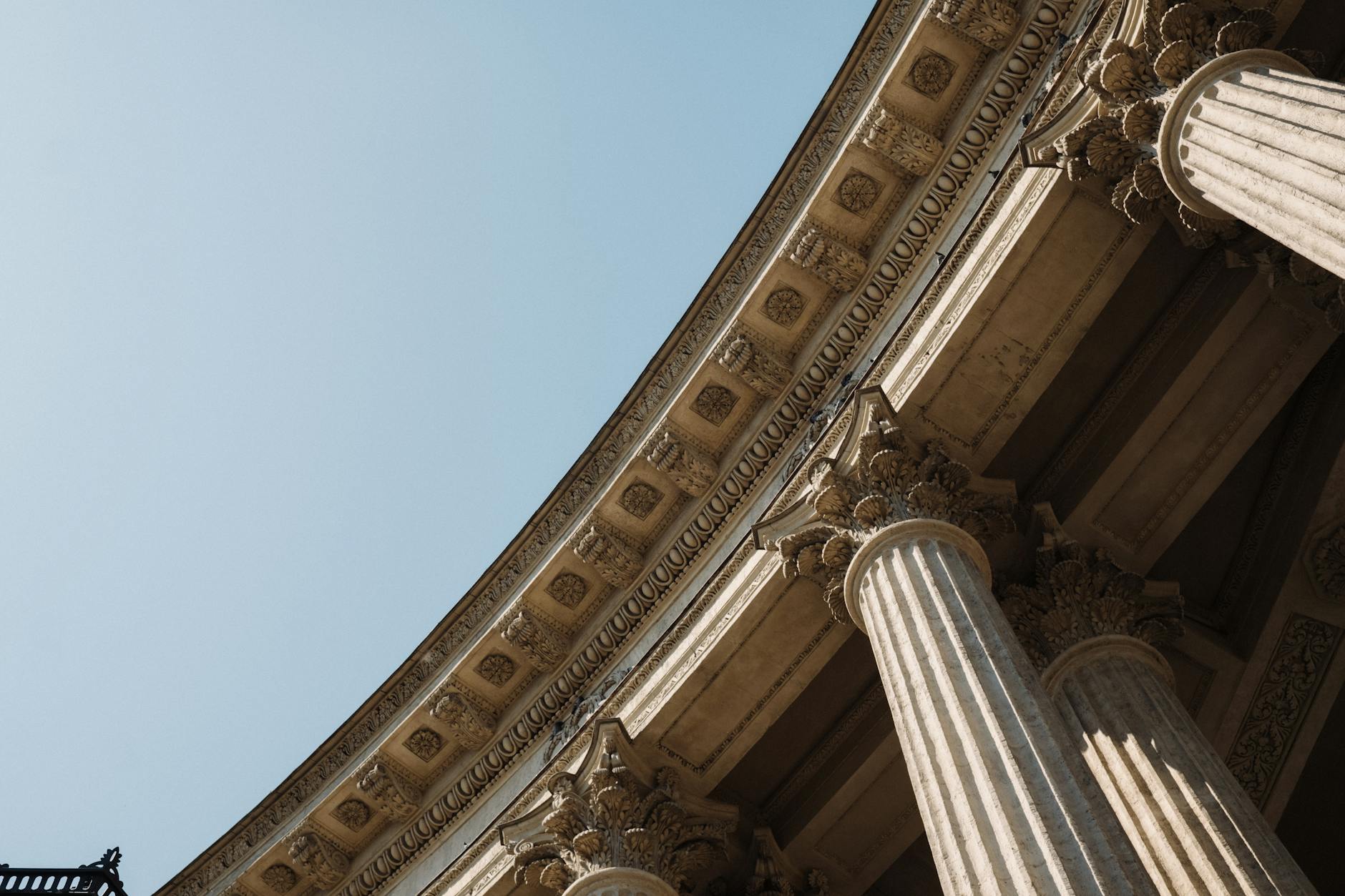
St George’s Hall is the largest neoclassical building in Europe outside London — and arguably the finest. The exterior is dominated by a great Corinthian colonnade running the full length of the east elevation, facing Lime Street station. The building is 169 feet long and 74 feet wide, with a portico of giant Corinthian columns and a continuous frieze running above. The model is the Roman Pantheon — Elmes had studied the Pantheon in detail, and the influence is visible in the proportions, the colonnade rhythm, and the relationship between exterior and interior.
The exterior is faced in Darley Dale sandstone — a hard, pale yellow stone from Derbyshire — and has weathered beautifully across 170 years. The portico steps and approaches are wide enough to function as a public square (St George’s Plateau), and have hosted everything from coronation celebrations to Liverpool FC trophy parades to political rallies. The Plateau is one of the principal civic gathering places in the city.
The building is Grade I listed and is widely cited (including by English Heritage) as one of the most important neoclassical buildings in Britain.
The Great Hall and the Minton Floor
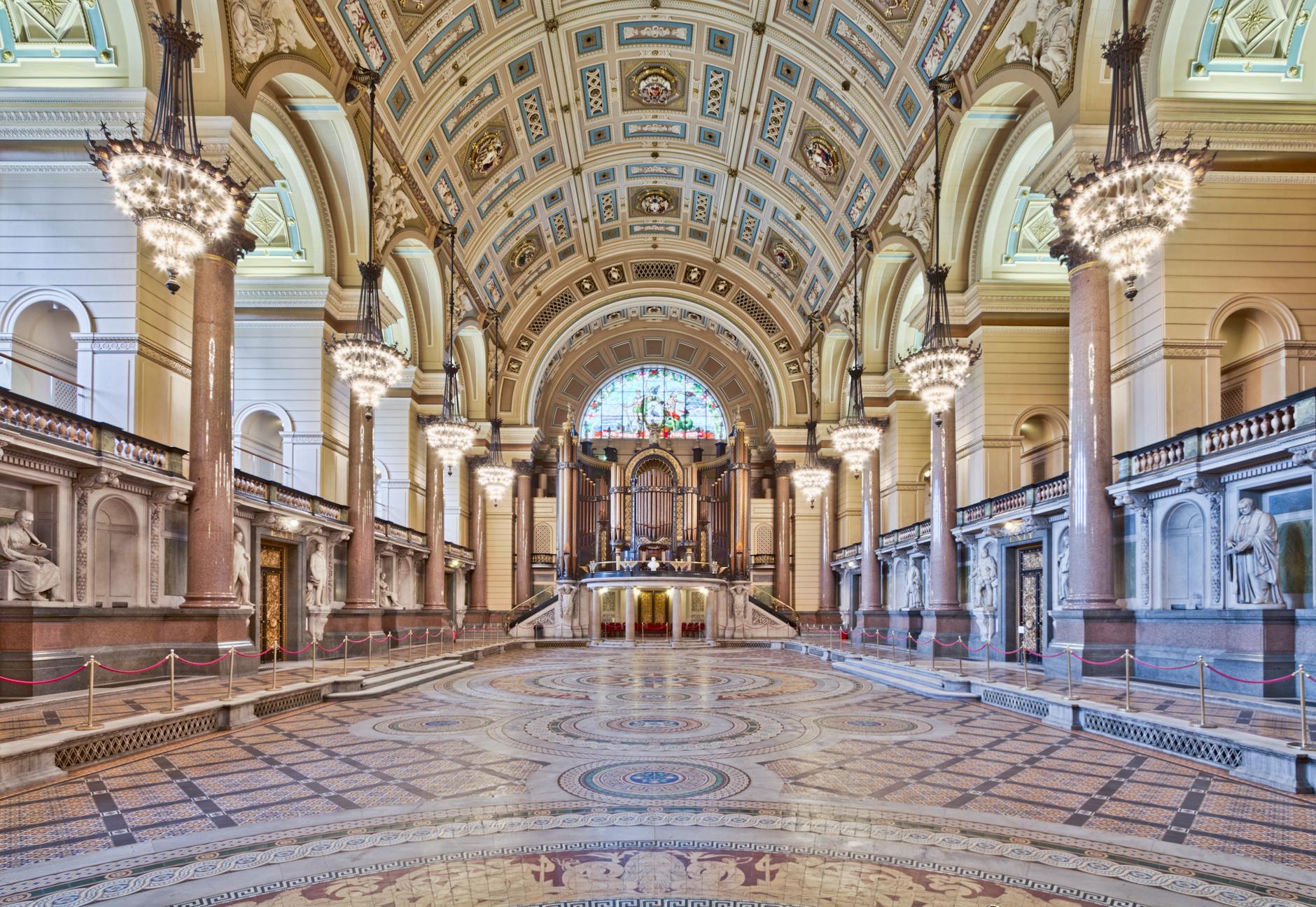
The interior of St George’s Hall is dominated by the Great Hall — a single vast room measuring 169 feet by 74 feet, with a tunnel-vaulted ceiling that is the largest of its kind in Europe. The vault rises to over 80 feet and is decorated with neoclassical mouldings, gold leaf, and a series of allegorical figures representing the arts and sciences.
The most extraordinary feature of the Great Hall is the floor. The Minton tile floor contains more than 30,000 individual tiles, produced at the Minton Hollins tile factory in Stoke-on-Trent and laid in the 1850s. The tiles are encaustic — made by pressing different coloured clays into deep moulds — and the floor pattern incorporates the royal and civic coats of arms, with the Royal Arms of Queen Victoria displayed in the centre of the vault.
For most of the year, the Minton floor is covered by a removable wooden floor to protect it from wear during the building’s use as an events venue. The floor is uncovered for public viewing only on specific occasions — typically a few weeks each year, often coinciding with Heritage Open Days events in September, plus occasional special openings advertised by the venue.
If your visit coincides with an uncovered period, take it as a serious bonus. The Minton floor is one of the largest single tile artworks in the world, and seeing it in its full extent is genuinely memorable. Check the St George’s Hall official website for current uncovered dates.
The Concert Room
At the south end of the building, separate from the Great Hall, is the Concert Room — a circular auditorium with a capacity of 500. The room was specifically designed for acoustically pure musical performance, with the curved walls and the dome producing an acoustic that Dickens, after attending performances here in the 1850s, famously described as “the most perfect Hall in the world.”
The Concert Room has hosted classical performances continuously since 1854. The interior is gilded, ornately decorated with caryatid figures supporting the gallery, and lit by a central chandelier. It remains one of the finest small auditoriums in Britain and continues to host classical concerts, candlelight performances, and seasonal events including the annual Carols by Lantern Light and dramatic readings of A Christmas Carol in December.
Attending a performance in the Concert Room is one of the more atmospheric cultural experiences in Liverpool. Programming runs year-round; check the venue website for current events.
The Courts and Prison Cells
The combined function of St George’s Hall as concert venue and courthouse means the building contains two original Victorian courtrooms — the Crown Court and the Civil Court — both still occasionally used for ceremonial and judicial purposes. The courtrooms are heavily decorated with carved oak panelling, original judicial bench seating, and Victorian iron lighting.
Below the courtrooms, in the basement of the building, are the original prison cells where defendants were held before and during their court appearances. The cells are small, brick-vaulted, atmospheric, and date from the 1840s-50s. Public access is included on the guided tour and is one of the most distinctive parts of the visit — most British neoclassical buildings don’t have functioning Victorian prison cells in the basement.
The most famous case heard at St George’s Hall was the 1889 trial of Florence Maybrick — a major Victorian murder trial in which Maybrick was convicted of poisoning her husband (the verdict has been heavily disputed by historians since). The courtrooms remain physically much as they were in 1889.
Visiting St George’s Hall: Guided Tours and Public Access
Guided Tours
The principal way to see the interior properly is via the guided tour. Tours typically run several days a week (Wednesday to Sunday in most months) and last around 75-90 minutes. The tour route includes the Great Hall, the Concert Room, the Crown Court and Civil Court, the prison cells in the basement, the Heritage Centre, and various ancillary rooms.
Tour guides are extremely knowledgeable — most are long-serving volunteer guides with substantial historical and architectural background. The tour is one of the best-value cultural experiences in Liverpool: typical adult ticket price around £12-15, with concessions available. Booking ahead via the Liverpool City Halls website is recommended, particularly for weekend tours.
Free Public Access
The exterior of St George’s Hall and the St George’s Plateau in front of it are entirely free and accessible 24 hours. The Heritage Centre on the ground floor — with displays on the building’s history and architecture — is free to visit during opening hours (typically 10:00-17:00, Wednesday to Sunday). The Heritage Centre alone is worth 30 minutes for the architectural model, the historical photographs, and the introductory exhibitions.
The Great Hall itself is sometimes open without ticketed access during specific events or open days, but the guided tour remains the most reliable way to see the interior properly.
Concerts, Events, and Performances
St George’s Hall hosts a substantial year-round programme of events — classical concerts, opera, candlelight performances, civic events, conferences, weddings, and seasonal programming. Tickets for individual events range widely; classical concerts in the Concert Room typically run £15-40 per ticket.
Highlights of the annual calendar include:
Carols by Lantern Light in December — atmospheric candlelit carol services in the Concert Room, often selling out weeks ahead.
A Christmas Carol dramatic readings in December — dramatised performances of Dickens’s famous Liverpool-associated novella in the gilded Concert Room.
Easter and summer Heritage Open Days — extended access to parts of the building not normally on the tour route, sometimes including the uncovered Minton floor.
Civic events — Liverpool City Council uses the Great Hall for major civic occasions, including Freedom of the City ceremonies and visiting dignitaries.
Programming is detailed on the official venue website. If your trip coincides with a Concert Room performance, booking ahead is strongly recommended — the room only holds 500 and atmospheric events sell out quickly.
St George’s Plateau and the William Brown Street Quarter
St George’s Hall sits at the centre of one of Liverpool’s most architecturally significant ensembles — the William Brown Street cultural quarter. The quarter was deliberately developed in the second half of the 19th century as a Greek Revival cultural-civic district. The buildings to the immediate north of St George’s Hall include:
The Walker Art Gallery (1877) — one of the finest art collections in England outside London. Free entry; the Pre-Raphaelite collection alone justifies a visit. See the Liverpool museums and galleries guide.
The World Museum Liverpool (1860) — Liverpool’s general museum, with Egyptology, natural history, ethnographic, planetary, and aquarium displays. Free entry.
The Liverpool Central Library — the city’s flagship library, with the Picton Reading Room (a remarkable circular Victorian reading room) and the famous tiled floor inscribed with literary names.
The Sessions House — the historic Victorian courthouse immediately behind St George’s Hall.
The Lord Nelson Monument on St George’s Plateau — the bronze sculpture commemorating Admiral Nelson, unveiled in 1813 (older than St George’s Hall itself), and the focus of various civic and military ceremonies.
The combined effect of St George’s Hall plus the William Brown Street ensemble is one of the most photogenic single architectural views in northern England, particularly at golden hour.
A Suggested Half-Day Around St George’s Hall
Here’s a half-day itinerary built around a St George’s Hall visit, taking in the adjacent William Brown Street quarter:
10:00 — Start at Lime Street station. Walk out and across to the St George’s Plateau. Photograph the Corinthian colonnade. 15 minutes.
10:15 — Visit the St George’s Hall Heritage Centre (free). 30 minutes for the introductory exhibitions and architectural model.
10:45 — St George’s Hall guided tour (pre-booked). 90 minutes for the Great Hall, Concert Room, courts, and prison cells.
12:15 — Walk to the Walker Art Gallery (5 minutes’ walk). Free. 90 minutes for the Pre-Raphaelite collection and the temporary exhibitions.
13:45 — Lunch. The Walker Art Gallery café, or walk down to Bold Street.
14:45 — Optional: World Museum (free, immediately adjacent). 90 minutes for the dinosaurs, Egyptology, planetarium, and aquarium.
16:15 — Walk down via William Brown Street and Whitechapel to Liverpool ONE for the end of the day.
This itinerary gives you the William Brown Street quarter comprehensively in a half-day, with St George’s Hall as the architectural anchor. Most of the visit is free (Heritage Centre, Walker Art Gallery, World Museum) with the St George’s Hall guided tour as the principal ticketed component.
St George’s Hall in Liverpool Civic Life
St George’s Hall is more than a historic building — it remains a working civic centrepiece. The Plateau in front of it has hosted some of the defining moments in modern Liverpool history: trophy parades following Liverpool FC’s Champions League victories (1977, 1978, 1981, 1984, 2005, 2019), Everton FC’s FA Cup and League title wins, civic celebrations of the 2008 European Capital of Culture year, the homecoming celebration after Eurovision 2023, and political and remembrance gatherings of various scales.
For visitors who happen to be in Liverpool on a major civic occasion, the Plateau is where the city gathers. The combination of the Hall’s monumental architecture, the open public space, and the proximity to Lime Street station makes it the natural focal point for any Liverpool event involving large crowds.
St George’s Hall FAQs
Where is St George’s Hall? St George’s Place, Liverpool L1 1JJ — directly opposite Lime Street station, on the eastern edge of the city centre. A 2-minute walk from Lime Street station, 10 minutes from Liverpool ONE, 15 minutes from the Albert Dock.
When was St George’s Hall built? Foundation stone laid 1841, opened by Queen Victoria on 18 September 1854. The total construction took 13 years.
Who designed St George’s Hall? Harvey Lonsdale Elmes — a 25-year-old London architect who won the design competitions in 1839 and 1840. After Elmes’s death in 1847, the project was completed by John Weightman, Robert Rawlinson, and Charles Robert Cockerell.
Is St George’s Hall free to enter? The exterior, St George’s Plateau, and the Heritage Centre on the ground floor are free. The guided tour of the Great Hall, Concert Room, courts, and prison cells is ticketed (around £12-15 adult). Concerts and events in the Concert Room are separately ticketed.
Can I see the Minton tile floor? The Minton floor is covered for most of the year to protect it from event use. It is uncovered for public viewing only a few weeks each year — typically around Heritage Open Days in September and occasional special openings. Check the venue website for current uncovered dates.
How big is the Minton floor? The floor contains more than 30,000 individual encaustic tiles produced at the Minton Hollins factory in Stoke-on-Trent in the 1850s. It is one of the largest single tile artworks in the world.
What did Dickens say about St George’s Hall? Charles Dickens attended performances in the Concert Room in the 1850s and famously described it as “the most perfect Hall in the world.” Dickens had close Liverpool connections and gave readings of his work in the building.
Can I attend a concert at St George’s Hall? Yes — the Concert Room hosts a year-round programme of classical concerts, candlelight performances, opera, dramatic readings, and seasonal events. Tickets typically £15-40 per performance. Book ahead via the official venue website.
Are guided tours of St George’s Hall worth doing? Yes — the tour is one of the best-value cultural experiences in Liverpool. The 75-90-minute route covers the Great Hall, Concert Room, courts, prison cells, and Heritage Centre, with knowledgeable volunteer guides. Booking ahead is recommended, particularly for weekends.
What is the most famous trial held at St George’s Hall? The 1889 trial of Florence Maybrick — a major Victorian murder trial in which Maybrick was convicted of poisoning her husband. The verdict has been heavily disputed by historians since. The Crown Court where the trial was heard remains physically much as it was in 1889.
Why St George’s Hall Matters
St George’s Hall is, by reputation and by architectural evidence, one of the finest neoclassical buildings in Europe and the single most important civic building in Liverpool. The combination of the Great Hall’s scale, the Minton floor’s extent, the Concert Room’s acoustic, the surviving 1840s courts and prison cells, and the building’s continued role as the venue for major Liverpool civic occasions makes it an essential visit for any traveller with even a passing interest in architecture, history, or 19th-century British public culture.
For first-time Liverpool visitors, the building is impossible to miss — it’s the first thing you see when you step out of Lime Street station. The mistake most visitors make is walking past it on the way to the Albert Dock without stopping. Make the time for the Heritage Centre at minimum, and book a guided tour if you have the half-day. The £12-15 ticket is among the best-value architectural and historical experiences in any UK city.
For broader heritage planning, combine St George’s Hall with the wider Liverpool architecture guide, the UNESCO World Heritage guide (the William Brown Street quarter was one of the six original inscribed zones), and the Liverpool museums and galleries guide (the Walker Art Gallery, World Museum, and Central Library all sit immediately adjacent). The Liverpool history and heritage parent guide places St George’s Hall in the wider chronological narrative of the city’s 19th-century rise.
One reason the plateau looks familiar before you have ever stood on it: this is the most-filmed building in Liverpool. Fantastic Beasts, The Batman and a long list of television drama have used the cobbles and the colonnade, usually standing in for 1920s New York or for Gotham. Our Liverpool film and TV locations guide maps it alongside the rest of the city’s screen history, and says which of the location tours are actually worth paying for.
Walk round to the back of the hall and you’re standing on a Peaky Blinders set. The St John’s Gardens elevation was piled with sandbags and filled with fake smoke for the 2026 film The Immortal Man, and the hall itself hosted some of Series 3’s biggest scenes. Our guide to the Peaky Blinders locations in Liverpool links this corner of town with Stanley Dock, Powis Street and Port Sunlight in a half-day walk.