This article contains advertising. Our booking links are routed through a partner that adds commission tracking automatically, so if you book through one we earn a commission from the provider, at no extra cost to you. It never affects what we recommend. Affiliate disclosure
Liverpool is often described as the most Irish city outside Ireland, and the statistics support the description: today, an estimated 75% of Liverpool’s population has some Irish ancestry, the city has the highest concentration of Roman Catholics of any English city, and the Liverpool accent — the famous Scouse — owes its distinctive sound primarily to the influx of Irish English speakers in the 19th century. Liverpool’s Irish story is far older and deeper than the Great Famine that brought the largest single wave of migration: by 1845, before the famine’s horror began, there were already 50,000 Irish people living in the city. What followed — the famine years of 1845-1852, when over 1.2 million famine refugees arrived through the Liverpool docks — transformed the city permanently. This guide covers Liverpool’s Irish heritage and history: the pre-famine community, the Great Famine migration, the Irish neighbourhoods that grew up around Scotland Road and the south-end Park Lane area, the Irish Famine Memorial, the religious and cultural legacy, and the modern Irish community in the city today.
This is a substantial chapter in Liverpool’s history that pairs with the wider Liverpool history and heritage guide. The Irish influence is also visible in many of the buildings covered in the Liverpool architecture guide (particularly the Metropolitan Cathedral) and the WWII history (the Irish community contributed disproportionately to the wartime workforce and military service).
Pre-Famine Liverpool Irish: Before 1845
Irish migration to Liverpool began centuries before the famine. Throughout the 18th century, seasonal workers came from Ireland to work the Lancashire harvest, the Liverpool docks, and the Wirral salt and shipbuilding trades. By the early 19th century, the Irish population in Liverpool had grown to substantial size — driven by rural poverty in Ireland, the agricultural opportunities of Lancashire, and the burgeoning industrial labour market of the rapidly expanding port city.
By 1845 — the year the potato blight struck Ireland — there were already around 50,000 Irish people living in Liverpool. They were concentrated in two main areas:
The north end: Vauxhall, Scotland Road, Everton, Exchange. The working-class district immediately north of the city centre, with cheap housing built to serve the docks, the gasworks, and the early industrial Liverpool. Scotland Road in particular became synonymous with Liverpool Irish life through the late 19th and 20th centuries.
The south end: Park Road, Park Lane, St James Street, and the area around the southern docks. A second Irish-Catholic concentration, distinct from but parallel to the north-end community.
Both communities were predominantly working-class, predominantly Catholic, and predominantly migrant or first-generation. By the 1840s the Irish in Liverpool had built churches, schools, pubs, mutual aid societies, and a self-sustaining community infrastructure.
The Great Famine, 1845–1852
In autumn 1845, the potato blight (Phytophthora infestans) destroyed Ireland’s staple food crop. The famine that followed — exacerbated by British government policies that continued grain exports from Ireland to England throughout the worst years — killed approximately one million people in Ireland and forced another two million to emigrate. Liverpool, the nearest large port and the principal British entrepôt for trade with Ireland, received the largest single share of those refugees.
Between 1845 and 1852, an estimated 1.5 million Irish migrants crossed the Irish Sea through Liverpool. The conditions on the “coffin ships” were appalling — often, by the time vessels reached Liverpool, a third of the passengers had succumbed to typhus, dysentery, or starvation. In the first three months of 1847 alone, over 100,000 famine refugees landed at the Liverpool docks.
Most were intending to travel onwards — to New York, Boston, Philadelphia, Montreal — but tens of thousands lacked the funds to continue. They stayed in Liverpool. The Irish-born population of Liverpool more than doubled in the famine years. By the 1851 census, over 20% of Liverpool’s total population was Irish-born — a statistic that does not include the children of Irish migrants born in Liverpool.
The conditions in Liverpool for the famine refugees were dire. The overcrowded courts and cellars of Vauxhall and the north end became disease zones — typhus, cholera, and dysentery killed thousands. In 1847, over 7,000 paupers (most of them Irish famine refugees) were buried in mass graves in Liverpool parish. Local resentment grew. The initial Liverpool sympathy for the famine victims hardened into hostility as the Poor Law obligations mounted and the existing English working class felt threatened by the desperate competition for jobs and housing.
By 1852, the worst of the famine was over. The migration continued at lower levels, but the Liverpool Irish community was now permanent — a population transformed from 50,000 to well over 100,000, occupying the inner-city districts in numbers that would not significantly decline until the post-war slum clearances of the 1960s.
The Liverpool Irish Famine Memorial
For 150 years, Liverpool had no public memorial to the famine refugees who had transformed the city. The Liverpool Irish Famine Memorial was finally unveiled in November 1998 by Mary McAleese, then President of Ireland. It stands on a public site in the city centre — the exact location has moved as Liverpool has redeveloped, but the memorial is currently located near St Luke’s Bombed Out Church / Berry Street area.
Designed by Irish sculptor Éamonn O’Doherty, the memorial consists of a 4-metre granite standing stone with a bronze cross on its front face, and a cracked stoneware bowl on a plinth in front of it — the broken bowl representing the fracturing of Irish culture caused by the famine. The inscription remembers “the thousands of men, women and children who left Ireland between 1849 and 1852 to escape hunger and economic hardship, many of whom died in Liverpool en route to the New World, and those who stayed and made Liverpool their home.”
The memorial is free to visit, accessible 24 hours a day, and a quiet but significant stop on any Liverpool history-focused walk. Annual commemoration events take place at the memorial in early summer.
Scotland Road and the Irish Neighbourhoods Today
The Liverpool Irish heartland of Scotland Road, Vauxhall, and the north end was substantially demolished in the post-WWII slum clearances and the construction of the Mersey Tunnel approaches in the 1960s. Much of what was the densest Irish community in 19th-century England no longer physically exists. Scotland Road itself remains as a major north-south road, but the close-knit Irish working-class community that lived along it has largely dispersed across the wider Liverpool urban area and beyond.
What does survive includes:
Roman Catholic churches built by and for the Irish community — including Holy Cross Church on Standish Street, St Anthony’s Church on Scotland Road, St Joseph’s on Grosvenor Street, and the smaller parish churches across north Liverpool. Several of these are architecturally significant and worth visiting in their own right.
The Vauxhall area retains some street patterns and surviving Victorian terraced housing from the Irish-community era, though much was demolished. The Eldonian Village — a community-led housing redevelopment from the 1980s — gave residents of the former Vauxhall slum-clearance areas the chance to stay in the neighbourhood and is one of the most successful 20th-century community regeneration projects in Britain.
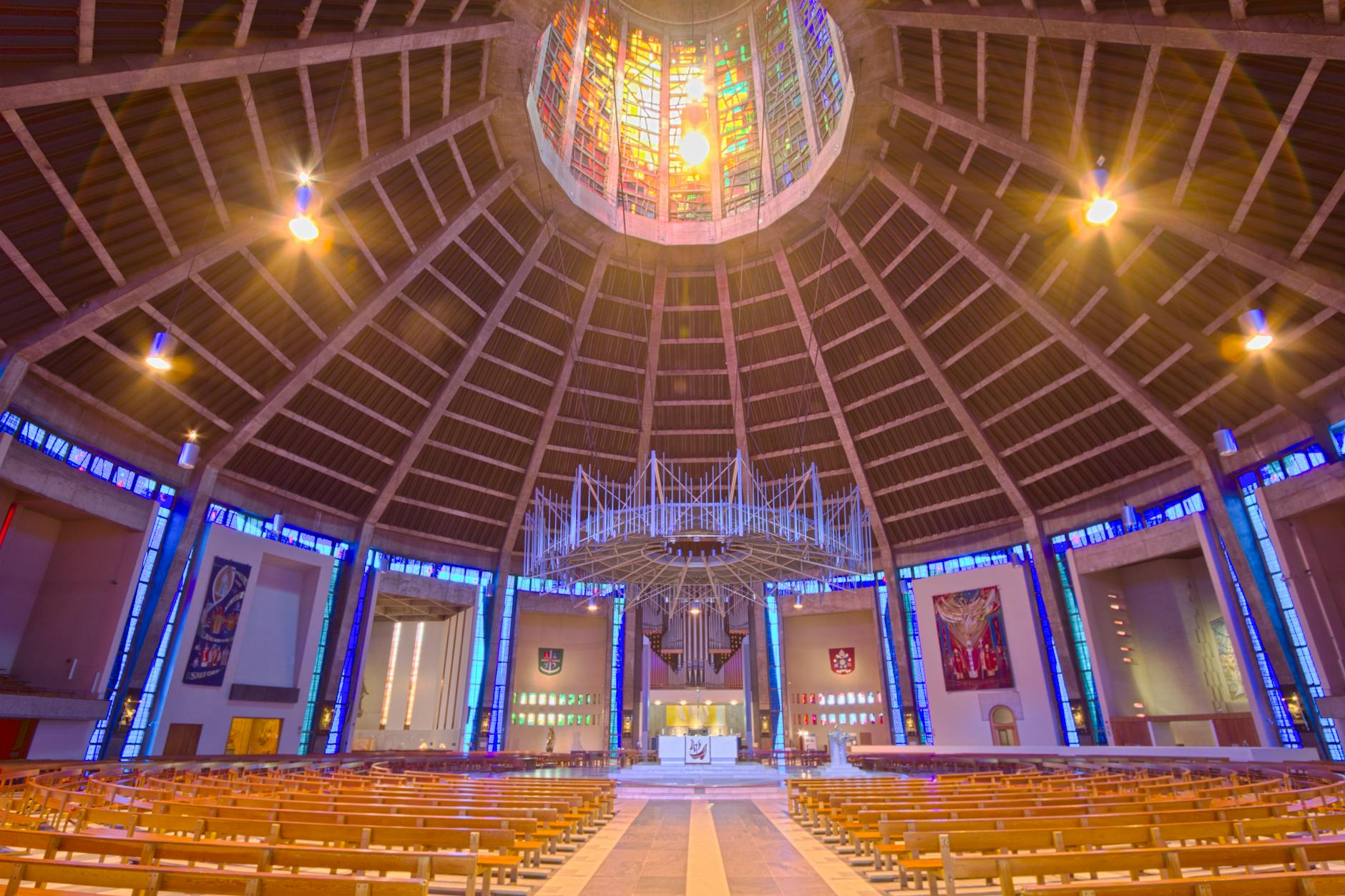
The Metropolitan Cathedral — built 1962-67 to serve Liverpool’s Roman Catholic population, which is predominantly Irish-descended. The cathedral is the spiritual home of Liverpool Catholic life and a tangible monument to the Irish migration. See the Liverpool architecture guide for architectural coverage.
Irish pubs across the city — most of Liverpool’s working-class pubs have some Irish heritage in their clientele and history. The Lion Tavern, the Pen Factory, McCooley’s, and a dozen smaller venues across the city centre and inner districts have Irish identity or programming.
The Cultural Legacy: Scouse and Irish Liverpool
The Scouse accent — Liverpool’s distinctive dialect — is one of the most recognisable English accents in the world, and its origins are substantially Irish. The 19th-century influx of Irish-English speakers into the city interacted with the existing Liverpool English (itself influenced by Welsh and Lancashire dialect) to produce a hybrid speech pattern with characteristic vowel shifts, intonation patterns, and vocabulary that has become globally famous through Beatles interviews, Liverpool FC broadcasts, and the city’s comedy tradition.
Scouse phonology — particularly the “adenoidal” nasal quality, the fricative pronunciation of /k/ in “back” or “like”, the distinctive treatment of the “th” sound — shows clear Irish English influence. Linguists trace the accent’s emergence to the mid-19th-century period when the Irish population in Liverpool was at its peak.
The cultural legacy extends beyond accent. Liverpool literature, music, comedy, and political identity are all marked by the Irish heritage. The Beatles themselves had Irish heritage in three of the four members (Lennon, McCartney, Harrison — only Starkey/Starr was not from Irish stock). Many Liverpool poets, playwrights, and musicians — Roger McGough, Brian Patten, Alan Bleasdale, the Christians, Echo and the Bunnymen, Frankie Goes to Hollywood — come from Irish-Liverpool family backgrounds.
Politically, Liverpool’s left-leaning, Labour-Catholic identity is substantially a product of the Irish community. The historic Liverpool Catholic vote was Labour from the late 19th century onwards, in contrast to the predominantly Protestant working-class Conservative pattern of much of urban England. The political alignment shaped Liverpool’s 20th-century identity as the most left-wing major English city.
The Liverpool Irish Festival
The annual Liverpool Irish Festival runs across two-and-a-half weeks each October, with music, theatre, film, literature, lectures, walking tours, family events, and community programming. It’s one of the largest Irish cultural festivals outside Ireland and a substantial moment in the Liverpool annual calendar.
The 2026 festival dates are typically the second half of October. Programming spans dozens of venues across the city — pubs, theatres, the Bluecoat, the Metropolitan Cathedral, the Adelphi Hotel, and a range of smaller cultural spaces. Most events are free or low-cost. If your trip coincides with the festival, it’s one of the best ways to engage with Liverpool Irish culture in person. Check the festival website closer to your visit for current programming.
Irish Heritage Sites to Visit in Liverpool
1. The Liverpool Irish Famine Memorial
Free, 24-hour access, near St Luke’s Bombed Out Church in the Berry Street / Leece Street area. Allow 15-20 minutes.
2. Metropolitan Cathedral
Hope Street top, free entry, the spiritual home of Liverpool Irish Catholic life. Frederick Gibberd’s 1967 design includes a separate Lutyens crypt (1933-41, paid access) that was the unrealised foundation of an even more ambitious cathedral. See the free things to do guide for visitor coverage.
3. Holy Cross Church (Standish Street)
One of the principal Catholic churches built to serve the 19th-century Liverpool Irish community. Atmospheric, atmospheric working parish church, free to enter during opening hours.
4. St Anthony’s Church (Scotland Road)
The historic Irish-community church on Scotland Road. The building dates from the 1830s and was the spiritual centre of the north-end Irish community throughout the 19th and early 20th centuries.
5. The Eldonian Village (Vauxhall)
The 1980s community-led housing regeneration project that allowed former Vauxhall residents to stay in their neighbourhood. The estate is private housing, but the wider Vauxhall area can be walked and the Eldonian community centre hosts public events.
6. The Adelphi Hotel
The grand Edwardian hotel opposite Lime Street station. Significant to Irish Liverpool as the long-standing venue for Liverpool Irish Festival opening events, Irish weddings, and Irish-community gatherings. The interior — particularly the central staircase and dining rooms — is worth a 20-minute look on any Liverpool walk. See the best hotels guide for current visiting status.
7. Irish Pubs in Central Liverpool
Multiple traditional Irish pubs operate in central Liverpool. McCooley’s on Concert Square is the most central; the Pen Factory on Hope Street has Irish heritage and a literary leaning; the Lion Tavern on Moorfields is a classic Liverpool back-street pub with deep Irish-Liverpool clientele. See the best bars in Liverpool guide for wider pub coverage.
8. The Liverpool Records Office (Liverpool Central Library)
The Liverpool Records Office holds extensive Irish-community archives, including parish records, immigration documentation, and oral history collections. For visitors with Liverpool Irish family connections, the archive can be invaluable for genealogical research. Free access; appointments recommended.
A Suggested Liverpool Irish Heritage Half-Day
For visitors who want to engage substantively with Liverpool’s Irish heritage in a single half-day, this is the route I’d build:
09:30 — Start at the Metropolitan Cathedral, Hope Street. Frederick Gibberd’s 1967 cathedral is the spiritual home of Liverpool Catholic life. 45 minutes including the Lutyens crypt.
10:15 — Walk down Hope Street to the Adelphi Hotel area (15-20 minutes). Look at the exterior of the Adelphi; if open, walk through the lobby briefly. 20 minutes.
10:45 — Walk via Bold Street to the Liverpool Irish Famine Memorial near St Luke’s Bombed Out Church. 30 minutes including time to read the inscription and reflect.
11:15 — Walk through the Bombed Out Church grounds and continue down via Castle Street area. 15 minutes.
11:30 — Lunch at one of the Bold Street independents or at an Irish-heritage pub like McCooley’s.
13:00 — Optional north-end exploration: take a bus or taxi to Scotland Road / Vauxhall area for the Eldonian Village walk and St Anthony’s Church. 90 minutes.
14:30 — Return to the city centre.
This route gives you the principal Irish heritage sites in a single half-day, with the Metropolitan Cathedral as the architectural and spiritual anchor and the Famine Memorial as the historical anchor.
Books and Resources on Liverpool Irish History
For visitors who want background reading:
Books: Tom Murphy’s The Irish in Liverpool, John Belchem’s Irish, Catholic and Scouse: The History of the Liverpool-Irish, 1800-1939, Frank Neal’s Black ’47: Britain and the Famine Irish, and the Liverpool Irish Festival’s published essays and historical resources.
Films: The BBC Liverpool Irish-themed documentaries (various), and contemporary work by Liverpool-Irish filmmakers covering the heritage.
Online: The Liverpool Irish Festival website hosts substantial historical material, and the National Museums Liverpool collections include extensive Irish-community archives.
Liverpool Irish Heritage FAQs
How many Liverpudlians have Irish heritage? An estimated 75% of Liverpool’s population today has some Irish ancestry, making Liverpool the most Irish-descended English city.
When did Irish migration to Liverpool begin? Substantially, in the 18th century. By 1845 (before the Great Famine), the Liverpool Irish-born population was around 50,000. The Famine years (1845-1852) brought a further 1.2-1.5 million Irish migrants through Liverpool, of whom tens of thousands settled in the city.
Where is the Liverpool Irish Famine Memorial? Near St Luke’s Bombed Out Church on Berry Street in central Liverpool. The memorial — a 4-metre granite standing stone with a bronze cross and a cracked stoneware bowl — was designed by Éamonn O’Doherty and unveiled in November 1998 by Mary McAleese, President of Ireland.
What was the impact of the Famine on Liverpool? The Famine doubled Liverpool’s Irish-born population in five years. By the 1851 census, over 20% of the city’s population was Irish-born. The cumulative effect was to make Liverpool the most Irish-influenced English city, with permanent demographic, cultural, religious, and linguistic consequences.
Did the Famine kill people in Liverpool itself? Yes — extensively. In 1847 alone, over 7,000 paupers (mostly Irish famine refugees) were buried in mass graves in Liverpool parish, most having died of typhus, cholera, or starvation after arriving in the overcrowded courts and cellars of the north end.
What is Scotland Road famous for? Scotland Road, in north Liverpool, was the spine of the densest Irish working-class community in 19th-century England. Much of the original community was demolished in the 1960s slum clearances and Mersey Tunnel construction, but Scotland Road remains a major north-south road in Liverpool, and surviving institutions (St Anthony’s Church, the Eldonian Village) carry the heritage.
Is the Scouse accent really from Irish English? Substantially yes. The 19th-century Irish migration into Liverpool produced significant Irish-English influence on the local Liverpool dialect, contributing to the distinctive vowels, intonation, and phonology of modern Scouse.
When is the Liverpool Irish Festival? Annually in mid-to-late October — typically two-and-a-half weeks of music, theatre, lectures, film, and family events across multiple Liverpool venues. Check the official festival website for current dates.
Are there guided Liverpool Irish heritage tours? Periodically — community organisations including the Liverpool Irish Festival run dedicated walking tours during October, and individual heritage tour operators offer Irish-themed walks year-round. Check current operators via the Liverpool walking tours guide.
Where can I research Liverpool Irish ancestry? The Liverpool Records Office at Liverpool Central Library holds extensive parish records, immigration documentation, and oral history collections relevant to Liverpool Irish heritage. Free access; appointment recommended for archive research.
Why Liverpool’s Irish Heritage Matters to a Visit
Visit Liverpool with even a passing awareness of its Irish heritage and the city becomes legible in a different way. The Scouse accent stops being a curiosity and becomes a 19th-century linguistic archaeology. The Metropolitan Cathedral stops being an architectural curiosity and becomes the spiritual centre of the city’s working-class community. Scotland Road stops being a busy road and becomes the spine of what was, in the 1850s, the densest Irish settlement outside Ireland itself. The pubs, the political tradition, the football clubs (Everton was founded by Catholic parishioners; Liverpool FC’s working-class identity has deep Irish roots), the comedy tradition — all are partly Irish.
For visitors with Irish family connections, Liverpool is one of the principal genealogical archive cities in Britain — many millions of Irish-Americans, Irish-Canadians, and Irish-Australians have ancestors who passed through Liverpool, and the records that document those passages are largely held in the city. For all visitors, engaging with the Irish heritage gives Liverpool an additional layer of meaning that the standard Beatles-and-Albert-Dock itinerary won’t supply.
For a fuller Liverpool history experience, combine the Irish heritage with the slavery history guide, the WWII Blitz guide, the maritime history guide, and the architecture guide. Liverpool’s identity is built on multiple migrant communities — Welsh, Irish, Caribbean, African, Chinese (the oldest Chinese community in Europe lives in Liverpool), Jewish, and more — and the Irish story is the largest single thread.
The Irish were the largest of the communities that Liverpool’s port brought to the city, but not the oldest of its kind: Chinese seamen were settling near the docks by the 1880s, founding what is now Europe’s oldest Chinese community. Our Liverpool Chinatown guide covers that history and the neighbourhood today.
The sea link that brought so many Irish people to Liverpool has changed shape: there has been no Liverpool–Dublin passenger ferry since the end of 2023, but Stena Line still sails from Birkenhead to Belfast, by day and overnight. Our guide to the ferry from Liverpool to Ireland sets out every current route.