This article contains advertising. Our booking links are routed through a partner that adds commission tracking automatically, so if you book through one we earn a commission from the provider, at no extra cost to you. It never affects what we recommend. Affiliate disclosure
The Three Graces — the Port of Liverpool Building, the Cunard Building, and the Royal Liver Building — line up at Pier Head in Liverpool in one of the most recognisable urban set-pieces in Britain. Three monumental Edwardian commercial buildings, raised between 1907 and 1917 at the absolute high point of Liverpool’s commercial wealth, fronted onto the Mersey across a granite esplanade, with the river behind them and the working-port skyline of the Wirral beyond. The composition has been the photograph that introduces Liverpool to the world for over a century. Even after the loss of the city’s UNESCO World Heritage status in 2021, the Three Graces remain Liverpool’s defining architectural image — and they remain, almost entirely unchanged, exactly as they were when the Cunard Building was completed in 1917. This guide covers each of the Three Graces in turn — architects, history, current use, visitor access — plus practical information on how to see them all in a single half-day and the best vantage points for photography.
The Three Graces sit at the heart of the Liverpool waterfront, are the most photographed buildings in the city, and were the centrepiece of the Liverpool UNESCO World Heritage Site from 2004 to 2021. The parent Liverpool history and heritage guide places this architectural set-piece in the wider historical context, while the maritime history guide explains the port history the buildings were built to serve.
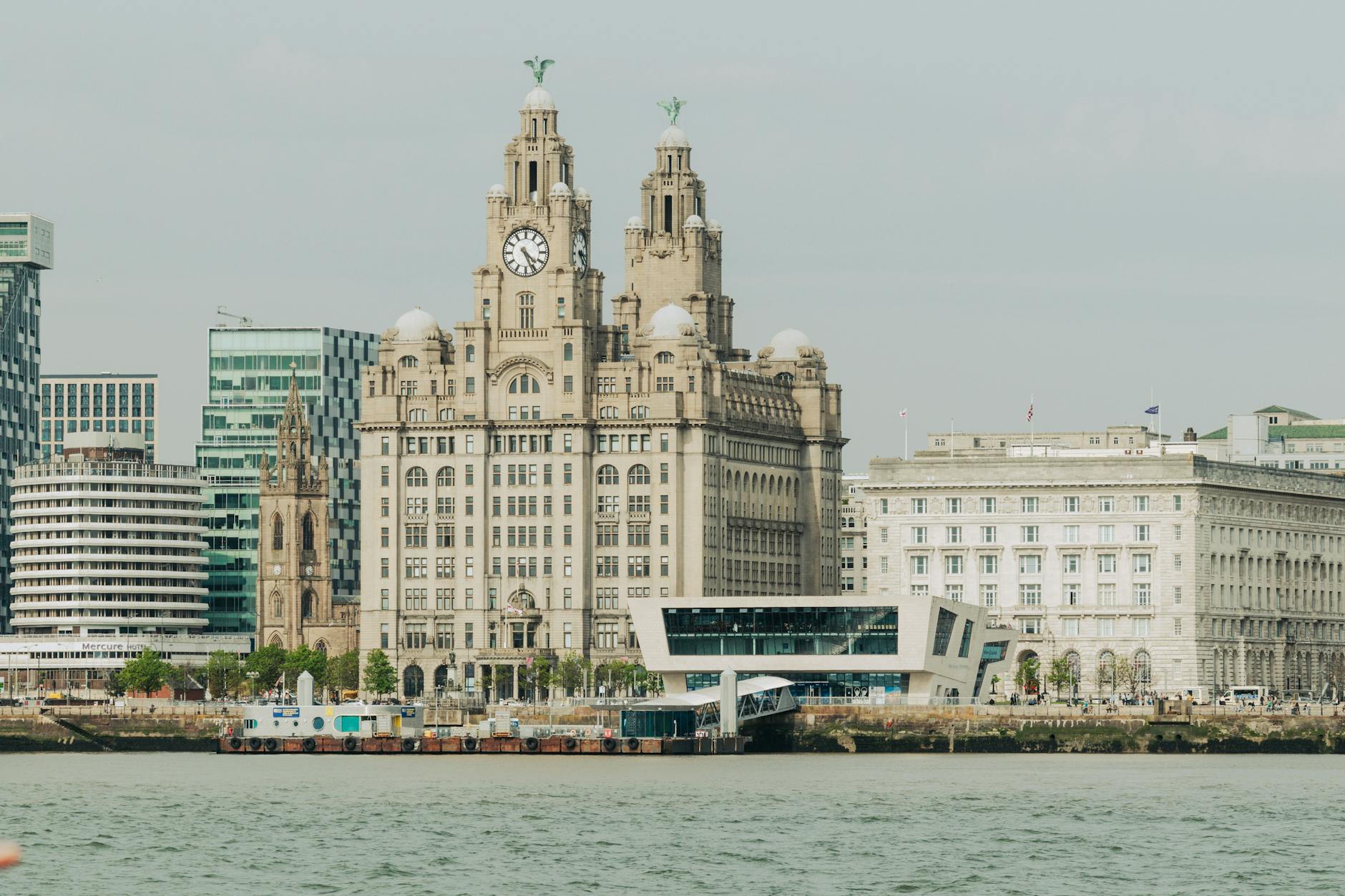
The Three Graces in Context
The phrase “Three Graces” — borrowed from Greek mythology’s three goddesses (Charites) personifying charm, beauty, and creativity — was applied to Liverpool’s Pier Head buildings sometime in the early 20th century. The three buildings were constructed by three different commercial institutions over a decade: the Port of Liverpool Building (1904-07, for the Mersey Docks and Harbour Board), the Royal Liver Building (1908-11, for the Royal Liver Friendly Society), and the Cunard Building (1914-17, for the Cunard Steamship Company).
None of the three institutions coordinated their commissions with each other; the buildings were planned and approved independently. What unifies them is the moment they were built. By 1907, when the Port of Liverpool Building broke ground, Liverpool was at the absolute peak of its Edwardian commercial wealth — the second city of the British Empire, the gateway for nine million emigrants to North America, the home of the Cunard Line and the White Star Line, the registered port of more shipping tonnage than London. The three commercial institutions that commissioned the Graces wanted buildings to match the city’s self-image. They got them.
The reclamation of the Pier Head waterfront from the Mersey’s tidal mud occurred in stages through the late 19th century, and by 1900 the broad granite-paved esplanade was available for monumental architecture. The Three Graces fill it from the south (Port of Liverpool Building) to the north (Royal Liver Building) with the Cunard Building between them.
The Port of Liverpool Building (1904–1907)
The southernmost and oldest of the Three Graces. Designed by Sir Arnold Thornely and F.B. Hobbs of Briggs & Wolstenholme, completed in 1907 as the headquarters of the Mersey Docks and Harbour Board — the body that administered Liverpool’s vast dock estate from the late 19th century onwards.
The style is Edwardian Baroque — exuberant, theatrical, drawing on the late 17th-century English Baroque of Wren and Hawksmoor. The defining feature is the great copper-domed cupola rising from the centre of the building — proportionally enormous, openly Baroque, often compared (with some justification) to St Paul’s Cathedral in London. The four corner pavilions, the rusticated ground floor, the giant Ionic columns of the principal facade, and the ornate sculptural detailing around the windows and parapets all show an architect deliberately reaching for the imperial grandeur the docks board wanted to project.
The building underwent a £10 million restoration between 2006 and 2009 which recovered original features that had been progressively obscured during 20th-century alterations. It is Grade II* listed. The interior — including the original ornate decorations of the boardrooms and ceremonial spaces — is privately occupied by commercial tenants and not generally open to the public, though the building hosts occasional Heritage Open Days events when visitors can see the principal rooms.
The exterior is the photograph. The Port of Liverpool Building is arguably the most pictorially beautiful of the three Graces, particularly in late-afternoon light when the dome catches the western sun.
The Cunard Building (1914–1917)
The central of the Three Graces, completed in 1917 — the last of the three to be built. Designed by William Edward Willink and Philip Coldwell Thicknesse of Liverpool architectural practice Willink & Thicknesse, with the input of New York-based architect Mewès & Davis (the firm that designed the London Ritz and the RMS Olympic’s interior).
The style is Italian Renaissance palazzo with Greek Revival elements — a deliberate departure from the Baroque exuberance of the Port of Liverpool Building. The Cunard Building is more restrained, more horizontal, more openly modern in its commercial-palace aesthetic. The model is the great Florentine and Roman palazzi of the 15th and 16th centuries — Strozzi, Farnese, Riccardi — translated into early 20th-century steel-and-stone commercial construction.
The building was originally the headquarters and passenger terminal of the Cunard Steamship Company — the company whose transatlantic liners (the Lusitania, the Mauretania, the Aquitania, later the Queen Mary and the Queen Elizabeth) made Liverpool the gateway between Europe and North America. Passengers checked in, collected their tickets, and waited for embarkation in the Cunard Building’s grand booking hall before walking out to the docks behind. The booking hall ceiling is one of the most remarkable Edwardian commercial interiors in Britain.
Cunard moved out in the 1960s as the transatlantic passenger trade collapsed. The building has been variously occupied since. Since 2017, the ground floor has housed the British Music Experience — a paid museum dedicated to British popular music from the 1940s to the present, with strong Beatles, Mersey-beat, and modern pop sections. A separate retail and office presence occupies the upper floors.
The British Music Experience is open to the public; the upper floors of the Cunard Building are largely not. It is Grade II* listed.
The Royal Liver Building (1908–1911)
The northernmost, the most famous, and the tallest of the Three Graces. Designed by Liverpool architect Walter Aubrey Thomas and constructed for the Royal Liver Friendly Society (a mutual insurance organisation founded in Liverpool in 1850). Foundation stone laid 11 May 1908; officially opened 19 July 1911.
The building is technically innovative — it was one of the first major buildings in the world to be constructed using reinforced concrete, with Thomas adopting the Hennebique system that allowed unprecedented structural spans and heights. At 322 feet (98 metres) to the top of the clock tower spires, the Royal Liver Building was, at the time of its 1911 completion, briefly one of the tallest buildings in Europe and the tallest reinforced concrete structure anywhere in the world.
The architectural style is harder to pin down than the other two Graces — Thomas drew on Edwardian commercial Baroque but added Gothic and Art Nouveau elements, with the twin clock towers and the steep spires giving the building a distinctly Northern European silhouette. The four clock faces — at 25 feet across, each larger than the Big Ben dial at Westminster — were the largest clock faces in the UK at the time and remain among the largest in the country.
Bella and Bertie: The Liver Birds
The crowning glory of the Royal Liver Building, and the most famous architectural detail in Liverpool, are the two copper Liver Birds mounted at the top of the building’s twin clock-tower spires. Each is 18 feet tall and weighs around 7 tons. They were designed by Carl Bernard Bartels, a German-born sculptor and woodcarver who won a national design competition for the commission.
The two birds are named: Bella (female) faces out to the sea, watching over the sailors leaving the port; Bertie (male) faces inland, watching over the families left at home. The Liverpool legend says that if the two birds ever fly away — if they ever separated — the city will cease to exist. They’ve faced each other across the Royal Liver Building’s twin spires since 19 July 1911.
Carl Bartels’ story is one of the more poignant chapters of the Royal Liver Building’s history. Three years after the completion of his Liver Bird sculptures, the First World War broke out. Bartels, as a German national living in Britain, was interned as an enemy alien for the duration of the war. His role in designing the Liver Birds was officially erased from civic records. He died in obscurity. It was only in 2011 — a hundred years after the building’s completion — that a successful public campaign restored Bartels’ place in the official history. A small plaque inside the Royal Liver Building now commemorates him.
RLB 360: Visiting Inside the Royal Liver Building
The Royal Liver Building was opened to public tours in 2019 for the first time, through the RLB 360 visitor experience. The tour takes visitors from the lower-ground-floor visitor centre on Water Street, up through the building, into the original clock-mechanism room, and out onto the open-air viewing platform at the 15th floor — directly beneath the spires and the Liver Birds.
The 15th-floor platform offers panoramic 360-degree views of the river, the Wirral, the Welsh hills on clear days, the dock estate north and south of Pier Head, the cathedrals, and central Liverpool. It’s the best urban viewpoint in the city. Tours run multiple times daily, last about 90 minutes, cost around £18 per adult, and book up well in advance for weekend slots. Pre-book via the RLB 360 official website.
The Royal Liver Building is Grade I listed.
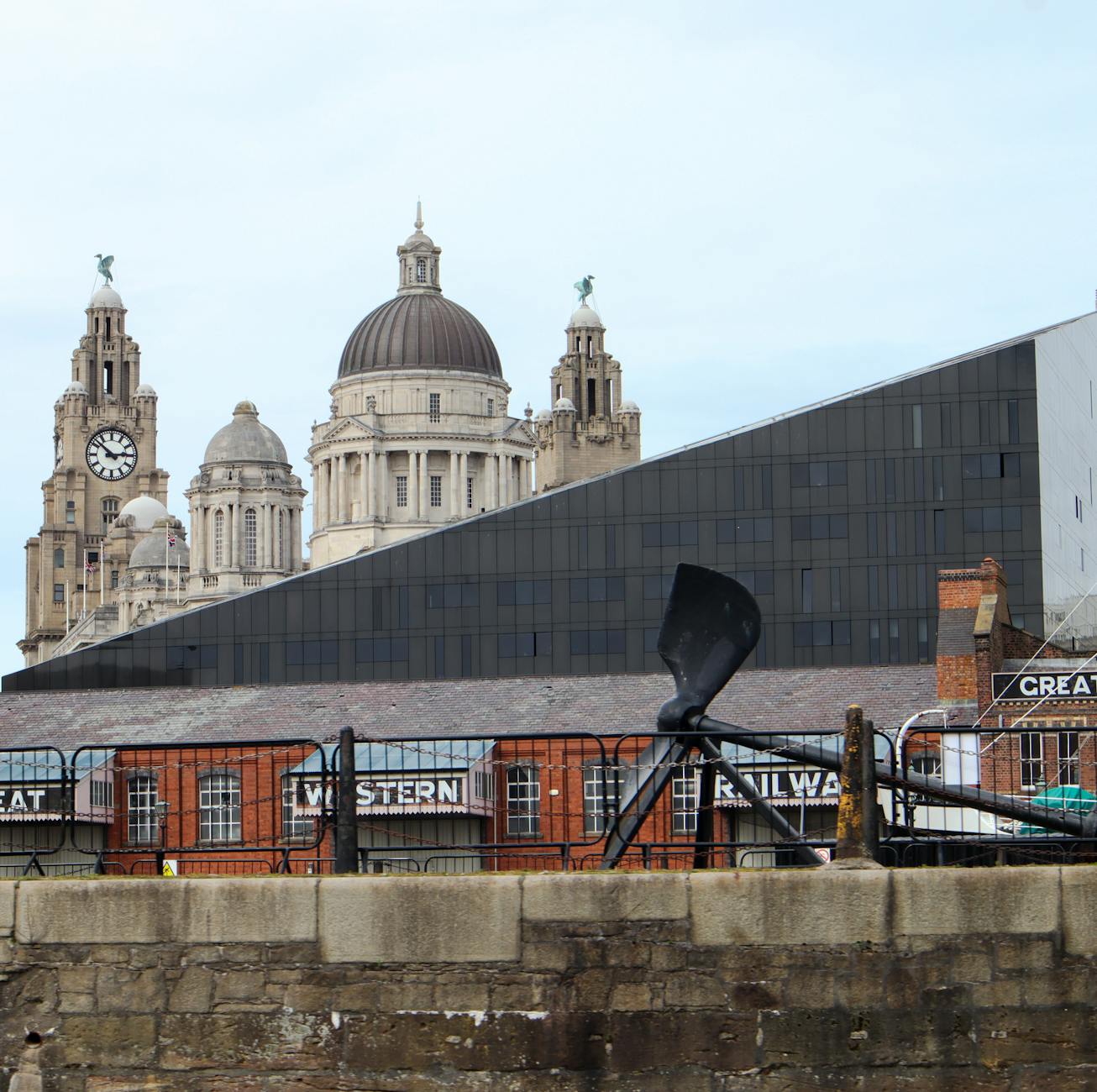
Visiting the Three Graces: A Half-Day Itinerary
The Three Graces are best experienced both from the outside (the photograph, the architectural ensemble) and from the inside (RLB 360 in the Royal Liver Building, the British Music Experience in the Cunard Building). Here’s a half-day route that covers everything.
09:30 — Start at Pier Head. Walk the broad granite esplanade in front of the Three Graces. Photograph them from the south end (Port of Liverpool Building in foreground), the centre (all three together), and the north end (Royal Liver Building in foreground). 30 minutes.
10:00 — Visit the British Music Experience in the ground floor of the Cunard Building. About £18 adult, around 90 minutes. The exhibition covers British popular music from the 1940s to the present, with strong Beatles, Mersey-beat, glam rock, punk, Britpop, and contemporary sections.
11:30 — Coffee break. Multiple café options at the nearby Royal Albert Dock or the Museum of Liverpool ground floor.
12:00 — RLB 360 Tour (Royal Liver Building). 90 minutes, pre-booked. Climb to the 15th-floor open viewing platform. Take the photograph.
13:30 — Lunch. Pier Head, the Albert Dock, or central Liverpool.
This itinerary gives you all three Graces externally, two of them internally (Cunard and Royal Liver), with the Port of Liverpool Building visible exterior-only (which is how most visitors see it).
Best Photography of the Three Graces
Five photographs make the Three Graces collection.
The classic ensemble from the south esplanade. Stand at the south end of Pier Head, look north, and the three buildings line up with the river on your right. Best in mid to late afternoon when the western sun catches the facades.
The river view from the Mersey Ferry. The Three Graces from the water are the photograph that explains why Liverpool was a port city. Take the River Explorer Cruise (around £12, 50 minutes) and shoot from the upper deck as the ferry approaches the Pier Head on its return leg.
The view from the RLB 360 platform. Once you’re up the Royal Liver Building, look down at the Cunard and Port of Liverpool Buildings from above. The composition is unlike any other view in the city.
The view from the M&S Bank Arena rooftop or the Liverpool Eye area. The longer-range view from the south of the Albert Dock area, looking back north towards Pier Head. The Wheel of Liverpool gives you a similar aerial perspective during its rotation.
The night photograph. The Three Graces are illuminated each evening, with subtle uplighting on the architectural detail and the Royal Liver Building’s clock faces lit. After sunset and into early evening is one of the better Liverpool photographs you’ll take. The reflections in the dock water at the Pier Head are particularly good after rain.
Three Graces Architecture FAQs
Why are they called the Three Graces? The name derives from Greek mythology’s three Graces (Charites) — goddesses personifying charm, beauty, and creativity. Applied to the three Pier Head buildings sometime in the early 20th century, the phrase has become the universal Liverpool collective term.
When were the Three Graces built? Port of Liverpool Building 1904-1907; Royal Liver Building 1908-1911; Cunard Building 1914-1917. The entire ensemble took 13 years to construct, with three different commissioning institutions and three different architects.
Who designed the Three Graces? Sir Arnold Thornely and F.B. Hobbs (Briggs & Wolstenholme) for the Port of Liverpool Building; Walter Aubrey Thomas for the Royal Liver Building; Willink & Thicknesse for the Cunard Building.
Can I go inside the Three Graces? Royal Liver Building: yes, via the RLB 360 paid tour. Cunard Building: yes, the ground-floor British Music Experience museum is open to the public. Port of Liverpool Building: no, the interior is privately occupied and not generally open, except during occasional Heritage Open Days events.
How tall is the Royal Liver Building? 322 feet (98 metres) to the top of the clock-tower spires. Briefly the tallest building in Europe when completed in 1911.
Who are Bella and Bertie? The two 18-foot copper Liver Birds mounted at the top of the Royal Liver Building’s twin clock-tower spires. Bella (female) faces the sea; Bertie (male) faces inland. Designed by Carl Bernard Bartels and installed in 1911.
What is the legend about the Liver Birds? Liverpool folklore holds that if Bella and Bertie ever flew away — or even turned to face each other — the city would cease to exist. The two birds have remained facing in opposite directions since 1911.
How much is the RLB 360 tour? Around £18 per adult (2026 pricing). 90-minute experience including the clock-mechanism room, the 15th-floor open viewing platform, and panoramic views of the city and the Mersey.
Are the Three Graces still UNESCO World Heritage Sites? No. Liverpool – Maritime Mercantile City (which included the Three Graces) was delisted by UNESCO in July 2021. See the Liverpool UNESCO World Heritage guide for the full story. The Three Graces remain Grade I (Royal Liver) and Grade II* (Cunard, Port of Liverpool) listed under UK law, with full legal heritage protection.
What other UK buildings compare to the Three Graces? The Three Graces are unusual in that no other British city has a comparable three-building Edwardian commercial ensemble on a single waterfront site. Closest parallels are individual buildings like Old Bailey in London, the Town Hall in Manchester, or the Sage in Newcastle — but the collective set-piece is distinctively Liverpool.
The Three Graces in Liverpool Culture
The Three Graces appear in essentially every visual representation of Liverpool — film, television, photography, advertising. The buildings function as the visual shorthand for the city, in the same way that the Eiffel Tower stands for Paris or the Sydney Opera House for Sydney. Liverpool FC’s European Cup parades have ended in front of them; the Beatles posed against them for the cover of With the Beatles; the Cunard Liners departed from the steps in front of them with two million emigrants between 1900 and 1960.
The Liver Birds appear on the Liverpool Football Club crest, on the Everton Football Club crest, on the Liverpool City Council coat of arms, and on the city’s tourism brand. The Royal Liver Friendly Society itself was a major institution well into the 20th century; the building remains, after the society’s reorganisations, a working office.
For visitors, the Three Graces are unmissable in the practical sense — every walking route to or from the waterfront passes them — but they reward a slower visit. Stand on the esplanade for ten minutes. Notice the differences between the three architects’ visions of monumental commercial architecture. Photograph them in golden hour. Take the RLB 360 tour and stand at the foot of Bella and Bertie at 322 feet above the river. You’ll come back to the photographs you take here as the defining images of the trip.
Combining the Three Graces With the Rest of Your Liverpool Trip
The Three Graces sit at the heart of the most-visited part of Liverpool. Natural pairings include the Liverpool waterfront tour, the Mersey Ferry cruise (which gives you the Three Graces from the river), the self-guided Beatles walking tour (which starts at the Pier Head Beatles Statue, directly in front of the Cunard Building), and the top tourist attractions guide for the wider city itinerary.
For history-focused visitors, pair the Three Graces with the Liverpool maritime history guide (the port story the Three Graces were built to serve), the UNESCO World Heritage guide (the inscription and delisting story they were at the centre of), the slavery history guide (the trade that built the wealth the Three Graces represent), and the upcoming Liverpool architecture guide (the wider city built before and around the Three Graces).
The Bottom Line on the Three Graces
The Three Graces are the single most important architectural composition in Liverpool, and one of the most important Edwardian commercial sets in Britain. Built between 1904 and 1917 by three different institutions at the absolute peak of the city’s commercial wealth, they fronted the working dock with a deliberate statement of imperial-commercial confidence that subsequent decades — World Wars, post-industrial decline, regeneration, UNESCO inscription, UNESCO delisting — have not erased.
Visit the Pier Head esplanade for the ensemble. Visit the RLB 360 for the climb to the Liver Birds. Visit the British Music Experience for the inside of the Cunard. Photograph all three from the Mersey Ferry on a clear afternoon. They are, after a century, the photograph that explains Liverpool to itself and to everyone who visits — and they are still beautiful, still standing, still full of working life, still watched over from above by Bella and Bertie.
If a cruise ship is in, it’ll be tied up just north of the Royal Liver Building, and that’s no accident of scale: the terminal at Princes Parade is about five minutes’ walk from the Graces. Cruise passengers can be standing where you are within minutes of leaving the ship. Our cruise terminal guide explains how the berth works.