This article contains advertising. Our booking links are routed through a partner that adds commission tracking automatically, so if you book through one we earn a commission from the provider, at no extra cost to you. It never affects what we recommend. Affiliate disclosure
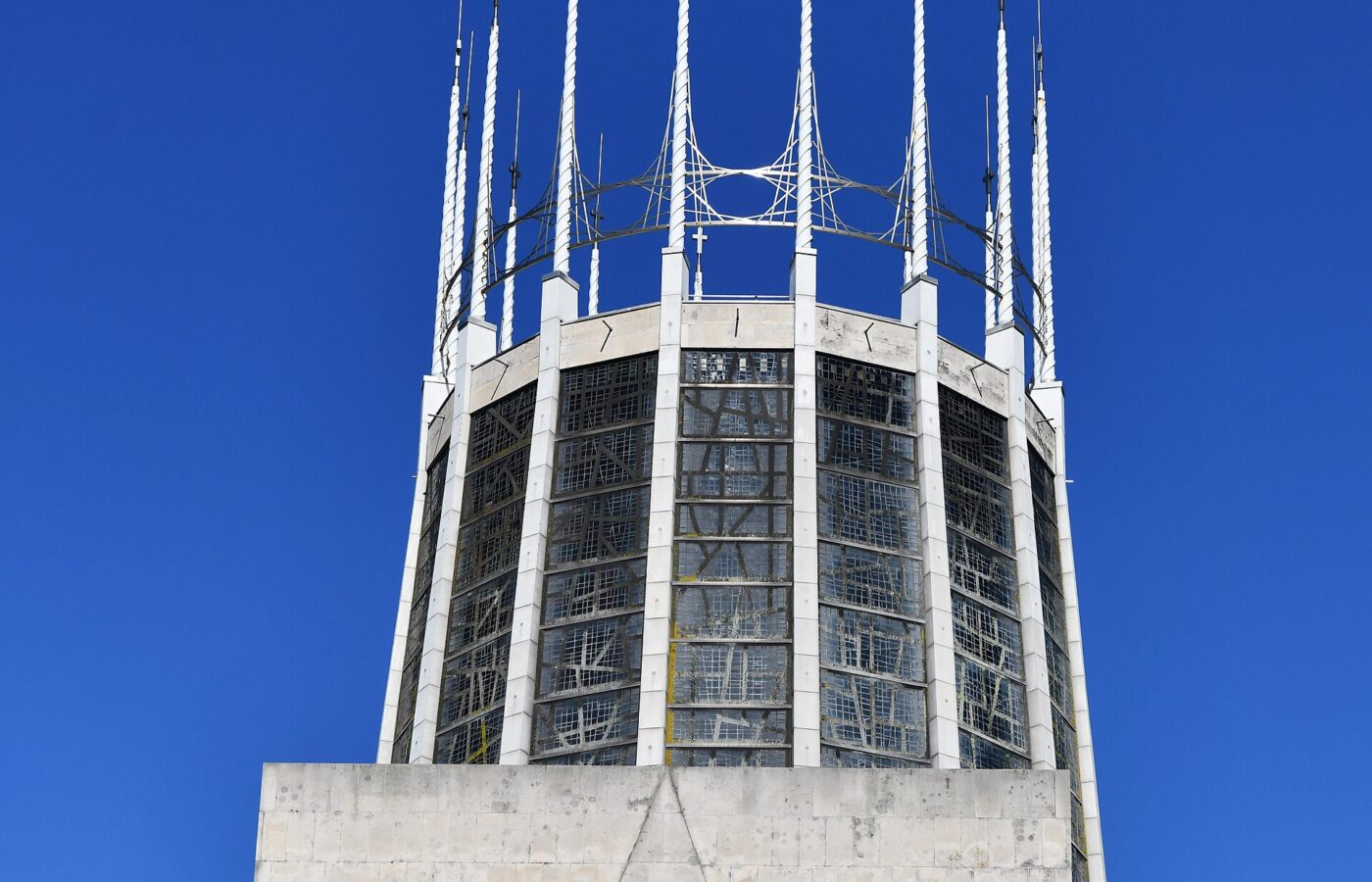
Walk up Mount Pleasant from the city centre and the first thing you see is the crown: a ring of slender pinnacles above a drum of coloured glass, sitting on top of a great tent of concrete and stone. Step inside and the effect reverses. The light that looked grey from the street pours down through the lantern in blue, red and gold, and lands on a white altar at the very centre of a circular church. The Liverpool Metropolitan Cathedral is a strikingly modern landmark, free to enter, open every day, and often overlooked by visitors who make for the Anglican cathedral at the other end of Hope Street and run out of time.
This guide covers the building and its story, what to see inside and below it in the Lutyens Crypt, tours, services and Christmas events, and the practical details: opening hours, prices, access and getting there. Everything was checked in November 2026 against the cathedral’s own pages; hours and events can change for services and special occasions, so check its website before you travel.
Liverpool Metropolitan Cathedral at a Glance
| What | Details (November 2026) |
|---|---|
| Full name | Metropolitan Cathedral of Christ the King |
| Where | Top of Mount Pleasant, at the north end of Hope Street; satnav L3 5TQ |
| Cathedral opening hours | Daily, 7:30am to 6pm |
| Cathedral entry | Free; donations welcomed |
| Lutyens Crypt | Monday to Saturday, 10am to 4pm, last entry 3:30pm; £5 per person, £12 family ticket |
| Guided tour | Free, every Saturday at 11:30am, suggested donation £5; no booking needed |
| Audio tour | £5, from the Welcome Desk, Monday to Saturday, 10am to 3:30pm |
| Access | Step-free via the car park, with lifts to all visitor areas including the crypt |
| Café and shop | Currently closed |
Why It Looks Like That: A Cathedral Built Three Times
The building you see is the third attempt to give Liverpool’s Catholics a cathedral, and the story of the first two explains a good deal about the third.
Pugin’s cathedral and Lutyens’s dream
The first scheme, in the nineteenth century, was designed by Edward Welby Pugin. Only its Lady Chapel was ever completed. The second was far grander. In the 1930s Sir Edwin Lutyens designed a vast cathedral for the site, a building the cathedral itself says would have rivalled St Peter’s in Rome. Its foundation stone was laid on 5 June 1933, and work began on the crypt. Then came the Second World War. Work on the crypt stopped, and after the war the cost of Lutyens’s scheme was out of reach. The crypt is all that was built of it, and it is still there, under your feet, as the Lutyens Crypt.
Gibberd’s competition-winning design
After an intermediate scheme by Adrian Gilbert Scott in the 1950s was also abandoned, the archdiocese held a worldwide competition in 1959. It was won by Sir Frederick Gibberd, with a circular design to be built on top of the Lutyens crypt. Construction began in 1962, and the cathedral was consecrated at Pentecost, on 14 May 1967.
The circular plan was more than a practical choice. It put the altar at the centre of the congregation, so that everyone could see and take part in the Mass, reflecting the changes in Catholic worship of the 1960s. The result is a church with no nave, no long view down an aisle, and the congregation gathers close around the altar.
Paddy’s Wigwam
Liverpudlians have their own name for it: Paddy’s Wigwam, a nickname for its tent-like conical shape. You will hear it used affectionately around the city, and you will see it in guidebooks, but who first coined it is unclear. It is the sort of nickname a city gives to a building it has decided to love.
Grade I listed
In June 2025 Historic England upgraded the cathedral from Grade II* to Grade I, the highest level of listing, putting it alongside the country’s most important historic buildings. The listing notes that it was built between 1962 and 1967 over the Lutyens crypt, and singles out the technique used in the lantern, where pieces of coloured glass are set in concrete ribs with epoxy resin.
Inside the Cathedral
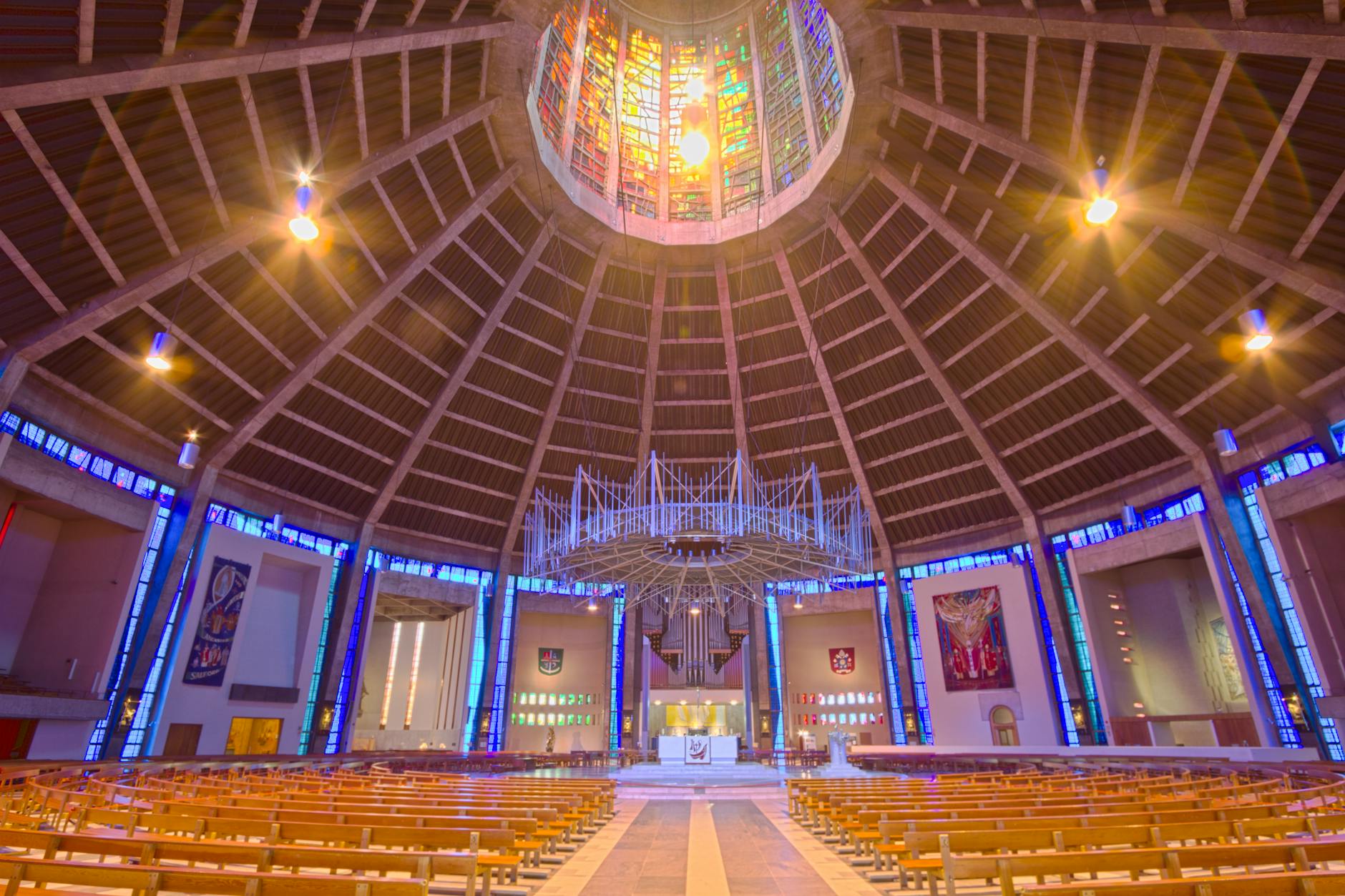
Give yourself a moment just inside the door before you start looking at details. The scale, the colour and the silence are the point, and the building works best if you let it.
The lantern
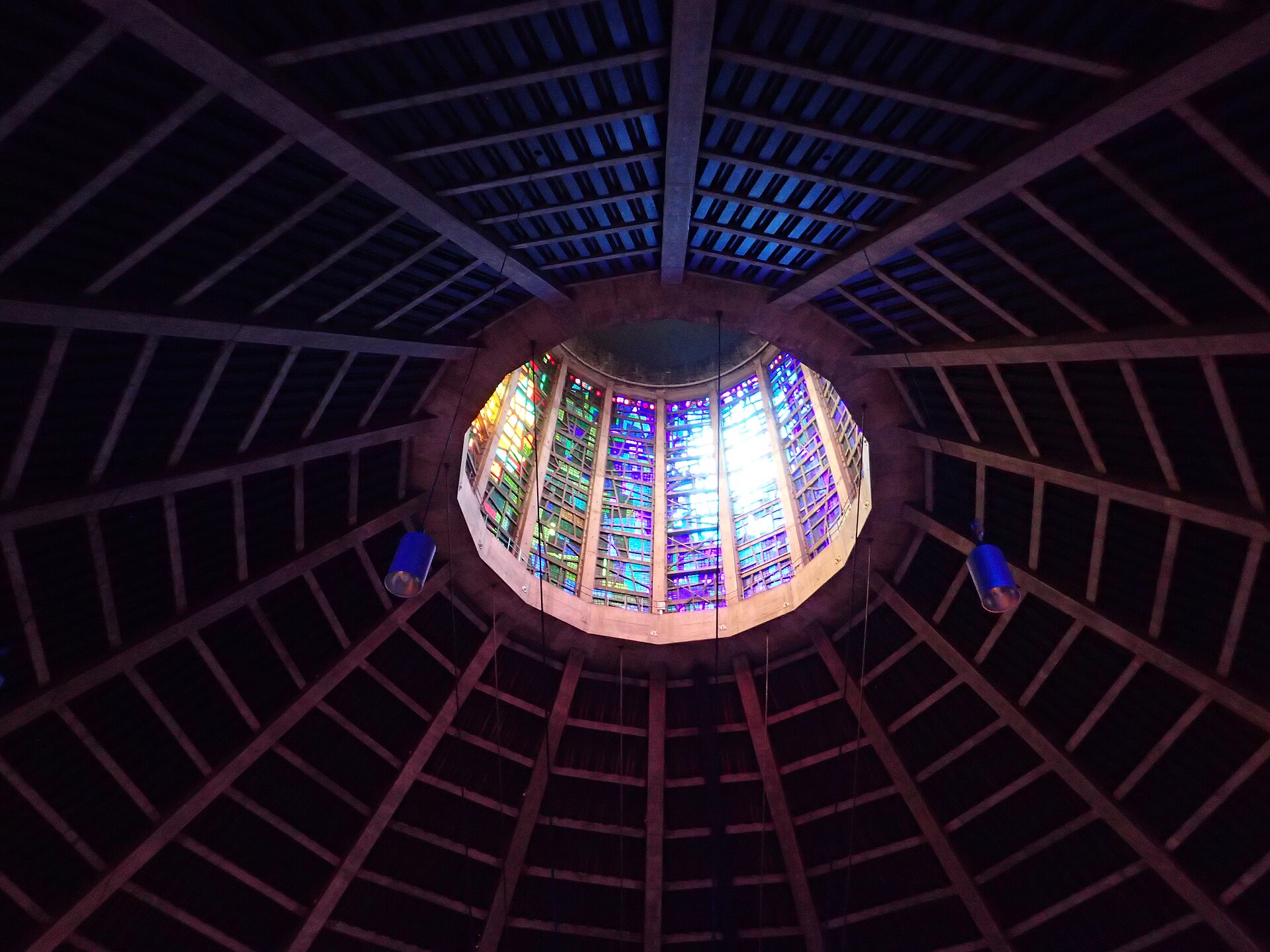
The lantern is the cathedral’s crowning feature, inside and out. Its glass was designed by John Piper and Patrick Reyntiens, and its three colours, red, blue and gold, represent the Blessed Trinity. On a sunny day the light shifts across the floor and walls as the sun moves; on a grey day the colour is subtler but still fills the space. Stand under the centre and look straight up.
The high altar
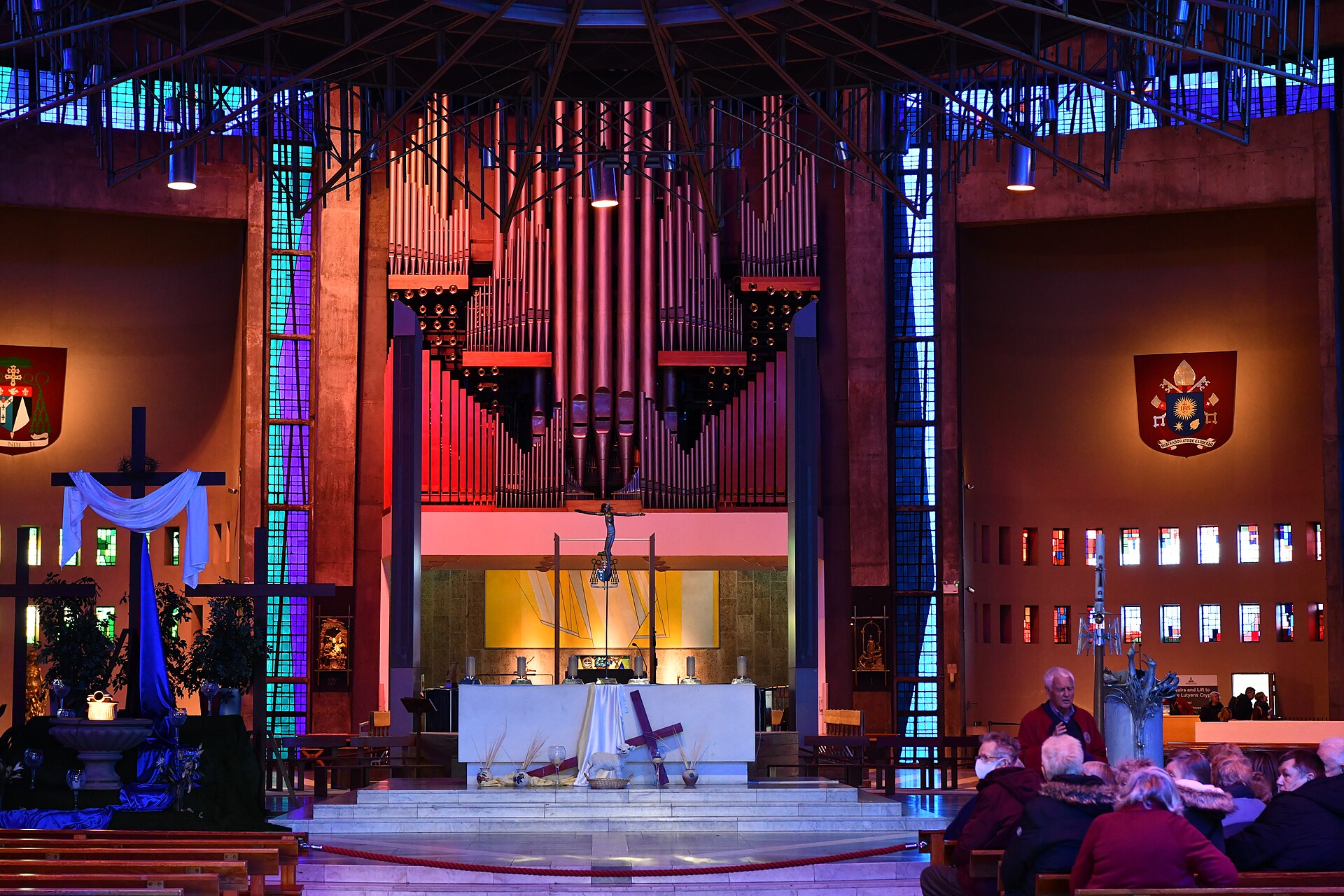
At the centre is the high altar, a single white block raised on steps, with a baldacchino, the canopy, suspended above it. The crucifix on the high altar is by Elisabeth Frink, one of the most celebrated British sculptors of the twentieth century. Walk round it: because the plan is circular, there is no front or back, and the altar looks different from every side.
The chapels
Around the edge of the circle is a ring of chapels, each with its own character and artworks. Highlights include:
- The Blessed Sacrament Chapel: home to a Risen Christ by Arthur Dooley and a reredos painted by Ceri Richards.
- The Chapel of Unity: with a mosaic of Pentecost by George Mayer-Marton.
- The other chapels, which hold a mix of sculpture, painting and glass. Take a slow lap; the chapels are where the cathedral’s smaller, quieter treasures are.
The free Explore with Eva family trail is a good way to get children looking at the details rather than just the scale.
The bell tower and doors
The wedge-shaped bell tower stands above the main doors, about 80 feet high, and holds four bells named Matthew, Mark, Luke and John. The bronze main doors below it are by William Mitchell. The cathedral’s tours and visitor information don’t include a tower climb; the tower is to be seen from outside.
The Lutyens Crypt
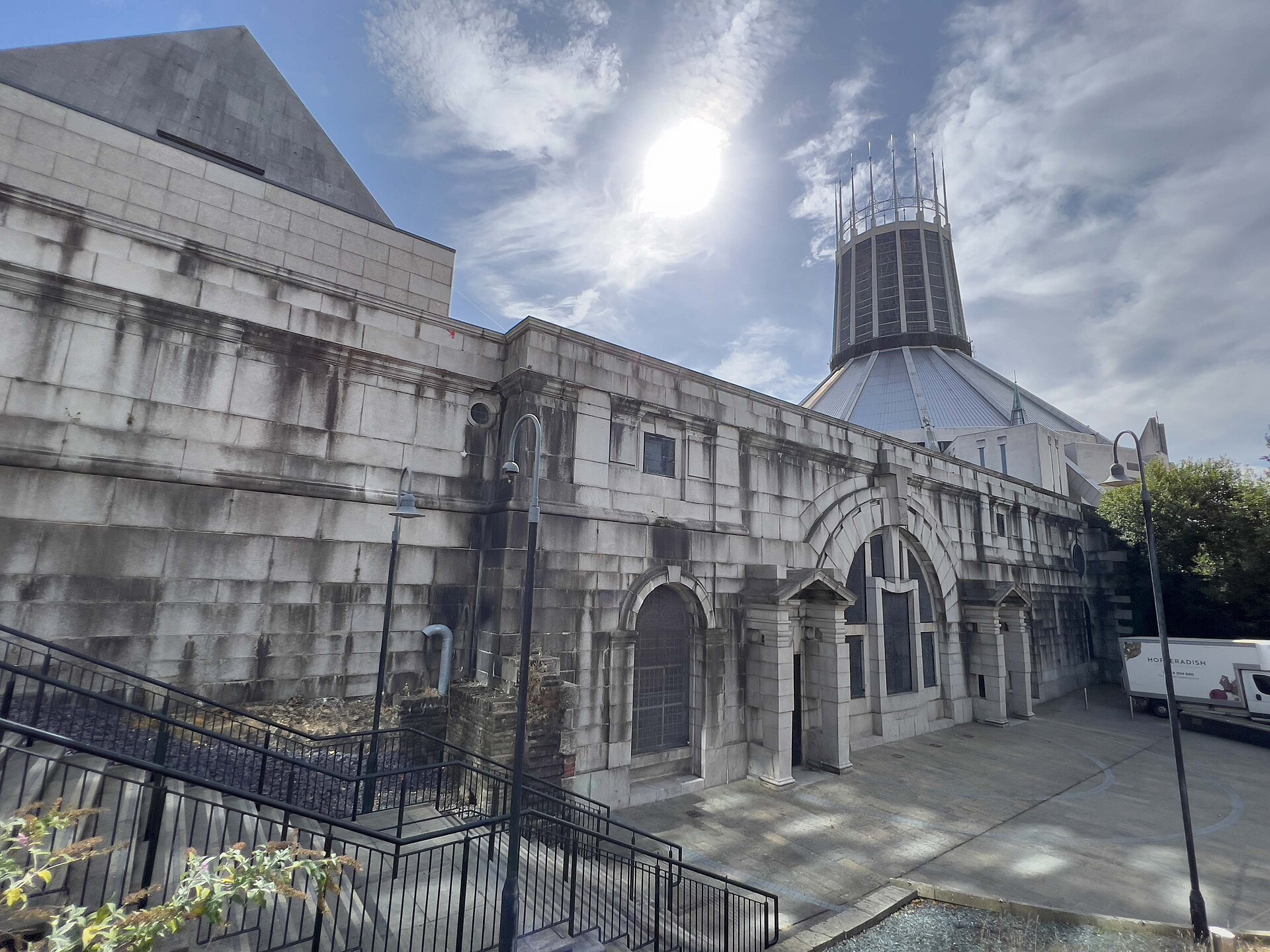
Below the cathedral is the part of a visit many people miss: the Lutyens Crypt, the only completed piece of the cathedral Sir Edwin Lutyens designed in the 1930s. Where the cathedral above is open and full of colour, the crypt is a world of massive brick vaults and stone, built on the scale of the colossal church it was meant to support. Walking through it gives you a sense of just how enormous Lutyens’s building would have been.
- Opening hours: Monday to Saturday, 10am to 4pm, last entry 3:30pm. It is closed on Sundays.
- Price: £5 per person, or £12 for a family ticket.
- The Treasury: inside the crypt, with the cathedral’s collection of precious objects. Photography is not allowed in the Treasury.
- Access: lifts reach the crypt level; the lift is in the Rotunda, to the right of the Blessed Sacrament Chapel. There is an accessible toilet at crypt level.
Is it worth the £5? Yes. The cathedral above is free and is the reason most people come, but the crypt is the half of the story that most visitors miss, and it is a very different space from the cathedral above.
A Suggested Route Round the Cathedral
If you are visiting on your own, this order makes the most of an hour and a half.
- Arrive from Hope Street. The main approach is up the wide steps from Hope Street, which gives you the full view of the bell tower, the bronze doors and the crown above. Coming up from the car park is step-free but less dramatic.
- Stop just inside. Take in the circle, the colour and the lantern before you look at anything in detail.
- Walk to the centre. Stand by the high altar, look up into the lantern, and notice the Frink crucifix and the suspended canopy.
- Take a slow lap of the chapels. Go round the edge of the circle, and spend time in the Blessed Sacrament Chapel and the Chapel of Unity.
- Go down to the crypt. The lift is in the Rotunda, to the right of the Blessed Sacrament Chapel. Allow time for the brick vaults and the Treasury, and remember the crypt is open Monday to Saturday only.
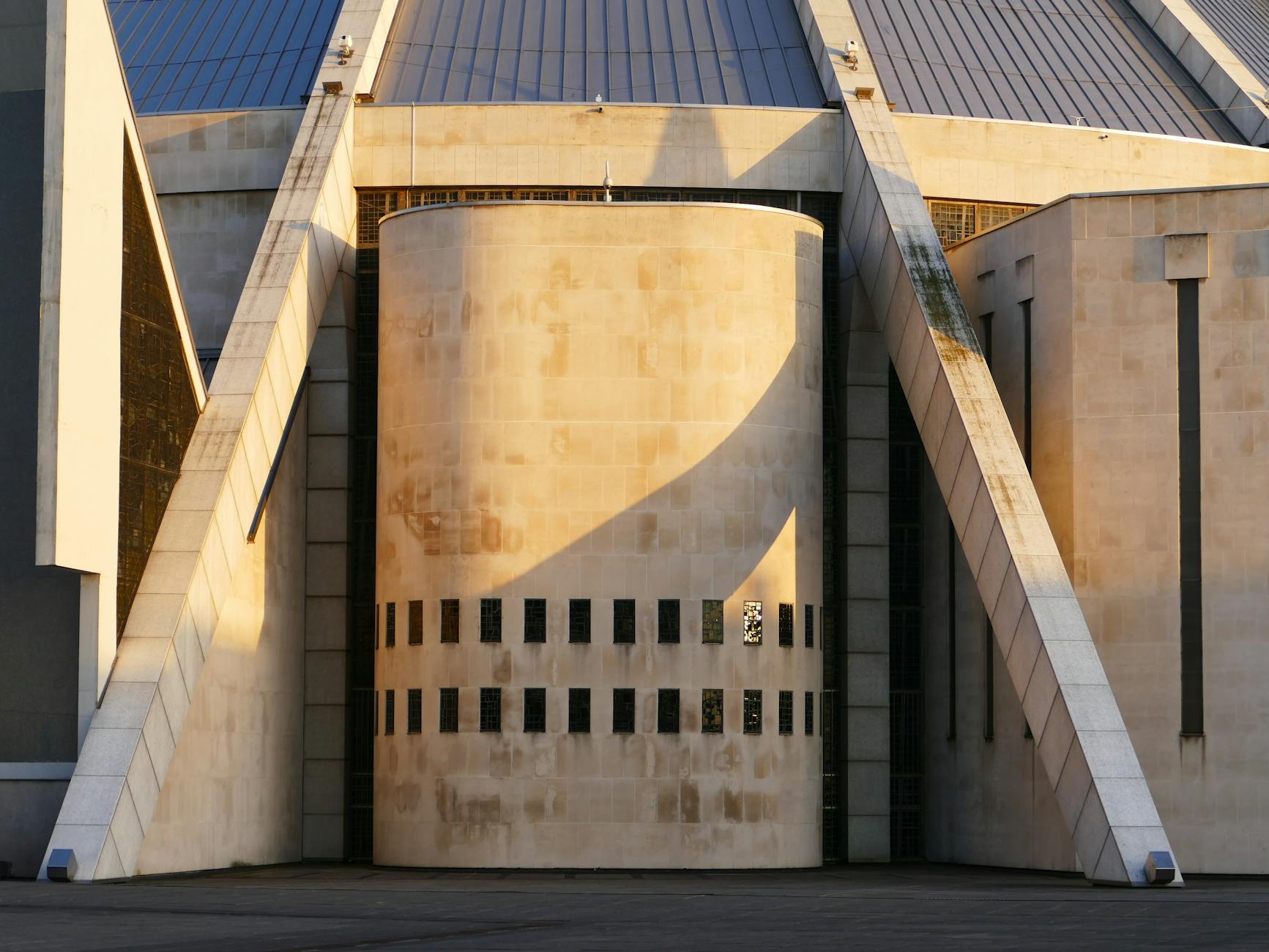
- Finish outside. Walk round the outside of the building to see the buttresses and the chapels from the street, then head south down Hope Street towards the Anglican cathedral.
Visiting with Children
The cathedral is an easier visit with children than its size suggests. Entry is free, so there is no pressure to stay long, and the colour of the lantern tends to impress even children who are not interested in buildings. The free Explore with Eva trail gives them something to look for in the chapels. The crypt’s family ticket is £12. Keep voices down during services, and check the services list so you do not arrive in the middle of a Mass. For more ideas, see our guide to Liverpool with kids.
Tours
- Free guided tour: every Saturday at 11:30am, with a suggested donation of £5 per person. No booking is needed. There are no tours between 24 December and 1 January inclusive.
- Audio tour: £5, available from the Welcome Desk, Monday to Saturday, 10am to 3:30pm. It comes in English, French, Italian, Spanish, Polish and Chinese, and is not available during services.
- Families: the free Explore with Eva trail.
If you can, time a visit for the Saturday tour. The building is easy enough to enjoy on your own, but a guide brings out the stories behind the artworks and the three cathedrals that never were.
Services and Mass Times
The Metropolitan Cathedral is a working cathedral first and a visitor attraction second. Visitors are welcome at services, and attending one is a good way to see the building as it was designed to be used. The regular schedule is below; check the services page for changes, especially around Christmas.
- Weekdays: Morning Prayer 7:45am; Mass 8am; Mass at 12:15pm in the Crypt Chapel.
- Saturday: Mass 9am; Reconciliation 9:30am and 3:30pm; Vigil Mass 5pm.
- Sunday: Mass 9am; Mass at 10am in the Crypt Chapel; Solemn Mass 11am, which is also livestreamed; Choral Evening Prayer 3pm in term time; Mass at 7pm in the Crypt Chapel.
If you are visiting to look round, avoid the main service times, especially the Sunday 11am Solemn Mass, and remember that photography is not allowed during services, concerts or rehearsals.
Christmas and Winter Events in 2026
The cathedral’s events calendar fills up from late November. Events listed for 2026 include:
- Advent Sequence: Sunday 29 November, 5pm to 6pm.
- NSPCC Carols by Candlelight: Tuesday 1 December, 6:45pm to 8:30pm.
- Light up a Life: Thursday 3 December.
- Bach and Handel: Sunday 6 December, 3pm.
- A Celebration of Christmas concert: Saturday 12 December, 7pm to 9pm, ticketed through an external site.
- Festival Carol Service: Sunday 20 December, 5pm.
- Christmas Eve: Thursday 24 December.
For Christmas Eve and Christmas Day service times, and for anything later in the season, check the cathedral’s services and events pages. Our guide to Christmas in Liverpool covers the rest of the city’s festive calendar.
Practical Information
Opening hours and prices
The cathedral is open every day from 7:30am to 6pm, and entry is free, with donations welcomed. The Lutyens Crypt is open Monday to Saturday, 10am to 4pm (last entry 3:30pm), and costs £5, or £12 for a family. The cathedral’s visit page lists any planned closures, such as organ tuning days or special services, so check it before you go.
How long to allow
Allow about 45 minutes to an hour for the cathedral itself, and another 30 to 45 minutes for the crypt and Treasury. If you are joining the Saturday tour or attending a service, plan for longer.
Accessibility
- Step-free access via the cathedral car park, with lifts to all visitor areas, including the crypt.
- Accessible toilets on the Lower Porch level and at crypt level.
- Wheelchairs available to borrow from the Security Office in the car park.
- A hearing loop in the cathedral and in the Crypt Chapel.
- There is no Changing Places toilet on site.
See our wheelchair-accessible Liverpool guide for other step-free attractions.
Photography and rules
- Photography is welcome, except during services, concerts and rehearsals, and in the Crypt Treasury.
- Video cameras and drones are not allowed.
- Only assistance dogs are allowed inside.
Food and facilities
The cathedral’s café and gift shop are currently closed. Plan to eat before or after your visit; the streets around Hope Street and the Georgian Quarter have plenty of options. A new Welcome Centre is being planned, with Buttress Architects appointed in April 2025, so facilities may change in future.
Getting There
- On foot: the cathedral is at the top of Mount Pleasant. It estimates a 10-minute walk from the city centre, past the Adelphi Hotel, and about 10 minutes from Lime Street station; follow the signs for the universities and cathedrals. The walk is uphill.
- By train: Lime Street is the nearest main station; the cathedral notes that Liverpool Central on Merseyrail is also nearby.
- By bus: the cathedral lists buses 79, 86, 86A and 86C from Liverpool ONE, and the 79 and 7 from Queen Square. The City Sightseeing and City Explorer tour buses also stop there.
- By car: the cathedral’s car park charges £2 for an hour, £5 for up to three hours and £8 for the day (8am to 6pm), with £6 evening parking for cathedral functions. The height limit is 7ft 6in, and there is no overnight parking.
Combining It with Hope Street and the Anglican Cathedral
Hope Street runs south from the Metropolitan Cathedral to the Anglican cathedral, Liverpool’s other great church, and walking between the two is one of the best short walks in the city. Along the way you pass the Philharmonic Hall, the Everyman Theatre and the Georgian terraces of the Georgian Quarter. Seeing both cathedrals in a morning is easy, and the contrast between them, one a vast Gothic sandstone church and the other a modernist circle of glass and concrete, is the point.
Our Liverpool Cathedral guide covers the Anglican cathedral and its tower, and our guide to the Georgian Quarter covers the streets between them. For an evening, see what is on at the Philharmonic Hall or the Everyman.
Is It Worth Visiting?
Yes, without hesitation, and it costs nothing to find out. The Metropolitan Cathedral is one of the few buildings in Liverpool that genuinely surprises first-time visitors: people who expect a dated 1960s concrete church walk into a space full of colour and light. The crypt adds a second, completely different experience underneath for £5. If you are interested in architecture, it is essential; if you are not, the lantern alone is worth the walk up the hill.
The honest caveats: the café and shop are closed, so do not plan on lunch there; the crypt is closed on Sundays; and if you arrive during a service, you will need to wait or come back to look round. Check the visit page for closures before you set out.
Frequently Asked Questions
Is the Liverpool Metropolitan Cathedral free?
Yes. Entry to the cathedral is free, with donations welcomed. The Lutyens Crypt costs £5 per person or £12 for a family ticket (November 2026).
What are the opening hours?
The cathedral is open daily from 7:30am to 6pm. The Lutyens Crypt is open Monday to Saturday, 10am to 4pm, with last entry at 3:30pm. Check the cathedral’s visit page for any closures.
Why is it called Paddy’s Wigwam?
It is a local nickname for the cathedral’s tent-like conical shape. It is used affectionately across the city, but who first coined it is unclear.
Is it the largest Catholic cathedral in England?
The cathedral describes itself as England’s largest Catholic cathedral.
When was it built?
Construction began in 1962 and the cathedral was consecrated at Pentecost, on 14 May 1967. It stands on top of the crypt of an earlier, unfinished cathedral designed by Sir Edwin Lutyens, whose foundation stone was laid in 1933.
What is in the Lutyens Crypt?
The brick-vaulted crypt is the only completed part of Lutyens’s 1930s cathedral. It also houses the Treasury, where the cathedral’s precious objects are displayed. Photography is not allowed in the Treasury.
Can you go up the tower?
The Metropolitan Cathedral’s tours and visitor information don’t include a tower climb. For a cathedral tower with a view, the Anglican cathedral at the other end of Hope Street offers its own tower experience.
Are there guided tours?
Yes. A free guided tour runs every Saturday at 11:30am, with a suggested donation of £5, and no booking needed. A £5 audio tour is available from the Welcome Desk, Monday to Saturday.
Related Liverpool Guides
- Liverpool Museums and Galleries
- Liverpool Architecture Guide
- Free Things to Do in Liverpool
- Liverpool’s Irish Heritage
- Self-Guided Walking Tour of Liverpool
- Rainy Day Activities in Liverpool
Photo Credits
Cathedral crown and bell tower (featured image): Liverpool, Metropolitan Cathedral of Christ the King, The tower – geograph.org.uk – 7768090 by Michael Garlick, CC BY-SA 2.0, via Wikimedia Commons.
The lantern from below: Inside the lantern of the Metropolitan Cathedral of Christ the King – geograph.org.uk – 8141488 by Marathon, CC BY-SA 2.0, via Wikimedia Commons.
The high altar: Liverpool, Metropolitan Cathedral of Christ the King, Interior 4 – geograph.org.uk – 7955241 by Michael Garlick, CC BY-SA 2.0, via Wikimedia Commons.
The Lutyens Crypt: Completed part of Sir Edwin Lutyens design of 1933 by Talsarnau Times, CC BY 4.0, via Wikimedia Commons.