This article contains advertising. Our booking links are routed through a partner that adds commission tracking automatically, so if you book through one we earn a commission from the provider, at no extra cost to you. It never affects what we recommend. Affiliate disclosure
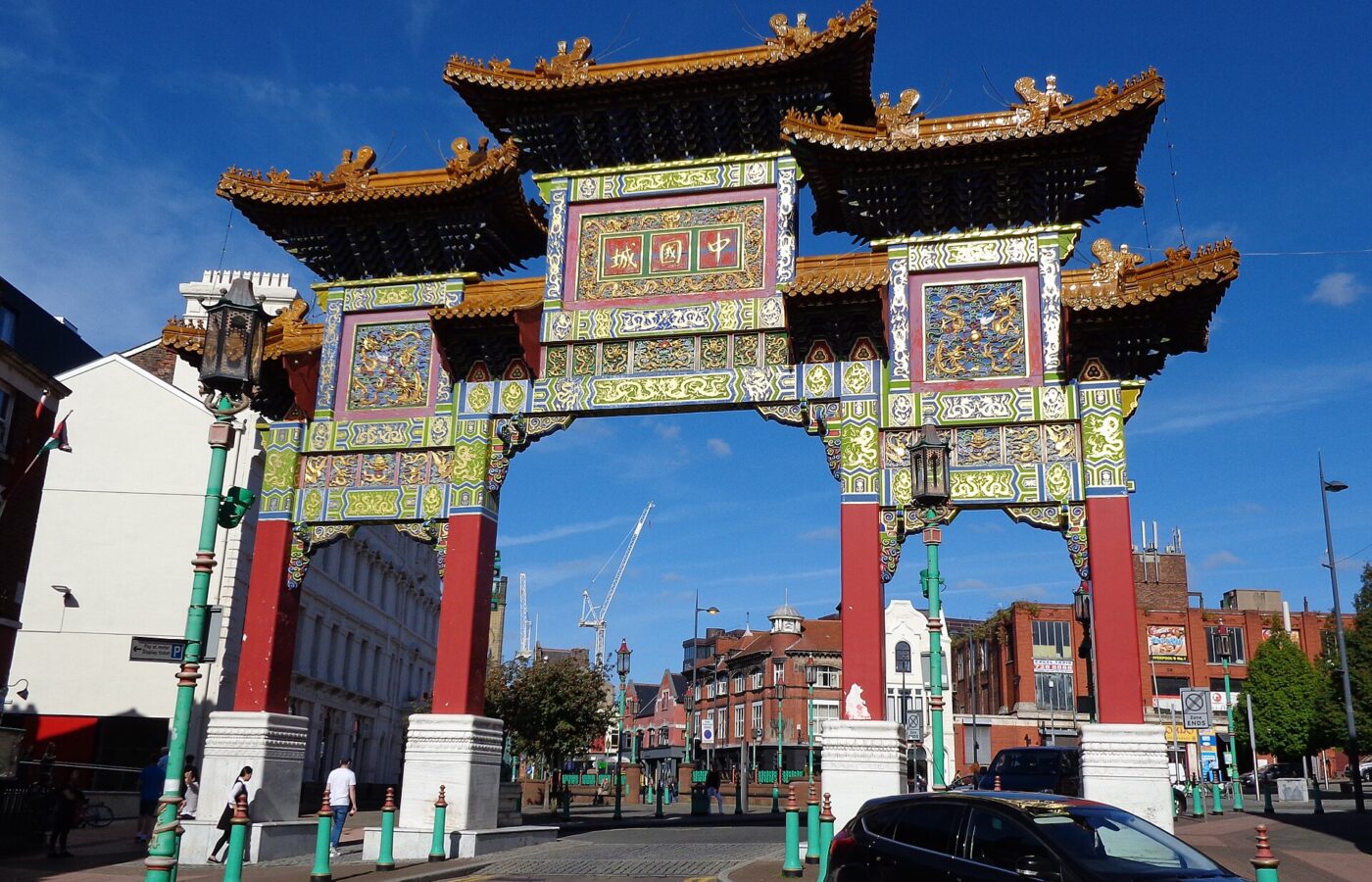
Stand under the arch at the top of Nelson Street and look up. The carving is dense enough to lose track of: gold dragons chase each other across green and red panels, 200 of them in all, and on the central panel three characters, read right to left, spell out “Chinatown”. It was made in Shanghai and put up in 2000, which makes it a newcomer. The community it marks is anything but: Liverpool Chinatown is home to the oldest Chinese community in Europe, founded by seamen who came off Liverpool ships in the 1800s and stayed.
This guide covers the history, from the first Chinese sailors to the men who were sent away after the Second World War, the arch and the streets around it, where to eat in Chinatown itself and in the newer Chinese food quarter up the hill, Chinese New Year, and how to fit it all into a walk. Restaurant details and dates were checked in September 2026. Restaurants come and go, so check before you make a special journey.
Liverpool Chinatown at a Glance
| What | Detail (checked September 2026) |
|---|---|
| Where | Nelson Street, Great George Square, Duke Street and Berry Street, between the Ropewalks and the Anglican cathedral |
| How old | Europe’s oldest Chinese community. Chinese seamen were settling here by the 1880s |
| The arch | Opened at Chinese New Year 2000. Made in Shanghai, 13.5 m (44 ft) high, with 200 carved dragons. The tallest Chinatown arch in Europe |
| Best for | The arch, the history, Cantonese roast meats and noodle soups, and Chinese New Year |
| Newer Chinese food | Myrtle Street, Mount Pleasant and London Road, near the universities, for Sichuan, Chongqing and Shanghainese cooking and hot pot |
| Chinese New Year 2027 | Saturday 6 February, Year of the Goat. The celebrations are usually on the nearest weekend |
| Time needed | 30–60 minutes for a look round, longer with a meal |
| Getting there | About 10 minutes’ walk from Liverpool Central or Liverpool ONE |
| Cost | Free to wander |
How Europe’s Oldest Chinatown Began
Liverpool’s Chinese story starts with ships. The first vessel to sail direct from China docked here in 1834, but the real connection came in the 1860s, when Alfred Holt’s Blue Funnel Line began running steamships between Liverpool, Shanghai and Hong Kong. Holt’s ships employed large numbers of Chinese seamen, and Liverpool became their home port in Britain.
Some of those sailors stayed. By the 1880s there was a settled community near the docks, and from the 1890s Chinese Liverpudlians were opening boarding houses for seamen, laundries and shops. Many married local women, and Liverpool families with Chinese surnames and Scouse accents go back several generations.
That first Chinatown stood in the docklands, around Pitt Street and Cleveland Square. It didn’t survive the Second World War. The dock area was bombed heavily, and the community rebuilt a little inland, around Nelson Street, just west of where the Anglican cathedral was rising. Our Liverpool in the Second World War guide covers the Blitz that reshaped this part of the city, and the maritime history guide tells the story of the port that brought everyone here.
Liverpool’s port made it one of Britain’s first truly international cities. The Chinese community sits alongside the Irish, Welsh, Scandinavian, West African and Caribbean communities who arrived the same way. For the largest of those migrations, see our Irish heritage guide.
Chinese Liverpool: a timeline
| When | What happened |
|---|---|
| 1834 | The first ship to sail direct from China docks in Liverpool |
| 1860s | Alfred Holt’s Blue Funnel Line links Liverpool with Shanghai and Hong Kong, employing large numbers of Chinese seamen |
| 1880s–1890s | A settled community forms near the docks, around Pitt Street and Cleveland Square, with boarding houses, laundries and shops |
| 1939–1945 | Up to 20,000 Chinese merchant seamen are based in the city. Bombing destroys much of the first Chinatown |
| 1942 | Chinese seamen strike for four months for equal pay |
| Late 1940s | Hundreds of seamen are forced to leave Britain, many leaving Liverpool families behind |
| 1950s–1970s | Migrants from Hong Kong arrive, and Chinese takeaways spread across Merseyside |
| 1999 | Liverpool twins with Shanghai |
| 2000 | The Chinatown arch opens on Nelson Street at Chinese New Year |
| 2006 | The memorial to Chinese merchant seamen is unveiled at the Pier Head |
| 2020s | A new Chinese food quarter grows up around Myrtle Street, Mount Pleasant and London Road |
The Seamen Who Were Sent Away
There’s a harder chapter to this history, and Liverpool has only recently started to talk about it openly.
At the start of the Second World War, up to 20,000 Chinese merchant seamen were based in the city, crewing the ships that kept Britain supplied. They were paid less than their British crewmates, and in 1942 they went on strike for four months for equal pay and conditions. After the war, their pay was cut by two-thirds and they were offered only one-way passage back to China. Hundreds were effectively forced out of the country, leaving behind wives and children in Liverpool. Many of those families were never told what had happened. Children grew up believing their fathers had simply abandoned them.
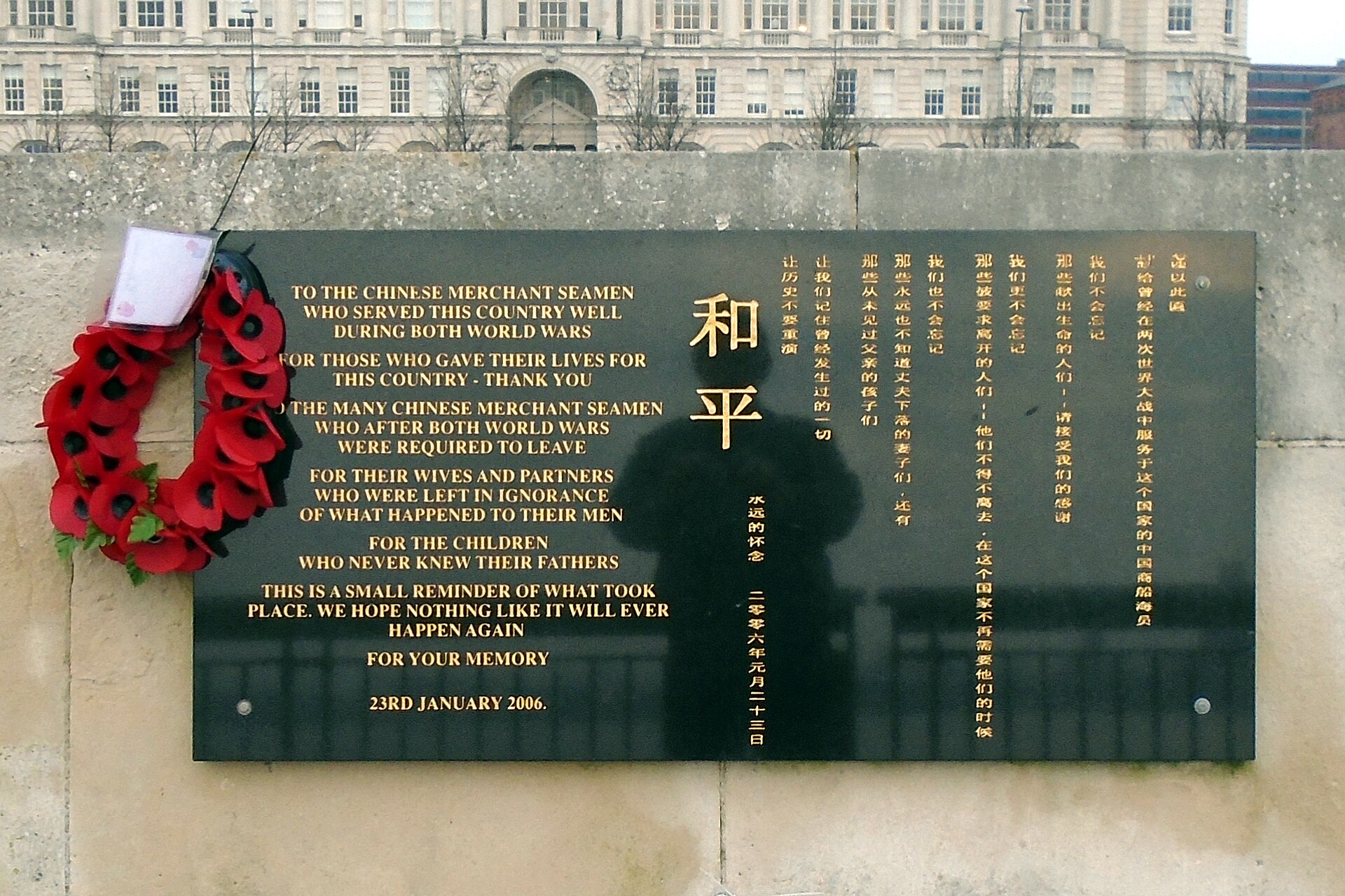
On 23 January 2006, a memorial plaque was unveiled on the river wall at the Pier Head, in English and Chinese. It thanks the Chinese seamen who served in both world wars and remembers those who were made to leave afterwards. It also remembers the wives and partners who were “left in ignorance of what happened to their men”. It’s on the river wall right in front of the Three Graces, and it’s worth finding before or after a visit to Chinatown. Our waterfront guide covers the Pier Head’s other memorials.
The Arch
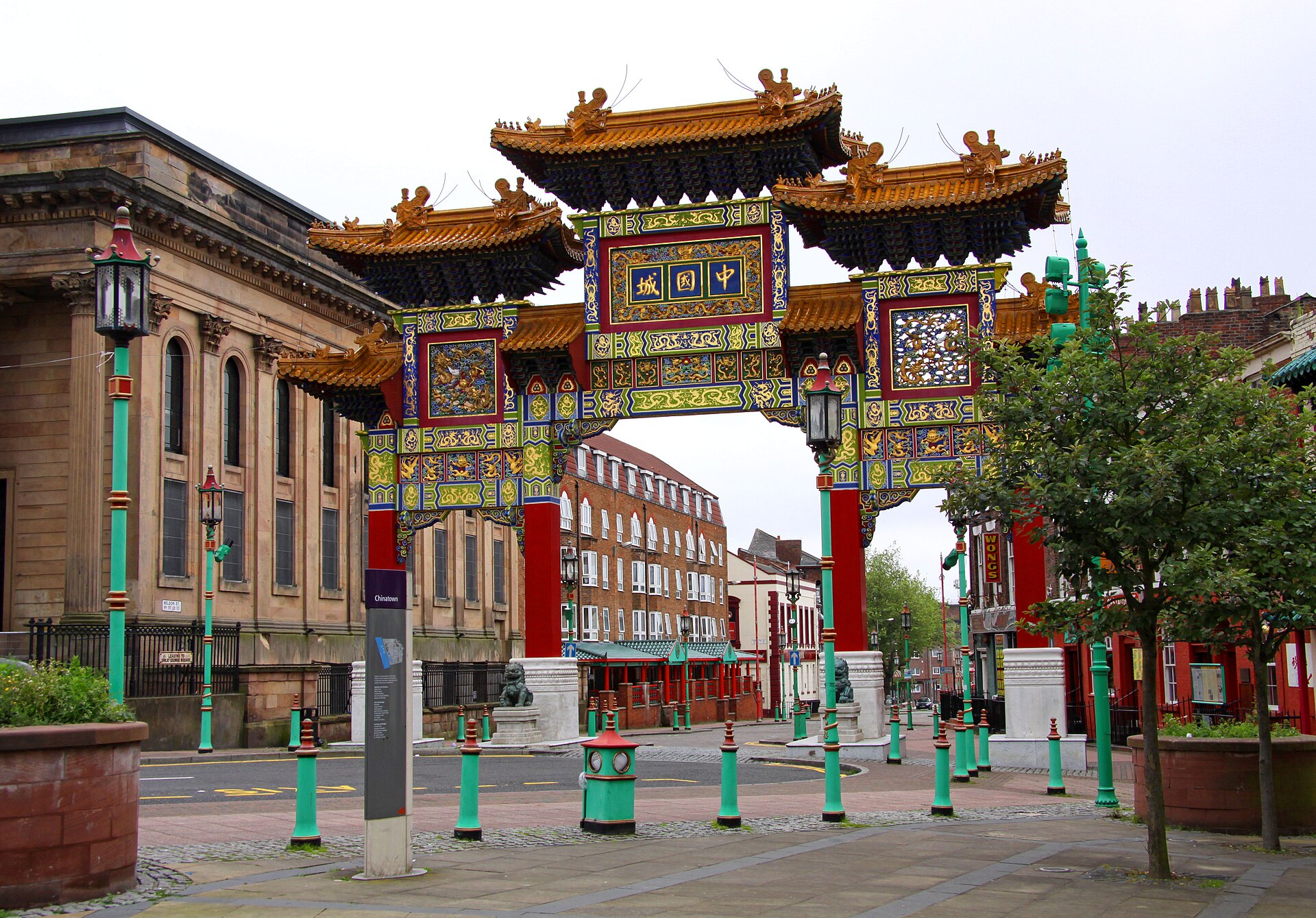
The arch is the obvious place to start, and it rewards more than a quick photo.
- Where it came from: it was made in Shanghai, Liverpool’s twin city, shipped over in pieces and assembled in Liverpool. It opened at Chinese New Year in 2000 and cost around £700,000.
- How big it is: 13.5 metres (44 feet) high. It’s the tallest Chinatown arch in Europe, and one of the tallest outside mainland China.
- The dragons: 200 of them, hand-carved. Look closely and you’ll find that 12 of them are pregnant.
- The guardian lions: a stone pair sits at the base, a traditional guard at a Chinese gateway.
- At night: a lighting scheme added in 2010 lights the arch up after dark, and it’s at its most striking on a winter evening.
For the classic photograph, stand on the Great George Street side and shoot up through the arch towards Nelson Street, ideally on a bright day when the colours stand out against a blue sky. Traffic runs through the arch, so keep your eye on the road rather than your screen.
Around the Arch: What Else to See
Chinatown itself is small, just a few streets, but it sits in one of the most interesting corners of the city.
- Nelson Street is the heart of it, with Chinese restaurants, supermarkets, community associations and red lanterns strung between the buildings.
- The Blackie, the huge domed building beside the arch, is the former Great George Street Congregational Church, completed in the 1840s. It was nicknamed for the soot that blackened its sandstone, and it was home for decades to a pioneering community arts centre.
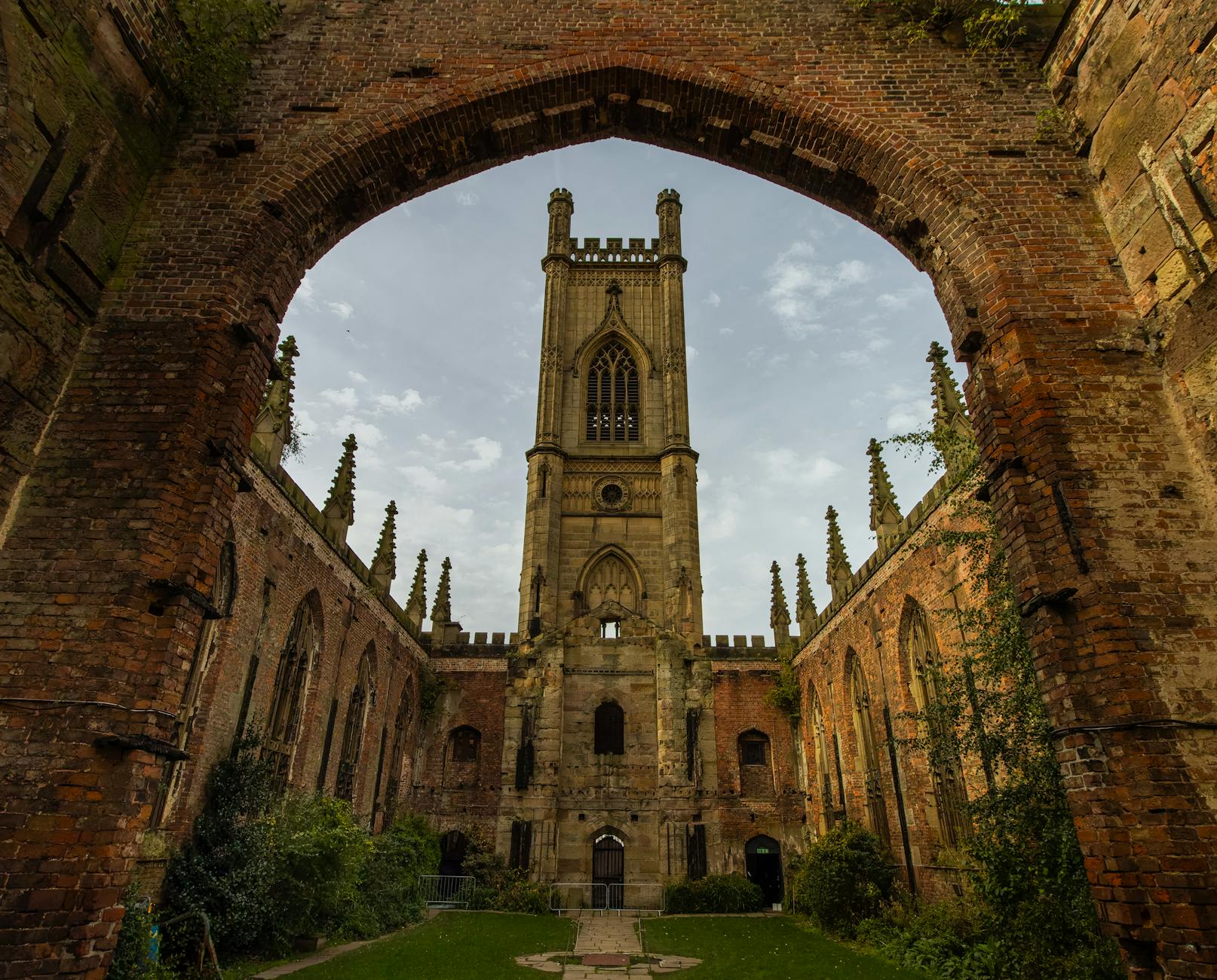
- St Luke’s, the “Bombed Out Church”, is five minutes away at the top of Bold Street. Built in 1832 and gutted by an incendiary bomb in the May Blitz of 1941, it was left as a roofless memorial. Its grounds now host events and markets.
- Liverpool Cathedral, the largest in Britain, looms at the top of Upper Duke Street, a few minutes uphill. Our Liverpool Cathedral guide covers the tower climb.
Chinatown sits where three of the city’s best neighbourhoods meet. To the north are Bold Street and the Ropewalks, to the east the Georgian Quarter, and to the south-west the bars and street food of the Baltic Triangle. Our Liverpool neighbourhoods guide shows how they fit together.
Where to Eat in Chinatown
An honest word first: Liverpool’s Chinatown has fewer restaurants than its fame suggests, and many of the best new Chinese restaurants in the city have opened elsewhere (see the next section). What Chinatown does best is Cantonese cooking: roast meats, noodle soups, and the family restaurants that have fed the community for decades.
- North Garden, Nelson Street. A family-run Cantonese restaurant much loved by locals. Order the smoky fried vermicelli noodles and the half roast duck. North Garden also runs a street-food stall at Blackstock Market in the city centre.
- New Capital, at the Nelson Street end of Chinatown. Open for more than forty years and still a favourite of Liverpool’s Chinese community, which is always a good sign. The portions are generous. Try the king prawn noodle soup or the char siu with crispy pork in black bean sauce.
- Chung Wah, a big Chinese supermarket, is the place to stock up on noodles, sauces, snacks, fresh fish and vegetables, and freshly made spring rolls and wontons to take home.
What to order: a quick Cantonese primer
- Roast meats (siu mei): crispy roast duck, sticky-glazed barbecue pork (char siu) and roast pork belly with crackling skin (siu yuk). Order a plate of mixed roast meats over rice for a cheap, filling lunch.
- Noodle soups: wonton noodle soup, or king prawn noodle soup, in a clear, savoury broth.
- Dim sum: steamed prawn dumplings (har gow), pork and prawn dumplings (siu mai), rice-noodle rolls (cheung fun) and barbecue pork buns (char siu bao), traditionally eaten at lunchtime with tea.
- Fried noodles and vermicelli: the test of a good Cantonese kitchen is the smoky “wok hei” flavour that only a very hot wok can give.
A few tips: lunchtime is the best time for roast meats, before the best cuts sell out. Go in a group, because Cantonese food is made for sharing. And if you’re unsure what to order, look at what the Chinese families at the next table are eating.
The New Chinese Food Quarter: Myrtle Street, Mount Pleasant and London Road
Over the last decade, a second Chinese food quarter has grown up about fifteen minutes’ walk uphill from the arch, around the universities. Liverpool has thousands of Chinese students, and restaurants have followed them, serving the regional cooking of Sichuan, Chongqing, Shanghai and the north rather than the Cantonese dishes of the old Hong Kong migration. Food writers, including Vittles, now send people here for regional Chinese cooking.
- eJoy Asian Supermarket, 1 Myrtle Parade (L7 7EL). Half supermarket, half food court, cooking Cantonese, Shanghainese and Sichuan food. The dim sum counter does some of the crispiest roast pork belly (siu yuk) in the city, alongside xiao long bao and handmade dumplings for about £8 a portion (checked September 2026). WeChat payment is accepted.
- No.1 Chongqing Fish and Original Chicken, 109 Mount Pleasant (L3 5TF). Fiery Sichuan and Chongqing cooking: Guilin noodles, yellow braised chicken, Chongqing fish hot pot and maocai, a solo hot pot for under £10.
- London Road has a cluster of hot pot restaurants, which are best with a group and a big appetite.
Our verdict: go to Chinatown for the arch, the history and Cantonese classics, and head uphill if you want regional Chinese food at its best. Both are cheap by UK standards. Our cheap eats guide and best restaurants guide cover the rest of the city.
Chinese Liverpool Beyond Chinatown
Chinatown is the symbol, but the community’s influence runs right across the city and its surroundings.
- The takeaway. After the war, migrants from Hong Kong opened Chinese takeaways across Merseyside, and the “Chinese chippy” became part of everyday Liverpool life. Many locals first met salt and pepper chips in one of them. They’re now a staple across the North, and Scousers will argue at length about where to get the best.
- The universities. Liverpool has thousands of Chinese students, and the University of Liverpool co-founded Xi’an Jiaotong-Liverpool University in Suzhou in 2006. That student population is behind the new food quarter up the hill.
- The twin city. Liverpool has been twinned with Shanghai since 1999, which is how the city came to get its arch.
- The families. Several generations of Chinese Liverpudlians, many with roots in the seamen’s marriages of the early 1900s, are part of the city’s fabric. Their story is one of the reasons Liverpool’s history is so different from that of other British cities.
Chinese New Year in Liverpool
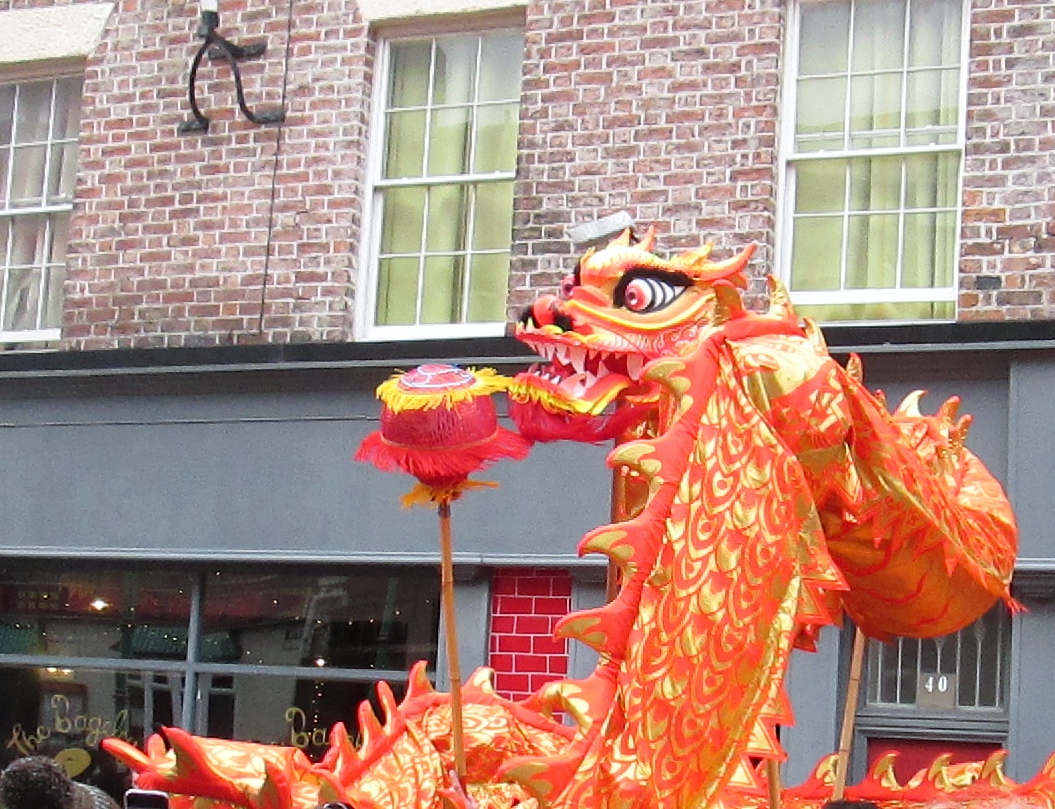
Chinese New Year is the best day of the year to visit, as long as you don’t mind crowds. Nelson Street fills with lion and dragon dances, drums, firecrackers and food stalls, and the celebrations draw big crowds every year.
- When: Chinese New Year 2027 falls on Saturday 6 February, the start of the Year of the Goat. Liverpool’s main celebrations are usually held on the nearest weekend. The programme is announced in the weeks before, so check the city’s events listings in January.
- Arrive early. The best spots near the arch fill quickly, and the narrow streets get very busy by early afternoon.
- With children: it’s a wonderful day out for families, but the firecrackers are very loud. Bring ear defenders for small children and anyone sensitive to noise.
- Eat before or after, not during. Restaurants on Nelson Street are packed on the day. Book, go early, or eat uphill on Myrtle Street.
Our Liverpool events and festivals guide has the rest of the year’s calendar.
A Short Walk: St Luke’s to the Cathedral via Chinatown
This makes an easy hour, or a whole afternoon with lunch and the cathedral tower.
- Start at St Luke’s, at the top of Bold Street, and walk round the outside of the bombed-out church.
- Walk down Berry Street into Great George Street. The arch stands at the junction with Nelson Street, beside the domed Blackie.
- Go through the arch and along Nelson Street for the restaurants, lanterns and supermarkets. Stop for lunch.
- Loop round Great George Square and back towards the Blackie.
- Climb Upper Duke Street to Liverpool Cathedral, a few minutes uphill, for the vast nave and, if you have energy left, the tower.
- Finish in the Georgian Quarter, along Rodney Street or Hope Street.
For more walking routes, see our self-guided walking tour.
Getting There
- From Liverpool Central (Merseyrail): about 10 minutes, up Bold Street, past St Luke’s and down Berry Street.
- From Liverpool ONE: about 10 minutes, heading east along Duke Street or Hanover Street.
- From Lime Street: 15–20 minutes on foot, or a short taxi ride.
- By car: there’s pay-and-display parking on the Chinatown streets, but spaces go quickly at weekends. The Liverpool ONE car parks are a 10-minute walk. On Chinese New Year, don’t try to drive in.
Our getting around Liverpool guide covers buses and Merseyrail in full.
Staying Nearby
There are few hotels in Chinatown itself, but it’s surrounded by good bases. The Ropewalks and Bold Street hotels are five to ten minutes’ walk away, with the city’s best independent bars and restaurants on the doorstep. The Georgian Quarter, uphill towards the cathedrals, is quieter and more residential, with townhouse hotels and guesthouses. Liverpool ONE and the waterfront are about fifteen minutes’ walk. Our best areas to stay in Liverpool guide compares them all. The short version: if Chinatown, Bold Street and the Baltic Triangle are your priorities, stay in the Ropewalks.
Tips for Visiting
- Timing: come at lunchtime for roast meats and dim sum, or after dark to see the arch lit up. Late afternoon works well if you’re heading on to the Baltic Triangle for the evening.
- Be respectful with your camera. Chinatown is a working neighbourhood with homes, community centres and family businesses, not a theme park. Photograph the arch freely, but ask before photographing people or inside shops and restaurants.
- Payment: most restaurants and supermarkets take cards, but some smaller places prefer cash for small amounts. It’s worth having a few pounds on you.
- Combine it: St Luke’s, Chinatown and Liverpool Cathedral make an easy, very varied afternoon on foot. Add the Pier Head plaque on a separate waterfront walk.
Is Liverpool Chinatown Worth Visiting?
- Yes, for the arch, which is genuinely spectacular, for the history, which few visitors know, and for a cheap, good Cantonese lunch. It fits easily into a day around the Georgian Quarter, the cathedral and Bold Street.
- Yes, absolutely, at Chinese New Year.
- Adjust your expectations if you know London’s or Manchester’s Chinatowns. Liverpool’s is smaller and quieter, a neighbourhood rather than a destination, and its newest and most adventurous Chinese food is now up the hill.
- Don’t skip the Pier Head plaque. It’s the piece of the story that turns Chinatown from a photo opportunity into something that matters.
Frequently Asked Questions
Is Liverpool’s Chinatown the oldest in Europe?
Liverpool is home to the oldest Chinese community in Europe. Chinese seamen, many of them working for the Blue Funnel Line, were settling here by the 1880s.
How tall is the Liverpool Chinatown arch?
13.5 metres (44 feet). Made in Shanghai and opened at Chinese New Year in 2000, it’s the tallest Chinatown arch in Europe and has 200 hand-carved dragons.
Where is Chinatown in Liverpool?
Around Nelson Street, Great George Square, Duke Street and Berry Street, between Bold Street and the Anglican cathedral. It’s about 10 minutes’ walk from Liverpool Central.
When is Chinese New Year in Liverpool in 2027?
Chinese New Year falls on Saturday 6 February 2027, the Year of the Goat. Liverpool’s celebrations in Chinatown are usually held on the nearest weekend. Check the city’s listings for the programme.
What happened to Liverpool’s first Chinatown?
It stood near the docks, around Pitt Street and Cleveland Square, and was largely destroyed by bombing in the Second World War. The community rebuilt around Nelson Street.
Where is the best Chinese food in Liverpool?
For Cantonese classics, Chinatown’s long-running family restaurants, such as North Garden and New Capital. For regional Chinese cooking and hot pot, the newer cluster around Myrtle Street, Mount Pleasant and London Road near the universities.
What is there to do in Liverpool’s Chinatown?
See the arch and its guardian lions, walk Nelson Street, eat Cantonese roast meats or dim sum, browse the Chinese supermarkets, and visit nearby St Luke’s Bombed Out Church and Liverpool Cathedral. At Chinese New Year there are lion and dragon dances in the street.
Is Liverpool Chinatown safe to visit?
Yes. It’s a central, busy neighbourhood next to Bold Street and the Ropewalks. Use the usual city-centre sense late at night, as you would anywhere, and take care crossing the busy roads around the arch.
What is the Chinese seamen memorial in Liverpool?
A plaque on the river wall at the Pier Head, unveiled in 2006. It honours the Chinese merchant seamen who served Britain in both world wars and remembers those who were forced to leave afterwards, and the families they left behind.
Related Liverpool Guides
- Liverpool Neighbourhoods
- The Georgian Quarter
- The Ropewalks
- The Baltic Triangle
- Bold Street Food Guide
- Liverpool Cathedral
- Liverpool Maritime History
- Cheap Eats in Liverpool
Photo Credits
The Chinatown arch against a blue sky: Chinatown Arch, Liverpool by Superchilum, CC BY-SA 4.0, via Wikimedia Commons.
The arch and Nelson Street: Chinatown Arch, Liverpool, England 2012-07-25 (7874269534) by Guillaume Baviere from Uppsala, Sweden, CC BY 2.0, via Wikimedia Commons.
The Chinese merchant seamen memorial at the Pier Head: Chinese merchant seamen memorial, Pier Head (cropped) by Rodhullandemu, CC BY-SA 4.0, via Wikimedia Commons.
A dragon dance on Nelson Street: Chinese New Year Nelson Street Liverpool – geograph.org.uk – 5689237 by Martin Dawes, CC BY-SA 2.0, via Wikimedia Commons.