This article contains advertising. Our booking links are routed through a partner that adds commission tracking automatically, so if you book through one we earn a commission from the provider, at no extra cost to you. It never affects what we recommend. Affiliate disclosure
One hundred cast-iron life-size figures, all modelled on the artist’s own body, all facing out to sea, scattered across two miles of sandy beach and stretching up to a kilometre out into the Irish Sea — that’s Another Place, Antony Gormley’s permanent sculptural installation at Crosby Beach in north Merseyside. The work has become one of the most distinctive and widely loved pieces of public art in the UK since its 2005 unveiling, and it’s genuinely one of the most extraordinary things you can see on a half-day trip from Liverpool. The figures stand silently as the tide rolls in and out around them, sometimes wholly visible, sometimes half-submerged, sometimes invisible beneath high water — a slowly changing artwork that responds to weather, light, and the rhythm of the sea. Crosby Beach itself, with its broad sands, dune backdrops, views across the Mersey estuary to the Wirral, and views back to the Liverpool skyline, is a substantial coastal landscape in its own right. This guide covers the best way to visit Crosby Beach and Antony Gormley’s Another Place from Liverpool: how to get there, the best places to park, tide-time planning, photography tips, and what to know about the installation itself.
For broader planning, see the parent day trips from Liverpool guide. Crosby pairs naturally with the Formby Beach guide (a few stops further north on the same train line, with red squirrels and pinewoods).
Another Place: The Sculpture
Antony Gormley’s Another Place was conceived in 1997 and first installed in Cuxhaven, Germany. The 100 figures subsequently travelled to Stavanger (Norway), then De Panne (Belgium), before arriving at Crosby Beach in 2005 as part of the inaugural Liverpool Biennial contemporary art festival. The original plan was for a temporary installation; after the work received overwhelming public support in Merseyside, planning permission was granted in March 2007 for the figures to remain at Crosby permanently.
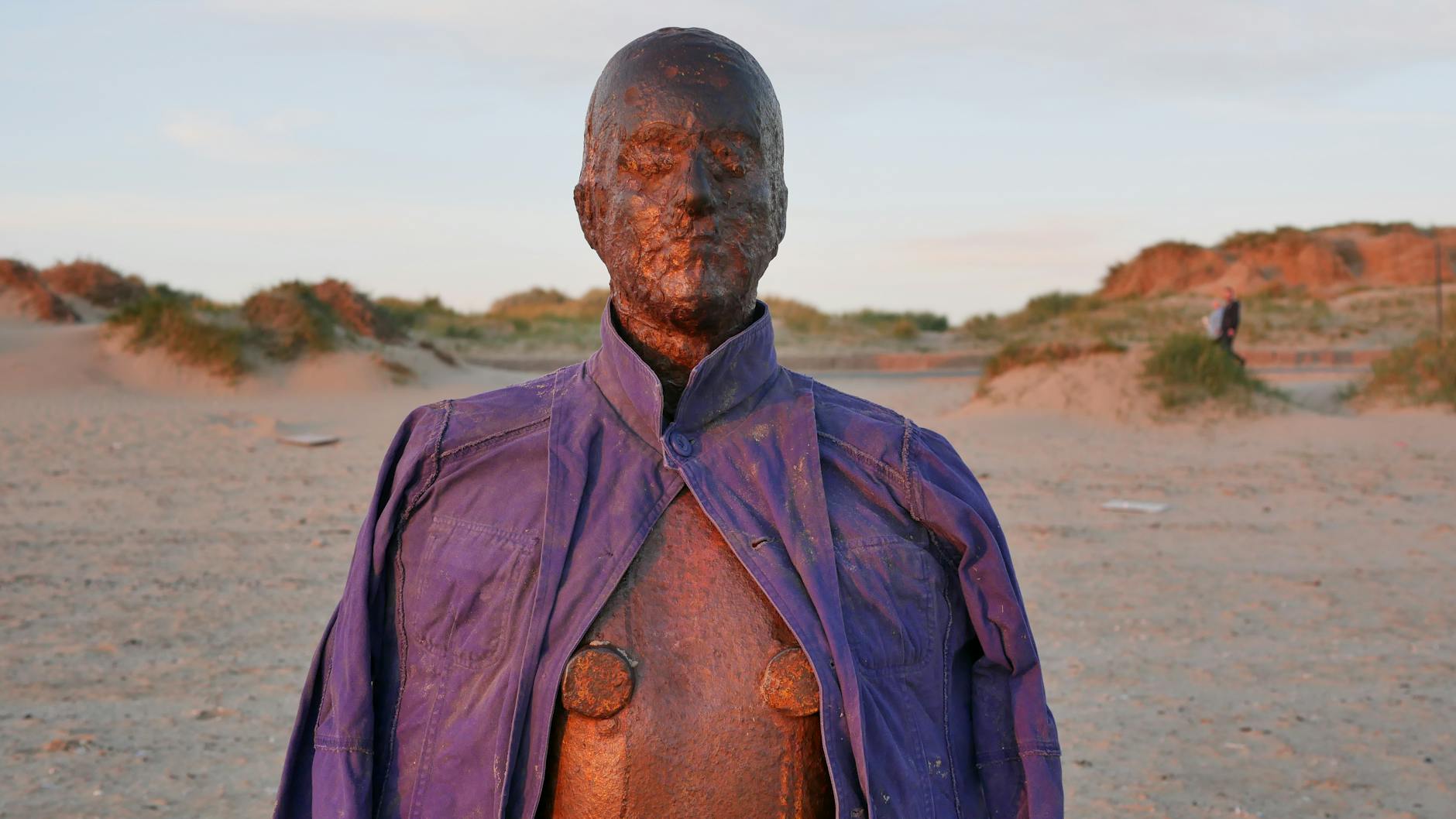
Each figure is 189 cm tall (6 feet 2 inches), weighs around 650 kg, and is cast from one of 17 different moulds taken directly from Gormley’s own body. The 100 figures are positioned along the tide line, spaced approximately 250 metres apart, with the installation extending almost 3 km along the coast and up to 1 km out to sea at the lowest tides. All face out to the open Irish Sea.
The artist’s stated intention was for the installation to harness “the ebb and flow of the tide to explore man’s relationship with nature.” The result is a sculpture that genuinely changes with the weather and the tides: at low tide, you can walk among the figures (and out beyond them, towards the most-seaward ones); at high tide, only the inland figures remain visible above the water, while the others are submerged. The same site looks completely different on consecutive days.
The figures themselves have weathered substantially since 2005 — the cast iron has rusted, marine growth (barnacles, mussels) covers the seaward figures, and lichen and seaweed accumulate on the bodies. The weathering is part of the work; Gormley explicitly accepted the figures would change physically over decades. They are still upright, still recognisable, and still looking out to sea.
How to Get to Crosby Beach from Liverpool
By Train (Recommended)
The easiest option. The Merseyrail Northern Line runs direct from Liverpool city-centre stations (Lime Street, Moorfields, James Street, Liverpool Central) to Blundellsands & Crosby station. Journey time around 20 minutes; trains run every 10-15 minutes.
From Blundellsands & Crosby station, it’s about a 0.5-mile, 12-minute walk to the beach. Follow the signs — the beach is well-signposted from the station.
Alternatively, stay on the train one more stop to Hall Road for the northern end of the beach (close to Burbo Bank, the recommended access point and the best concentration of figures). Hall Road is around 25 minutes from Liverpool city centre.
A Saveaway day ticket (£6) covers the return trip plus any extra Merseyrail or bus use. A regular Day Return is around £4-5.
By Car
About 25 minutes’ drive from Liverpool city centre. Recommended postcode: L23 6SX for Burbo Bank, the northernmost and most accessible part of the beach. Free or low-cost parking at the Mariners Road and Burbo Bank car parks. The Burbo Bank car park is the best choice for visitors with mobility considerations — flat, paved, accessible — and is also the best single concentration of figures.
By Bus
Various Arriva and Stagecoach buses serve Crosby from Liverpool, journey times around 35-45 minutes. The train is faster and more reliable.
The Best Place to See the Statues
The 100 figures are spread across nearly 3 km of beach, but they’re not evenly distributed. The highest concentration — and the easiest viewing — is at the northern end of the installation, around Burbo Bank (also known as Hightown end).
From the Burbo Bank car park, you can walk out onto the beach and immediately encounter a dense cluster of figures, with the wider line stretching south down the foreshore towards Crosby and beyond. The Burbo Bank area is the best single viewpoint for first-time visitors — best concentration of figures, best parking, accessible facilities (toilets, ice cream van, coffee van), and the best wheelchair and pushchair access.
The southern end (closer to Crosby town centre and the Marina) has fewer figures and less obvious infrastructure, but is reachable from the Blundellsands & Crosby train station with a slightly longer walk.
For the fullest experience, walk the beach from Burbo Bank south for at least 30 minutes — you’ll pass dozens of figures, see the line extending in both directions, and get the full sense of the scale of the work.
Tide Times: The Critical Factor
Crosby Beach’s tide range is substantial, and the figures look very different at different tides. Plan around tide times for the best experience:
At low tide: Most figures visible. You can walk among the seaward figures (some are up to 1 km from the high-water mark). The most photographically rewarding tide.
At mid-tide (incoming or outgoing): The most dramatic photographs — figures partially submerged, water lapping at their chests, dramatic light catching the rusted iron. The classic Gormley photograph.
At high tide: Only the figures closest to the dunes remain visible above water. Some figures completely submerged.
Critical safety warning: The tide at Crosby comes in extremely fast and can outpace walking speed. If you walk out to the seaward figures at low tide, monitor the tide carefully and start back well before the water reaches the inner figures. People have been cut off by the incoming tide here. Check tide times before you go — the Crosby Tide Times are the standard reference.
For the best photograph, aim to be on the beach approximately 1-2 hours either side of low tide — figures are visible, the light is good, and you have time to walk among them safely.
Photography at Crosby Beach
Some practical tips:
The classic shot is a single figure with water lapping around the ankles or up to mid-thigh — the silhouette against the sea, the figure standing while the tide moves around it. Best captured 1-2 hours either side of low tide, with the sun behind you.
Golden hour photography — sunrise or sunset — produces the most atmospheric images, with the iron figures backlit against the western sky. Crosby faces west across the Irish Sea, so sunset is particularly dramatic.
The long-shot composition — multiple figures in a line stretching towards the horizon, with the diminishing perspective. Walk along the shore until you find a stretch with multiple figures in alignment.
Liverpool skyline backdrop — from the southern end of the beach, you can frame figures against the distant Liverpool waterfront and the Wirral wind farms. A wider lens helps.
Weather: Overcast days produce beautiful, moody images. Stormy days are dramatic but hard to photograph; bright sunny days flatten the light. Slightly overcast or partly cloudy is ideal.
Equipment: Standard phone cameras work for most of the standard shots. A small tripod helps for the long-shot compositions. A wide-angle lens (or your phone’s wide setting) is more useful than a telephoto.
Crosby Beach Beyond the Sculptures
The beach itself is a substantial coastal landscape independent of the Gormley work. The southern end (near Crosby Marina) has a recently regenerated promenade, the Crosby Lakeside Adventure Centre (watersports), and the Crosby Marine Lake (sailing, paddleboarding). The northern end blends into the Sefton Coast nature reserves and the dune systems running up to Formby.
The Liverpool skyline view from Crosby Beach is one of the best in Merseyside — you can see the Three Graces, the Liver Birds, the Anglican Cathedral, and the Wirral docks across the Mersey estuary. On clear days, North Wales hills are visible to the south-west.
The Wirral wind farms — including the Burbo Bank wind farm directly offshore — are a distinctive feature of the seaward horizon. The wind turbines turning slowly behind the Gormley figures make for a peculiarly modern visual composition.
The “Blitz Beach” Connection
A few miles further north of Crosby, at Hightown, the foreshore contains a distinctive feature known locally as “Blitz Beach” — the dumped rubble from the Liverpool Blitz of 1941, transported up the coast and dumped on the foreshore to combat coastal erosion. Eighty-five years on, the rubble has been worn smooth by tides; Victorian carved stonework, brick, lamp-post fragments, and tile flooring still emerge from the sand. Worth a separate visit if you’re interested in the wider Liverpool wartime history — covered in the Liverpool in WWII guide.
A Suggested Half-Day at Crosby Beach
10:00 — Check tide times for the day. Aim to arrive at Burbo Bank about 1-2 hours before low tide.
10:30 — Train Liverpool to Blundellsands & Crosby (or Hall Road for the northern end). 20-25 minutes.
11:00 — Walk to the beach via the residential streets. About 12 minutes.
11:15 — On the beach. Walk the figures. Take photographs. Walk south or north to extend your distance. 90 minutes.
12:45 — Coffee or ice cream at the Burbo Bank facilities (or back at Crosby Marina).
13:15 — Walk back to the station via Crosby town centre, or extend the day with a Marina visit.
14:00 — Train back to Liverpool.
This is a comfortable half-day. For a full day, combine with a Formby Beach stop on the way back (one stop further north on the train) — see the Formby Beach guide.
Practical Tips for Visiting Crosby Beach
Wear sturdy shoes. The beach is sandy but with sections of softer sand and patches of stone/shingle near the high-water mark. Trainers work; sandals struggle with sand.
Dress for the wind. Crosby is exposed and almost always windy. Bring a windproof jacket even on summer days.
Watch the tide. Mentioned twice, worth repeating: the tide comes in fast and can cut you off. Monitor the water level constantly, particularly when walking out to the seaward figures.
The beach is dog-friendly. Dogs are welcome year-round, with no seasonal restrictions on the main beach areas.
Public toilets and cafés at Burbo Bank and the Crosby Marina end. None in the middle of the long beach stretch.
Photography respect: Don’t climb on the figures. Don’t damage them. Don’t graffiti them. The figures have been treated with extraordinary care by visitors for two decades — please continue the tradition.
Don’t swim in the Mersey estuary. The currents are dangerous; the channel is busy with shipping; water quality is variable. Crosby is a walking beach, not a swimming beach.
Crosby Beach Antony Gormley FAQs
How do I get to Crosby Beach from Liverpool? Merseyrail Northern Line direct from Liverpool city-centre stations to Blundellsands & Crosby (20 minutes) or Hall Road (25 minutes). By car: M57/M58, postcode L23 6SX for Burbo Bank.
How many sculptures are there at Crosby Beach? 100 cast-iron figures, each modelled on Antony Gormley’s own body, spread across nearly 3 km of beach and up to 1 km out to sea.
When were the Gormley figures installed at Crosby? 2005, as part of the Liverpool Biennial contemporary art festival. Made permanent by planning permission in March 2007.
Is it free to visit Crosby Beach? Yes — completely free, open 365 days a year. Parking is also free or low-cost.
Where is the best place to see the figures? Burbo Bank (northern end), accessible from Hall Road train station or the Burbo Bank car park. Best concentration of figures, best parking, best facilities.
When is the best time to visit Crosby Beach? 1-2 hours either side of low tide gives you the best mix of visible figures and walkable beach. Sunrise or sunset for the best light. Spring and autumn for fewer crowds.
Is Crosby Beach safe? Generally yes — well-managed Sefton Council beach, with lifeguards in summer, regular police patrols, and good public facilities. The principal hazard is the fast incoming tide; check tide times and don’t walk too far out at low tide without monitoring the water.
Are the figures damaged or vandalised? Remarkably little. The figures have weathered (rust, marine growth, lichen) which is part of the artistic intention. Vandalism has been minor and well-managed. The figures remain in good condition after 20 years.
Can I touch the figures? Yes — they’re public sculpture installed on a public beach. The standard polite approach: photograph and observe, don’t climb, don’t damage. Children love to compare their height to the figures, which is fine.
Can I see the figures at high tide? Some — the figures closest to the dunes remain visible above the water. The seaward figures are submerged. High tide can be photographically interesting in its own right but reduces the number of visible figures.
Can I combine Crosby Beach with Formby? Yes — Formby is two stops further north on the same Merseyrail Northern Line (Freshfield station). A combined Crosby + Formby day is a substantial Merseyside coastal exploration. See the Formby Beach guide.
Why Crosby Beach Is Essential Visiting from Liverpool
Antony Gormley’s Another Place is one of the most distinctive pieces of large-scale public sculpture installed anywhere in Britain in the 21st century, and the Crosby Beach location gives it a coastal landscape that the work itself responds to and amplifies. The experience of walking among the figures — particularly at a falling tide, with the sea retreating, the figures emerging from the water, and the long line stretching out towards the horizon — is genuinely memorable. You won’t see anything else quite like it in any English city.
From Liverpool, the trip is straightforward: 20 minutes on the train, a 12-minute walk, free to enter, completely outdoor. Combine with Formby for a full day on the Sefton Coast, or pair with a Liverpool city day for a contrast — the Three Graces and the Liver Birds in the morning, the Iron Men of Crosby in the afternoon. For all the broader day-trip planning, see the parent day trips from Liverpool guide, the Formby Beach guide, and the Southport guide — the three Sefton Coast destinations work together as a full Merseyside coastal exploration.
Crosby beach is worth more than a quick photograph of the figures. Our guide to Waterloo and Crosby covers the Marine Lake, South Road’s cafés and bars, the Plaza Community Cinema and a flat half-day walk from Waterloo station to Blundellsands & Crosby that takes in all of it.